admissions - April 15, 2009 @ 9:36 am
· Filed under 1L Experiences, Academia / Research / Writing, Administrative Law, Administrator, Admissions General, Admissions Process, Alternative Careers, Alumnus/a, Antitrust, Child Advocacy / Education, Civil Rights / Civil Liberties, Clerkships / Appellate Advocacy, Clinical Programs, Commercial / Business / Corporate Law, Constitutional Law, Criminal Law, Cyberlaw, Employment / Labor Law, Environmental Law / Land Use, Faculty, Family Law, Fellowships, Financial Aid, Financial Institutions / Securities Law, Government Lawyering, Health Law / Biotech / Bioethics, Human Rights / Law & Development, Immigration / Asylum Law, Intellectual Property, International Law / Trade / Finance, Joint Degrees, Jurisprudence / Law & Philosophy / Legal Theory, Law & Economics, Law & Gender, Law & Race, Legal History, Legal Profession / Ethics, Life at HLS, Local Government / Cities / Urban Planning, Negotiation / Mediation / ADR, People, Property / Real Estate, Prosecution, Public Interest / Service, Public Policy / Politics, Sports / Entertainment / Media, Student, Summer Experiences, Tax Law, Technology, Trial Advocacy / Litigation
1L and Co-Chair of the Public Interest Auction Sarah Jelsema recently sat down for a Q & A with us after this yearly highlight of the HLS calendar.
What is the public interest auction?
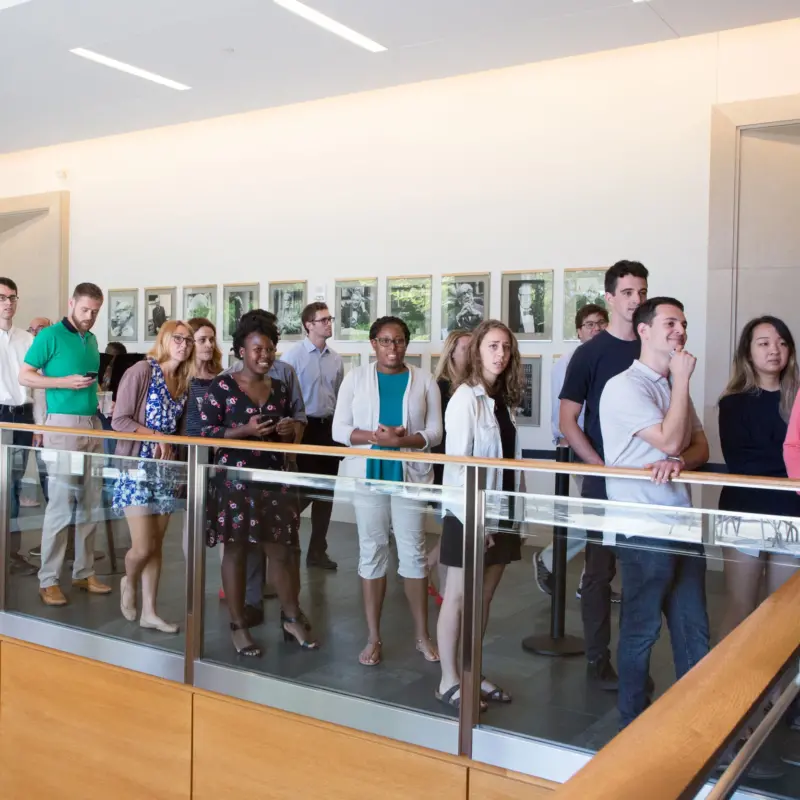
The public interest auction is a fundraiser run entirely by the 1L class that raises money to support students who do public interest work over the summer. We solicit donations from faculty, staff, alumni, parents, students, firms, and local businesses. Some donate money and some donate things to auction off. We receive all sorts of donations – things like Red Sox tickets, gift certificates to restaurants and salons, lunches and fishing trips with professors, cookies and brownies made by the librarians, and a tour of the Northwest Corner Construction project. The auction is one of the biggest social events of the year. Every year the auction has a theme, and we decorate Austin Hall accordingly. This year the theme was “Bright Lights: Bid City” and so the different rooms were decorated as different big cities – London, Paris, and New York.
What has gone into preparing for this event and what have you gotten out of the experience as a co-chair?
Almost all of the 1L class helps out with the auction. We divide the students up by committees and committees mostly help out either by asking for donations, calling alumni and asking them to donate, emailing firms, going door to door in Cambridge, or by helping process the donations and get them ready to sell, or by helping out on the night of the auction. As one of the auction co-chairs, I had the opportunity to work with a group of amazing people to try to plan and coordinate this huge event – it was definitely a challenging experience for all of us. From coordinating hundreds of student volunteers to keeping track of hundreds of donations, to making sure everything comes together on the night of the auction, being a co-chair was a lot of work, but it was extremely rewarding. It was also a good opportunity to meet new students.
The event is always a lot of fun for students, faculty and staff. What was your favorite part of the evening? Did anything surprise you?
The event was a huge success. My favorite part of the evening was the live auction. Our auctioneers – this year Professors Elizabeth Warren and Jonathan Zittrain – were auctioning off the “right to be – or not be – in the 2010 parody.” The first bidder was the Dean of Students because they gave her a hard time this year in the parody, but then Professor Mann, who bought this item last year, got in a bidding war with Professor Warren and everyone was laughing so hard!
Why should admitted and prospective students seeking a strong public interest community choose Harvard? Why did you?
I think that students looking for a strong public interest community should choose Harvard because they can go anywhere and do anything with a degree from Harvard Law. We are a bigger law school, but as a result, we have so many more options to pick from than other law schools. Good public interest law jobs are really competitive – and since I want one, I’m glad I chose Harvard. I know that the connections and friends that I will make here, with professors and fellow students, will be of benefit for the rest of my life.
admissions - April 10, 2009 @ 9:14 am
· Filed under 1L Experiences, Academia / Research / Writing, Administrative Law, Administrator, Admissions General, Admissions Process, Alternative Careers, Alumnus/a, Antitrust, Child Advocacy / Education, Civil Rights / Civil Liberties, Clerkships / Appellate Advocacy, Clinical Programs, Commercial / Business / Corporate Law, Constitutional Law, Criminal Law, Cyberlaw, Employment / Labor Law, Environmental Law / Land Use, Faculty, Family Law, Fellowships, Financial Aid, Financial Institutions / Securities Law, Government Lawyering, Health Law / Biotech / Bioethics, Human Rights / Law & Development, Immigration / Asylum Law, Intellectual Property, International Law / Trade / Finance, Joint Degrees, Jurisprudence / Law & Philosophy / Legal Theory, Law & Economics, Law & Gender, Law & Race, Legal History, Legal Profession / Ethics, Life at HLS, Local Government / Cities / Urban Planning, Negotiation / Mediation / ADR, People, Property / Real Estate, Prosecution, Public Interest / Service, Public Policy / Politics, Sports / Entertainment / Media, Student, Summer Experiences, Tax Law, Technology, Trial Advocacy / Litigation
Starting April 15, HLS will begin accepting transfer applications for the fall. Over the last couple of years, there have been increased opportunities for Harvard Law students to study off-campus through joint degree and foreign study programs which make it possible for us to admit more transfer students than ever before.
The question of whether to apply as a transfer student is the right move is up to you, but we think that a little research will show you the vast benefits of transferring to HLS. With 102 full-time professors and more than 300 courses, HLS is home to the most intellectually stimulating legal community in the world. Outside the classroom, there are 14 journals, over100 student organizations, clinical placements in approximately 30 areas of the law, and more than enough opportunities for you to experience the incredible diversity of the HLS community during your second- and third- year. For example, the Harvard Law Review encourages transfer applicants to apply for membership and several past transfer students have been successful in that endeavor.
Bottom line? Whether you are interested in constitutional law or environmental law or human rights advocacy or any number of other areas, the breadth and depth of our offerings is incredible. Whether you want to clerk at the circuit court level, follow the path to academia, or pursue a career in public service, the opportunities presented to our graduates are unsurpassed.
For more details on the transfer application process including eligibility guidelines, deadlines, and application requirements, please visit: http://www.law.harvard.edu/prospective/j…
Also, stay tuned in the coming days and weeks for blog entries of a few students talking about their experience transferring into Harvard Law School!
admissions - March 13, 2009 @ 8:53 am
· Filed under Admissions General, Child Advocacy / Education, Clinical Programs, Commercial / Business / Corporate Law, Environmental Law / Land Use, Human Rights / Law & Development, Immigration / Asylum Law, International Law / Trade / Finance, Law & Economics, Law & Gender, Life at HLS, Local Government / Cities / Urban Planning, People, Public Interest / Service, Public Policy / Politics, Student, Summer Experiences, Trial Advocacy / Litigation
Interested in working in India doing either public interest or private practice work? If so, a recent panel hosted by the South Asian Law Students Association (SALSA) would have been right up your alley.
2L Nitya Shekar, whose interests include public interest litigation and activism, got her internship last summer with the Alternative Law Forum (ALF) in Bangalore through the Human Rights Program here at HLS. “It was really a great experience in a great city,” she said. “Bangalore is on the rise with public interest movements.” While she was there, Shekar was involved with the city’s first GLBT pride parade and anti-road widening litigation.
3L Lauren Birchfield and SJD student Iain Frame were also involved in public interest with the Human Rights Law Network (HRLN) in New Delhi were. “The Human Rights Law Network provides pro bono legal services, conducts public interest litigation, participates in advocacy, and collaborates with social movements and human rights organizations. Maintaining both litigation and publishing departments, HRLN works on issues such as right to food, women’s justice, dalit rights, disability rights, and rights for persons living with HIV/AIDS,” explained Birchfield who worked specifically with the Right to Food Campaign. “I greatly appreciated how much HRLN invested in us and in our project, and how much freedom was given to us regarding the project’s construction and implementation. I found HRLN a fantastic organization to work for, and I was pleased to walk away from the internship having recognized that this – this kind of work, this kind of project – is what I want to pursue as a career.”
On the private-sector side was 2L Erin Walczewski, who spent Winter Term with Nishith Desai Associates in Mumbai. “I was interested in alternative dispute resolution and arbitration and got to do lots of research on the differences among arbitration tribunals,” she said. “I met with clients, and the attorneys walked me through how litigation worked in India. The attorneys were especially interested in how business practices differed between the U.S. and India.”
When asked how to approach the application process for public interest firms, the panel advocated being direct and having a project in mind. Respect for interns at HLRN? “It of course depends on the supervisor you get,” said Frame. “Because HRLN was so large it helps to have an idea about what you want to do when you get there… your experience will be more dynamic if you take charge.”
Concerned about needing experience in Indian or international law? “I dealt almost entirely with Indian law which was totally new to me,” said Shekar. “But since ALF is so small, the work they do is very focused and my relationship with them was more intimate… there was no hierarchy and everyone was happy to answer questions for me.” “I found my international law class from 1L year to be very helpful,” said Walczewski, “particularly in terms of understanding how international agreements work.”
admissions - March 2, 2009 @ 10:02 am
· Filed under Admissions General, Alumnus/a, Child Advocacy / Education, Civil Rights / Civil Liberties, Clerkships / Appellate Advocacy, Clinical Programs, Constitutional Law, Criminal Law, Employment / Labor Law, Family Law, Fellowships, Government Lawyering, Human Rights / Law & Development, Law & Economics, Law & Gender, Law & Race, Legal History, Legal Profession / Ethics, Life at HLS, People, Podcasts, Public Interest / Service, Public Policy / Politics, Trial Advocacy / Litigation
While at HLS, alumnus Lam Ho was a public interest dynamo. As president of the Harvard Legal Aid Bureau, a supervising member of Reaching Out About Depression (R.O.A.D.), and Founder & Coordinator of the Giving Tree, which raises holiday gifts for children of the HLS clinical and student practice organization clients, Lam never shied away from going above and beyond the call of duty… including 60-90 hours a week dedicated to his clinicals.
Lam is currently on a Skadden Fellowship starting a community legal clinic for low income youths and their families in Chicago. Admissions staffer Julia Foresman recently caught up with Lam in the wake of a victory he scored with the Legal Assistance Foundation of Metropolitan Chicago. Lam had been trying to get Chicago Public Schools to follow through with the Individualized Educational Plan that CPS and his client Mary Greenlee had put in place for her 6 year old grandson, Rayvaughn. “It’s been extremely rewarding to educate and empower my clients,” he said. “… this is what gets me up in the morning.”
Podcast: Lam Ho (13:09)
admissions - October 27, 2008 @ 11:25 am
· Filed under 1L Experiences, Academia / Research / Writing, Administrative Law, Administrator, Alternative Careers, Alumnus/a, Antitrust, Child Advocacy / Education, Civil Rights / Civil Liberties, Clerkships / Appellate Advocacy, Clinical Programs, Commercial / Business / Corporate Law, Constitutional Law, Criminal Law, Cyberlaw, Employment / Labor Law, Environmental Law / Land Use, Faculty, Family Law, Financial Institutions / Securities Law, Government Lawyering, Health Law / Biotech / Bioethics, Human Rights / Law & Development, Immigration / Asylum Law, Intellectual Property, International Law / Trade / Finance, Joint Degrees, Jurisprudence / Law & Philosophy / Legal Theory, Law & Economics, Law & Gender, Law & Race, Legal History, Legal Profession / Ethics, Life at HLS, Local Government / Cities / Urban Planning, Negotiation / Mediation / ADR, People, Property / Real Estate, Prosecution, Public Interest / Service, Public Policy / Politics, Sports / Entertainment / Media, Student, Summer Experiences, Tax Law, Technology, Trial Advocacy / Litigation
We did a bunch more interviews of students and faculty members to add to the HLS Speaks page off the JD Admissions home page. New categories of interview clips include: (1) Clinical & Pro Bono Programs; (2) Criminal Law & Justice; (3) Law, Business & Economics; (4) Negotiation & Conflict Resolution; (5) Constitutional Law & Policy; (6) Why Law School; (7) Law, Science & Technology; (8) Reading Groups & Small Seminars; (9) National Security & Terrorism; (10) Social & Gender Justice, Civil Rights; (11) Career Plans; and (12) Joint Degrees.
Please visit the link to HLS Speaks off the JD Admissions home page if you’re interested in these subjects.
admissions - May 22, 2008 @ 11:07 am
· Filed under Child Advocacy / Education, Faculty, Family Law, Government Lawyering, Human Rights / Law & Development, Legal Profession / Ethics, People, Public Interest / Service, Public Policy / Politics
Anyone considering HLS for whom the allure of law school is sweetened by the promise of never having to endure Science again might be advised to consider the number of fields in which scientific research is altering the way law is administered. Take child advocacy work, for instance. A recent panel of experts including Charles Nelson, the Richard David Scott Chair in Pediatric Developmental Research at Harvard Medical School, and Cindy Lederman, a judge of the Miami/Dade County Juvenile Court joined HLS Professors Charles Ogletree, Martha Minow, and CAP Director Elizabeth Bartholet in exploring the short and long-term effects of toxic stress related to child abuse and neglect, parental substance abuse, maternal depression, and exposure to violence.
To frame the issue, Dr. Nelson provided the clinical background for examining maltreatment and neglect. “Early experiences have a particularly strong influence,” said Nelson, “Timing of abuse, the nature of it, and one’s genetic predisposition can be long-lasting due to fundamental changes in mental circuitry.” To illustrate his point, Nelson explained the findings of the Bucharest Early Intervention Project, a randomized trial of foster care as intervention for social deprivation associated with the institutionalization of nearly 200 children in Romania. “Due to negative experiences as infants, many of the children had stunted growth, anxiety disorders, and reductions in brain activity.” Nelson stressed that we must improve our understanding of the neurobiology of early adversity to improve the court’s understanding of neural plasticity… we must translate science to policy.”
Judge Lederman agreed with Nelson and admitted that the cases she sees involve, by and large, parents unengaged with and apathetic to their babies. “Mothers that come before me are there as a last resort; they don’t understand why their children have been taken away from them,” she explained. “We’re forced to make clinical and mental health decisions all the time. Dealing with the deterioration is not something they teach you in law school.” Judge Lederman insisted that to properly attend to the needs of children jurists must become students of the science of early childhood development.
Presented with the clinical side of child maltreatment, Professors Bartholet and Minow weighed in. “I see two very important policy implications arising from these social science findings,” said Bartholet. “It involves enabling as many parents as possible to be able to nurture and support their kids… and it further involves intervening early and coercively to place abused children under foster care.”
“We know that when the phrase ‘in the best interest of the child’ is uttered with a lawyer in the room that it’s already too late for these kids,” explained Minow. “We’re looking now for the least worst thing that can happen…time matters when you’re talking about kids, and new brain research can help us facilitate their well being.”
admissions - April 22, 2008 @ 9:57 am
· Filed under Administrator, Child Advocacy / Education, Clinical Programs, Life at HLS, People, Public Interest / Service
An admitted student recently asked me how supportive Harvard is of student initiatives that maybe don’t match up with existing opportunities here. I asked Lisa Dealy, who heads up our office of Clinical and Pro Bono Programs, to respond. She forwarded me her response so I would know what’s happening around here too and said I could post it here if I liked:
“We actually spend a lot of our time with students helping them design and implement clinical and pro bono projects (and sometimes even non clinical/pro bono things) and I like to think we are very supportive of student initiatives. Here are some examples:
“Students wanted to start a Spanish for Public Interest Lawyers course & came to us…we were able to do it quickly (by the next semester) and fairly cheaply by hiring LLM students who are native Spanish speakers; we run it out of the clinical office even though it is a non credit (and non clinical) course. It’s been very successful and now we offer two different levels of the course.
“A few years ago, students approached us about sponsoring trips during fly-out week. We now have established programs during fly out week and spring break and winter intersession—this year about 40 students did pro bono work over spring break and we arranged the placements through various HLS alumni and Lee Branson went as far as arranging housing and group activities for the students. We invited clinical instructors to go and provide extra on-site supervision. So, not only did we respond to the initial student idea, but we’ve continued to refine the idea and make it better each year.
“We also recently assisted a student who was trying to set up a program for local kids coming out of foster care—she was not seeking credit for this, but she wanted replicate a model she had learned about during her independent clinical work last winter. We gave her contacts with people both within HLS and outside of HLS and gave her advice on how to proceed and what she could do within HLS to ensure this program kept going after she had graduated. I met with her several times and last week she was in to report that a Cambridge non-profit had picked up the program and she has 1L students interested in keeping the program going.
“We work really hard to make sure students aren’t duplicating efforts (either within HLS or trying to start an organization that already exists in the community)…but even when we find students trying to reinvent the wheel we don’t turn them away, we talk to them to see if they can do something that hasn’t been done yet!”
admissions - April 17, 2008 @ 9:43 am
· Filed under Administrator, Child Advocacy / Education, Civil Rights / Civil Liberties, Criminal Law, Environmental Law / Land Use, Fellowships, Government Lawyering, Human Rights / Law & Development, Life at HLS, People, Prosecution, Public Interest / Service, Public Policy / Politics
Alexa Shabecoff heads up the Bernard Koteen Office of Public Interest Advising. I thought a little Q&A with her would help highlight our philosophy and practices in the area of public interest and public service advising and programming. I’ll do one Q and one A each day for the next 3…
Q: What is the advantage to students at Harvard Law School of having an entire office devoted to public interest advising (as opposed to having just one person or being part of a general career services office, as is the case at other schools)?
A: One advantage of an entire office with a number of advisers is that in peak seasons we still have plenty of staff to go around. Since we (and all law schools) aren’t allowed to provide 1Ls with individual career counseling until November 1st, the floodgates open then and I would imagine that even at a small school one person would be swamped. We also are able to offer a wide range of backgrounds, personalities and expertise.
For example, we have a staffer with a ton of experience in criminal work. We have a staffer who does nothing but federal government advising and runs our Heyman Fellowships program. We have someone who only does Fellowships advising–her expertise is a main driver of our success at winning competitive outside fellowships (which is why we haven’t had to resort to having many of our own fellowships).
Our large staff means that we can build up expertise on a wide range of issues; for example, one person is developing a lot of expertise in human rights placements (on top of the expertise that the many attorneys in our Human Rights Program already have). Finally, it means we have people with different personality types that fit the wide array of personalities at HLS–extroverts, introverts, people who will hold your hand a lot and people who will help but let you do your own thing if you don’t need too much guidance–so that students can find the right adviser for them.
We are very fortunate in having a full office with its own budget as that allows us to focus on public service, continue to refine our expertise and create programs—not just advising but also community-building programs—that we think can best serve the students and alumni at Harvard Law School while working closely with other offices at the law school.
admissions - April 8, 2008 @ 10:33 am
· Filed under Child Advocacy / Education, Environmental Law / Land Use, Family Law, Health Law / Biotech / Bioethics, Human Rights / Law & Development, International Law / Trade / Finance, Law & Gender, Law & Race, Legal History, People, Public Interest / Service, Student
During her Winter Term, 2L Lauren Birchfield traveled to Delhi, India to work with the Human Rights Law Network on the Right to Food Campaign. Upon her return, she shared her story and photos with us.

“I spent January 2008 interning at the Human Rights Law Network (HRLN) in Delhi, India, working on the Right to Food. The Human Rights Law Network provides pro bono legal services, conducts public interest litigation, participates in advocacy, and collaborates with social movements and human rights organizations. Maintaining both litigation and publishing departments, HRLN works on issues such as Right to Food, Women’s Justice, Dalit Rights, Disability Rights, and rights for persons living with HIV/AIDS.
“Along with my colleague Jessica Corsi, I investigated and documented the history of the Right to Food Campaign, its accompanying case, PUCL v. India & Others, and the post-litigation implementation of India’s constitutional right to food. Our time in India was spent largely traveling around Delhi and other parts of the country conducting interviews with activists involved with the Right to Food Campaign. The fact-finding, research, and interviews conducted are currently being incorporated into a final document, which will be completed by June 2008. In our forthcoming paper, we intend to address not only the campaign and litigation, but also larger questions about the right to food, as well. These larger issues include food sovereignty, the effects of neoliberal economic policy and trade liberalization on the rural poor, and the relationship between food security, agricultural production, and employment rights.
“While in India, we had several opportunities to travel. These photographs document the time we spent in Uttar Pradesh and Rajasthan, as well as some of our excursions around Delhi. Our first week in Delhi, we observed and assisted on a fact-finding mission in the villages of rural Uttar Pradesh. The objective of this mission was to collect data on the status of food security in U.P.’s Banda district, and to assess how Supreme Court mandated food and employment orders were being implemented. These images depict some of the villages and the stone quarry we visited while in Uttar Pradesh.
Directly upon our return from Uttar Pradesh, we departed for Rajasthan, where we spent several days interviewing some of the key social activists involved with the Right to Food Campaign. Our first days in Rajasthan were spent in Beawar at a National Right to Information Youth Convention, where we had the opportunity to participate in a candlelight vigil commemorating the first Youth Convention that had taken place in Beawar several years earlier.
“Once we arrived back in Delhi, we spent our last ten days in India tracking down and interviewing human rights activists, economists, Supreme Court Commissioners, professors, and lawyers who had either worked directly on or were invested in food security in India. During our last few days, we also managed to squeeze in a few sight-seeing excursions. We toured the Taj Mahal, as well as some sights around Delhi, such as the Jama Masjid Mosque (Delhi’s principal mosque, which can hold up to 25,000 worshippers).
“Overall, words cannot really express how much I enjoyed both working at HRLN and my winter term experience. At HRLN I met incredibly passionate and qualified people, and was accepted into an office that recognized each of its staff members as important components in its vision for change. There was never a dull moment at HRLN – we were constantly on our feet, putting in calls to human rights activists, scheduling meetings, and traveling all over the country to interview those activists whenever and wherever they could meet with us. I greatly appreciated how much HRLN invested in us and in our project, and how much freedom is gave us regarding the project’s construction and implementation. I found HRLN a fantastic organization to work for, and I was pleased to walk away from the internship having recognized that this – this kind of work, this kind of project – is what I want to pursue as a career.”
admissions - March 18, 2008 @ 11:17 am
· Filed under Child Advocacy / Education, Clerkships / Appellate Advocacy, Clinical Programs, Environmental Law / Land Use, Financial Aid, Government Lawyering, Human Rights / Law & Development, Immigration / Asylum Law, Prosecution, Public Interest / Service, Public Policy / Politics
Starting with the incoming Class of 2011 (starting this fall), HLS students can get their 3rd year of law school tuition paid by us in return for a 5-year commitment to public service. The official announcement is here on the home page.
Here are the details on the Student Financial Services website.
It is also being covered in the New York Times and Wall Street Journal Law Blog.
We’re very excited to be the first law school in the country to do this!