David Weinberger is liveblogging the event.
Kevin Parker is liveblogging the event.
Wendy Seltzer is liveblogging the event.
Drew Clark is liveblogging the event.
Join the live IRC Chat in the room.
Post a question for discussion here.
Listen to the live webcast here.
FCCBoston08 Del.icio.us Tag Stream
(These notes are by no means complete and comprehensive – and represent a summary, not a transcript, of the event)
1:20: Kevin Parker on the Q + A portion of the panel
1:15: Drew Clark posts on the hearing
12:50: Professor Yoo: There’s no question that network providers must add capacity. In this world, the network owners have to make decision on how they’re going to configure their bandwidth. We’re now in world where we have many different transmission technologies and are susceptible to traffic problems. One suggestion: We need to build more bandwidth, but it’s expensive and difficult to predict about.
12:45: Tim Wu: I hope the commission takes the time to clarify one thing: To arrive at a very simple kind of rule. Whatever we think reasonable network management is, it should not include blocking lawful applications. I’ve been interested in this issue since my time in Silicon Valley, and I use to be on the other side of this debate. One of the things that always bothered me about selling the products I did, was selling these products to oppressive regimes. In these technologies, and in searching deep packet inspections, you have the tech of censorship being built into the system. We should think very carefully about allowing America – the home of the free and open internet – becoming a place that has a reputation for a filtered and closed internet.
Let me discuss how this intersects with policy. America has spent a lot of time advertising itself as the home of a free press and a free internet. We advertise ourselves as the model of free speech and open networks. Keeping the internet as the American internet. What happens here will be followed everywhere.
12:30: From Kevin Parker:
“Panelist 3 – Judge Bosley. In western Mass broadband is important for economic development. Small businesses need bandwidth. Who gets to say what we need? (Nobody should.) This sounds like slotting fees at supermarket, pay for the end of the aisle. But this has become anticompetitive.
Issue isn’t content, it is capacity. ISPs have a point here, but we need to have an open net to find the most creative and innovative solutions. What we need is a national broadband plan. As is, ISPs have no incentives to increase average speeds, etc.
Panelist 4 – David Cohen, EVP Comcast. Wants to be a participant and not the main course for the meal. Comcast wants to give customers a superior internet experience. 92% of the country has broadband availble through cable. What is the key to success? Market forces and a lack of gov’t regulation.
There is nothing wrong with network management. This must happen. We have to fight congestion, spam, and viruses. Bandwidth consumption is a real concern. Goal is to have a minimal impact on a small number of users. We don’t block any websites or applications (but HMS does!).”
12:20: David Weinberger on Yochai Benkler’s testimony
12:11: Panels Begin: Marvin Ammori: This is about the future of the internet. Comcast is deliberately targeting and interfering with p2p technologies, including Bittorrent and others. These technologies help to distribute open source software, high resolution photos, and video. Video services, like Bittorrent and Miro, threaten Comcast. By targeting p2p, Comcast is threatening innovation.
12:04: Gilles: We only provide distribution to licensed content and have agreements with the content providers on our network.
11:53: Technology demonstration of Vuze. Gilles BianRosa. The reason I am here is to foster transparency and openness. Vuze is one of the fastest growing video distribution platforms – we offer a high resolution experience, comparable to watching a DVD. There have been 20 million downloads of our application. We have more than 150 content partners, including PBS, BBC, Showtime, History Channel. The absence of enforceable ground rules threatens the openness of the internet. And we only have promises of good faith to protect us. Make the rules relevant and transparent, so innovators like Vuze can deliver – the future of the internet depends on it.
11:45: McDowell: Today we focus on the positive and constructive economic destruction caused by the vibrancy of new media. The new media economy is working through growing pains. In fact, Comscore reported that American viewed an eye-popping 10 billion online videos in December alone.
11:35: Adelstein: Our colleagues at the FTC, held their own hearing on net neutrality over 8 months ago. I’m glad we’re doing this now. We need to establish an effective internet bill of rights that will secure rights for generations to come. We must preserve the open and neutral character of the internet that’s been it’s hallmark from the very beginning. Right now we’re seeing a broadband market where telephone/isps control 93% of the broadband market… Consumers don’t want the internet to become another version of old media. We face a major challenge in this country making sure we deploy affordable broadband connection everywhere. I think that preserving the vibrant quality of the internet, and having high speed access, are issues that go hand in hand. Access translates into opportunity.
11:32: If we don’t get this right, we will have squandered a technology and an opportunity.
11:30: Now we have allegations that an operator is degrading/blocking p2p file programs. I am not saying that all of these services are unlawful. But the affect our choices in the future – what we say, where we can go, what info we can encounter, and how we can access it. How all of this turns out is a very big deal for each and every one of us. I keep saying: The time has come that the specific enforceable principle of non-discrimination at the FCC… should be added to the FCC’s internet policy statement.
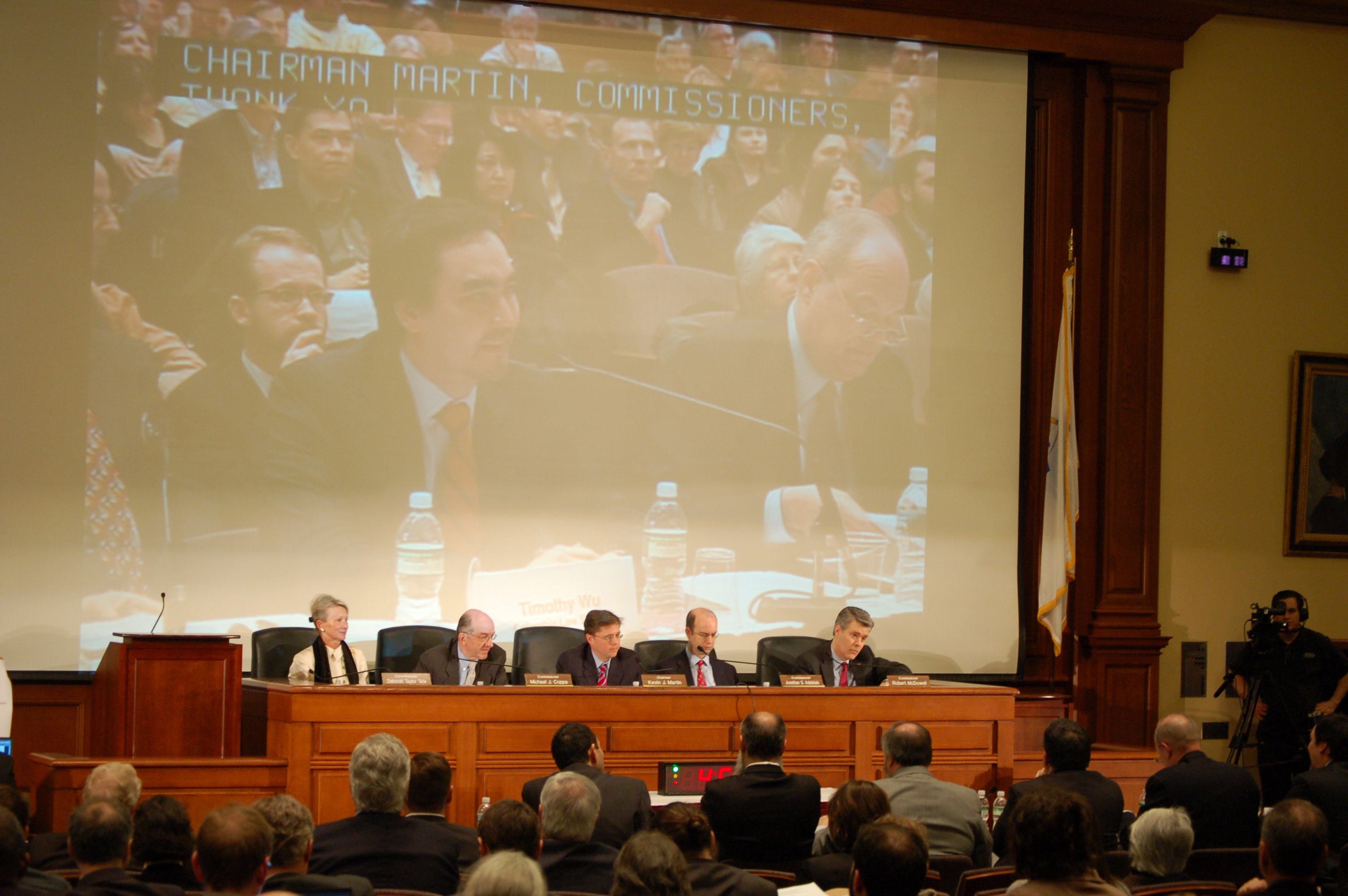
11:25: Copps: I have long advocated that the commission get away from the beltway to hear from the people about these issues – and the future of the internet is one such issue. I see no reason for us to wait on a new law to get this going… Before we begin hearing from our panelists, consider for a moment where we are in chartering the future of the internet. Right now, network operators are making choices that will determine how Americans will communicate now and in the future. Some of their choices may be right, some of their choices may be wrong. These are hard and complex questions. But these critical questions are indeed being made, and they were being made in a virtual black box that the American public had little opportunity to peek into. If anyone is uncertain that these choices are indeed being made right now, let’s take a quicklook at what we learned in 2007. That was the year that one of the nation’s wireless providers rejected a pro-choice text message as too controversial.
11:18: Martin: Review of the FCC’s internet policy statement
11:16: Marky: Finally, the commission should examine these issues not only to discern corporate practice, but also to ascertain whether these actions are temporary – “managerial creations of the moment” that the carriers may find useful and make permanent for non-networking reasons. The beauty of the internet is its wonderful, chaotic, evolving nature, and it’s ability to reinvent itself every year.
11:13: Marky: I am pleased that the commission has returned to MA in exploring contemporary issues in the development of the internet. We should keep in mind (1) The internet is as much mine and yours as it is Verizons, AT&T’s, and Comast’s, (2) The nature of the net is really not about services provided by carriers themselves – they don’t provide internet services, they provide broadband access to the internet. This distinction is vital in my view.
11:07: We’re fortunate and delighted to say that Chairman Ed Markey could attend, and we want to welcome him to open with remarks.