~ Archive for General ~

Thoughts on Joel Tenenbaum’s Deposition

0

Listen to Joel Tenenbaum’s deposition:

Read Shubham Mukherjee on the deposition:

The story of the deposition really began the previous day at the status hearing. The hearing was a success for us: the judge set an early trial date of December 1 against the wishes of Plaintiffs’ counsel. This may have left them in a bad mood. After the hearing, Plaintiff’s supervising attorney – a middle-aged woman with a generally unpleasant disposition and poor manners – informed Prof. Nesson that he could only bring 2 students along with him to the deposition because they could not find a conference room large enough to accommodate more. She said it was absolutely impossible to get a larger room. I mentioned that the students won’t mind squeezing a bit, but she said “no, we can’t crowd the court reporter.” Notably, Plaintiffs’ deposition team would include 3, and at times 4, attorneys; apparently they were unwilling to afford Joel the same-sized team. In any event, Prof. Nesson and Plaintiff’s supervising attorney engaged in back and forth about this, until Prof. Nesson stated quite matter-of-factly “We are bringing 3,” at which point Plaintiffs’ supervising attorney simply walked off without comment. This was the stage that she set.

As a side note, Joel asked on the day of the hearing whether he needed to dress in a particular way for the deposition. Prof. Nesson said that ordinary clothes would be fine. Joel decided then and there that he would wear a Boston Red Sox t-shirt. It was meant to be his own small dig at Plaintiffs’ counsel: they were from Denver, and Joel was thinking about the Red Sox defeat over the Rockies’ in a recent World Series.

Our team met briefly the morning of the deposition. As promised, Joel was in his red sox t-shirt. Prof. Nesson’s chief advise to Joel was to be a “warrior:” You have your story, and you calmly and coolly state that story; you stay calm and focused at all times; you do not let them antagonize you or rush you or take you off your rhythm; you answer their questions with as few words as possible and by telling your story; nothing more; nothing less.

We arrived at local-counsel’s law offices and were shown to the conference room. I was expecting something small and cramped. The conference room was large enough to comfortably fit over a dozen people. The plaintiff’s lawyers at the deposition were: the case’s supervising attorney (the unpleasant woman whose name I don’t recall); Laurie Rust (the junior attorney on the case); and plaintiff’s in-house counsel (he introduced himself but I can’t remember his name). Laurie seemed like a pleasant and polite woman and so did the in-house counsel.

The supervising attorney took the deposition. Joel was apparently trying to really get into his “warrior” persona – he put on sun-glasses, maybe to keep them from seeing the whites of his eyes? She immediately began by asking Joel a litany of questions about how Prof. Nesson became involved in the case. For each question, Prof. Nesson asserted attny-client privilege. This happened for about a dozen questions; each time, plaintiffs asked Joel a question, he said “I’ve been instructed not to answer,” plaintiff asked Prof. Nesson if he was instructing Joel not to answer, and Prof. Nesson said “yes.” It was all quite repetitive, until Plaintiffs began asking about whether Joel reviewed documents with Prof. Nesson. Unsuprisingly, Prof. Nesson asserted privilege. In-house counsel asked to go off the record.

The in-house counsel stated the questions they were asking were completely ordinary and routine, they are not subject to privilege, and he has never been in a deposition where privilege was asserted. He explained that the contents of the documents may be privileged, but not a description of the nature of the documents; parties are required to produce “privilege logs” all the time. He then implied (with no subtlety at all) that Prof. Nesson was out of touch with current legal practice because he was a professor and doesn’t take many depositions these days. Prof. Nesson responded by commenting on the bullying nature of the litigation: the record companies are inappropriately using bullying tactics against the public in general, and have been unnecessarily harsh in their dealings with Joel in particular. The in-house counsel replied by saying that he has quite different views on the matter: many people get laid-off every year because of lost sales due to file-sharing and that is who he was fighting for. With regards to Joel’s case, he stated that Plaintiffs have been extremely generous with him and have afforded him many courtesies because he was pro se. He noted that Joel was the one being unduly harsh when he filed two separate motions for sanctions. As evidence of Joel’s supposed disrespect, he pointed out: “Here is a kid who shows up in our office wearing a Red Sox T-shirt and sun glasses!” The decision was made to save that conversation for another day and continue the deposition.

Eventually, the line of questioning went towards inquiries about other people who used or may have used Joel’s Kazaa account on the family computer. One by one, Joel listed off family and friends who used the computer over the years and explained why he thinks they may have used Kazaa (e.g., “they are music fans;” “they burn CDs;” “they download things”). The questioning for each such person took about 15 minutes or more. After 4 of these iterations, I had to leave to get to my clinical. I’m very curious about what else happened and how the deposition ended.

Welcome to CyberOne: Law in the Court of Public Opinion

2

Welcome to the course website for Law in the Court of Public Opinion. This course is being offered jointly in the Harvard Law School and the Harvard Extension School in the fall semester, 2006.

If we do say so ourselves, the course will be unlike any that has ever been taught. It is a course in persuasive, empathic argument in the Internet space. Throughout the course we will be studying many different media technologies to understand how their inherent characteristics and modes of distribution affect the arguments that are made using them. Students will be immersed in this study through project-based assignments in which they will be using these technologies to make their own arguments. For a good introduction to the class, watch this video of a discussion with Charlie and Rebecca hosted by the Berkman Center.

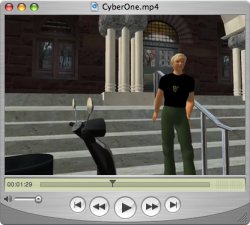
CyberOne Screenshot

Our brief trailer video gives an A/V description of the CyberOne experience.

Note: The video requires Quicktime 7 (free). Alternatively, watch the lower quality Flash version.

~

Three Ways to Participate in CyberOne:

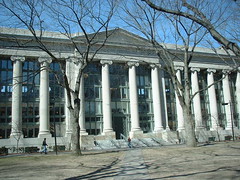
Langdell Hall

As a Harvard Law Student

Only Harvard Law students can register for the law school version of this course. Students at other schools of Harvard may enroll by cross-registering according to the rules of their home school.

Photo by: Bad Glacier

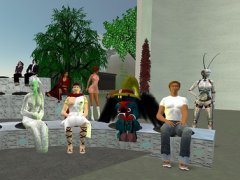
Second Life

As a Harvard Extension Student

Enrollment to the Harvard Extension School is open to the public. Extension students will experience portions of the class through a virtual world, known as Second Life. Videos, discussions, lectures, and office hours will all take place on Berkman Island. Students from anywhere in the world will be able to interact with one another, in real time.

Photo by: Pathfinder Linden

Internet

As an Internet User “At Large”

All of our videos and lecture materials will be freely available to anyone with an Internet connection. We’ll also be broadcasting select video on Cambridge Community Television, for residents of Cambridge, Massachusetts.

Photo by: Colin Gregory Palmer

Welcome to Law in the Court of Public Opinion!

8

Welcome to the course website for Law in the Court of Public Opinion. This course is being offered jointly in the Harvard Law School and the Harvard Extension School in the fall semester, 2006.

If we do say so ourselves, the course will be unlike any that has ever been taught. It is a course in persuasive, empathic argument in the Internet space. Throughout the course we will be studying many different media technologies to understand how their inherent characteristics and modes of distribution affect the arguments that are made using them. Students will be immersed in this study through project-based assignments in which they will be using these technologies to make their own arguments. For a good introduction to the class, watch this video of a discussion with Charlie and Rebecca hosted by the Berkman Center.

CyberOne Screenshot

Our brief trailer video gives an A/V description of the CyberOne experience.

Note: The video requires Quicktime 7 (free). Alternatively, watch the lower quality Flash version.

~

Three Ways to Participate in CyberOne:

Langdell Hall

As a Harvard Law Student

Only Harvard Law students can register for the law school version of this course. Students at other schools of Harvard may enroll by cross-registering according to the rules of their home school.

Photo by: Bad Glacier

Second Life

As a Harvard Extension Student

Enrollment to the Harvard Extension School is open to the public. Extension students will experience portions of the class through a virtual world, known as Second Life. Videos, discussions, lectures, and office hours will all take place on Berkman Island. Students from anywhere in the world will be able to interact with one another, in real time.

Photo by: Pathfinder Linden

Internet

As an Internet User “At Large”

All of our videos and lecture materials will be freely available to anyone with an Internet connection. We’ll also be broadcasting select video on Cambridge Community Television, for residents of Cambridge, Massachusetts.

Photo by: Colin Gregory Palmer

Log in
Protected by AkismetBlog with WordPress