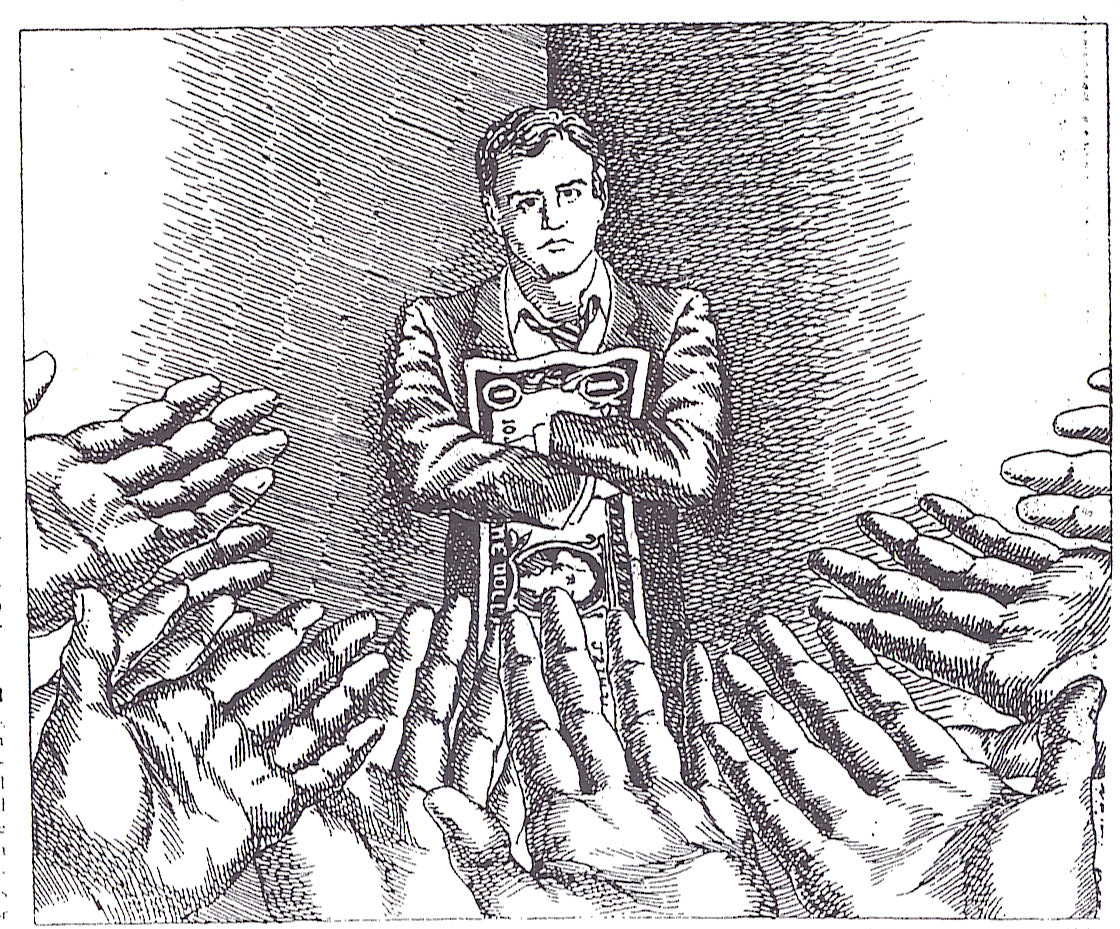
Pope Benedict XVI has apparently disappointed America’s “conservative” Catholics by not coming out swinging on their favorite issues. (Washington Post, “Pope’s 1st Year Lacks An Ideological Edge,” by Alan Cooperman; npr, “New Pope Surprises American Catholics,” by Greg Allen; April 19, 2006). Well, I’ve finally read Benedict’s first encyclical, “Deus Caritas Est“(“God Is Love”), dated Dec. 25, 2005, and I’m pretty sure America’s Catholic conservatives are disappointing their Pope.
 Pope Benedict XVI cover of America (March 13, 2006)
Ever since learning late last year that the Papal Letter, Deus Caritas Est [“DCE”], discusses “caritas” or “charity,” and the relationship between justice and charity, I’ve been waiting for conservative Catholic webloggers to analyze DCE — hoping to see how Catholic teachings affect their stance on important public policy issues. I’m especially interested, because prominent law professors — including Steve Bainbridge, MoJ‘s Rick Garnett, and Deans Thomas Menger (St. Thomas Law School) and Mark Sargent (Villanove Law) — have insisted that we need a revival of serious that is “unapologetically and actively committed to discerning and expressing distinctively Catholic approaches to law and lawyering.” (our prior post)
Call it an apostate’s natural suspicion, but the lack of discussion by conservative Catholics (and Catholic conservatives) — of DCE made me suspect that the Encyclical might have called for a bit too much caritas in the public sphere, or too high a level of commitment to charitable politcal activism by laypeople, for their liking.
What pushed me into actually finding and reading the DCE text, in fact, was Prof. Bainbridge’s discussion last week about the minimum wage, in response to was an article by Kevin Drum at Washington Monthly, dated April 11, 2006.) (our prior post) Steve’s thoughts were endorsed by Volokh Conspiracy‘s Jim Lindgren. At Prof. B‘s, VC, and WM, there were dozen of Comments, and the basic tone was so uncharitable and unloving — so miserly and spiteful — regarding the poor in America, that I decided it was time to see if Benedict XVI could help me figure out the issues. What the Pope had to say made my suspicions about a Catholic conservative cover-up appear quite justified.
Is Deus Caritas Est relevant to debates on issues such as minimum wage laws? I believe it absolutely is — for the Catholic faithful and for those who see in the core teachings of Jesus a universal ethics of human connection, interdependence, and responsibility. In summarizing Catholic teaching on caritas and justice, on the roles of both the Church hierarchy and the faithful, the Encyclical calls for an active,
engaged commitment among the laity to improve the plight of the poor — not merely through Church institutions and personal acts of charity, but also by using political processes in the public forum. (Such a “distinctively Catholic approach to law and lawyering” is one that Your Editor would welcome at American law schools.)
Here’s what I discovered in Benedict XVI’s first encyclical letter, Deus Caritas Est:
The Letter first addresses at length the subject of God as love. Benedict eventually turns to the topic of “Jesus Christ – the incarnate love of God,” and explains that Jesus has “truly united” love of God and love of neighbor. Benedict explains [para. 16], for example, that through the parable of the Good Samaritan:
“The concept of “neighbour” is now universalized, yet it remains concrete. Despite being extended to all mankind, it is not reduced to a generic, abstract and undemanding expression of love, but calls for my own practical commitment here and now. The Church has the duty to interpret ever anew this relationship between near and far with regard to the actual daily life of her members.”
Benedict closes the section with this reminder:
“Lastly, we should especially mention the great parable of the Last Judgement (cf. Mt 25:31-46), in which love becomes the criterion for the definitive decision about a human life’s worth or lack thereof. Jesus identifies himself with those in need, with the hungry, the thirsty, the stranger, the naked, the sick and those in prison. “As you did it to one of the least of these my brethren, you did it to me” (Mt 25:40). Love of God and love of neighbour have become one: in the least of the brethren we find Jesus himself, and in Jesus we find God.”
jesus/moneychangers
Before you protest that this pious love-your-neighbor stuff belongs in the context of each Catholic’s personal life, please read on.
Part II of the Letter, titled “Caritas” begins by describing the centrality of charity to the essence of the Church. It then attempts to clarify the relationship between charity and justice. After dismissing the Marxist rejection of charity, Benedict nevertheless states [para. 26] (emphases added):
“It is true that the pursuit of justice must be a fundamental norm of the State and that the aim of a just social order is to guarantee to each person, according to the principle of subsidiarity, his share of the community’s goods. This has always been emphasized by Christian teaching on the State and by the Church’s social doctrine.
“Historically, the issue of the just ordering of the collectivity had taken a new dimension with the industrialization of society in the nineteenth century. The rise of modern industry caused the old social structures to collapse, while the growth of a class of salaried workers provoked radical changes in the fabric of society. The relationship between capital and labour now became the decisive issue—an issue which in that form was previously unknown. Capital and the means of production were now the new source of power which, concentrated in the hands of a few, led to the suppression of the rights of the working classes, against which they had to rebel.”
After “admitt[ing] that the Church’s leadership was slow to realize that the issue of the just structuring of society needed to be approached in a new way,” the Letter notes that the illusion of a Marxist panacea for injustice has vanished. However [para 27]:
“In today’s complex situation, not least because of the growth of a globalized economy, the Church’s social doctrine has become a set of fundamental guidelines offering approaches that are valid even beyond the confines of the Church: in the face of ongoing development these guidelines need to be addressed in the context of dialogue with all those seriously concerned for humanity and for the world in which we live.”
An editorial in Catholic Weekly, “A More Excellent Way” (Feb. 13, 2006), explains the Church’s role “with respect to justice”:
“The letter also makes a familiar and necessary distinction between the charitable work of the church and that of partisan, ideological movements. It affirms that justice is primarily the work of the state.
“With respect to justice, the church’s role is that of teacher and critic. It hands on its social doctrine, guides consciences and helps identify the goals of authentic justice in society. ‘The church is duty-bound to offer, through the purification of reason and through ethical formation, her own specific contributions towards understanding the requirements of justice and achieving them politically,” Pope Benedict writes.
While not replacing the state, ‘she cannot and must not remain on the sidelines in the fight for justice.’

A similar explanation can be found in Greg Sisk’s posting at Mirror of Justice. The curious mind has to be wondering, “Well, if the Church’s insitutional role in achieving justice — defined by Benedict as “guarantee[ing] to each person, according to the principle of subsidiarity, his share of the community’s goods” — is indirect, who and how will the just society be achieved?
Benedict tells us the Church wants “dialogue with all those seriously concerned for humanity and for the world in which we live.” Naturally, he also expects that it is individual Catholics who will be the most receptive, who will have the most highly-enlightened consciences, and will in the forefront in securing justice and social caritas.
 How do I know? Not because any conservative weblogger has told me! I know because Benedict tells us explicitly in Deus Caritas Est:
“The direct duty to work for a just ordering of society, on the other hand, is proper to the lay faithful. As citizens of the State, they are called to take part in public life in a personal capacity. So they cannot relinquish their participation “in the many different economic, social, legislative, administrative and cultural areas, which are intended to promote organically and institutionally the common good.” [21] The mission of the lay faithful is therefore to configure social life correctly, respecting its legitimate autonomy and cooperating with other citizens according to their respective competences and fulfilling their own responsibility. [22] Even if the specific expressions of ecclesial charity can never be confused with the activity of the State, it still remains true that charity must animate the entire lives of the lay faithful and therefore also their political activity, lived as “social charity”.[23] (emphases added)
I dare you to find either the sentence “The direct duty to work for a just ordering of society, on the other hand, is proper to the lay faithful,” or the clause “charity must animate the entire lives of the lay faithful and therefore also their political activity, lived as ‘social charity,'” in any of the political, economic, or religious commentary and punditry of the leading conservative Catholic webloggers. Indeed, you won’t find them on any obscure weblogs either (except for the Edmund Rice Justice Bulletin, which looks a little lefty to me).
You can learn more about the Catholic notion of “social charity,” and “social justice” here. For example, the Catholic Catechism tells us that “The principle of solidarity, also articulated in terms of “friendship” or “social charity,” is a direct demand of human and Christian brotherhood.” Also, “Solidarity is manifested in the first place by the distribution of goods and remuneration for work.” And, “The equal dignity of human persons requires the effort to reduce excessive social and economic inequalities,” because economic “differences encourage and often oblige persons to practice generosity, kindness, and sharing of goods.”
Pope Benedict anticipated such reactions. In DCE, Benedict therefore reminds the Faithful:
The just ordering of society and the State is a central responsibility of politics. As Augustine once said, a State which is not governed according to justice would be just a bunch of thieves. [para 28a]
Perhaps most tellingly, Benedict tells ideologues of the Left and the Right: “One does not make the world more human by refusing to act humanely here and now. We contribute to a better world only by personally doing good now, with full commitment and wherever we have the opportunity, independently of partisan strategies and programmes.” [para. 31b]
That’s strong stuff. It seems directly relevant to political issues ranging from the level of the minimum wage, and the creation of universal health care rights, to the treatment of illegal (but otherwise law-abiding) immigrants.
When it comes to issues of social justice — and social caritas — it seems clear that Jesus was indeed a Liberal. Living past 30 didn’t change that, and I’m sure the past two millennia haven’t either. The Sermon on the Mount, with its Eight Beatitudes, deserves the full respect of stare decisis. Jesus didn’t have a means test when he distributed the loaves and fishes. When the multitudes were hungry, He fed them — he didn’t tell them to figure out for themselves how to fish, or how to swim.
Conservative Catholics like First Things’ Richard John Neuhaus may be disappointed to see Benedict XVI playing the role of pastor now, rather than “enforcer.” But, even old cynics like myself believe that The Job often dictates the role that an incumbent must play. No job calls for the love of pastor and shepherd — and conscience for the faithful — like the papacy. I just hope the faithful are listening to Deus Caritas Est and will choose to live up to its call for political action in the name of social justice and charity.
afterthought (April 20): When it comes to feeding (or clothing, sheltering, healing, educating) the poor, the working poor, or even His more-comfortable “neighbors,” Christ was no Cafeteria Catholic. Can we say the same for America’s Catholic conservatives? Are they disappointing Jesus and His current Vicar, Benedict XVI? Are they leaving the social-justice heavy lifting to the non-religious (like myself), who they so often claim can have no solid moral foundation, and to the Liberal Catholics, who they so often deride as not really being Catholic at all?
 larger Albany Times Union/Barbara Cummings – see our most-recent discussion of tax whiners:
ghosts of tax days past (Scrooge was surely a tax-whiner)
they curse the first snow
like it’s a beggar…
rest stop
in vain
the baby bird begs…
a stepchild

Great Japan!
even a beggar’s house
has a summer banne
even birds
make their nests…
beggars under the bridge
autumn wind–
a beggar looking
sizes me up
they must have kids–
bridge beggars
calling fireflies
deutzia tree–
among gods and beggars
it blooms
a pretty kite soars
a beggar’s shack
below
Issa, translated by David G. Lanoue