Yesterday I posted a transcript of Jenova Chen’s interview on Joystiq in which he discussed how his attempt to create a cooperative game failed and his subsequent conclusions about designing for moral behavior. This sparked some good discussion that I’ll try to recap here.
Here’s one exchange that transpired on Facebook:
Kristen Maxwell: At SXSW 2 years ago i asked Warren Spector about Ultima V’s ethical/political underpinnings and why we don’t see that kind of allegorical use of the medium… he copped out and said that games shouldn’t teach an agenda. Neil Stephenson did a similar dodge at GDC Austin this year when i asked him about the lack of subversive lessons in games (his book Diamond Age is about the transformative power of a subversively-themed game/learning device a poor girl accidentally receives). He said that it wasn’t in games’ interest to promote such an ideology.
Matthew Weise: There is no such thing as a game that has no ideological underpinnings. Politics are everywhere, especially in places where we pretend there are not.
Maxwell: Their dismissal said to me “we’d rather everyone remain ignorant of what thee games are teaching than take responsibility for it”
By contrast, Bart Simon of Concordia’s TAG writes, “Is that really the response to the situated morality of action that we want to take as game designers… to ‘make players see and feel what’s right’? Do we really want to come off being so paternalistic? Not just in interviews but in the actual design?”
While Simon proceeds to argue for a “label on the box” (“this game is designed to make players see and feel what’s right …according to the designer”), Maxwell and Weise point out that authorial values are embedded into games whether we like it or not (and whether we know it or not). Game developers create worlds in which, by design of the rules, what is ‘right’ and ‘wrong’ is at least suggested or incentivized if not enforced. This doesn’t take volition or free choice out of the hands of the player – at a minimum, players can always (rage) quit – but it certainly argues against the idea that developers can claim moral neutrality when they create their games. Unconsciousness, perhaps, or ignorance – but not neutrality.
But what of the project of moral education itself? Simon jumps to a critique of how Chen realized the moral vision of Journey:
The fact remains that while Journey is a fairly ‘on the rails’ experience in which one sometimes gets the feeling of being railroaded (I did ‘ooh’ and ‘ah’ and shed a tear all at the right moments I assure you) the opposite condition of some mythical realm of free choice and even handed moral deliberation most certainly does not exist.
Elsewhere, Sam Gilbert agreed that “it’s not really a moral game if you don’t have a choice in the matter. The multiplayer interaction is really sweet and pleasant, and you feel good about yourself and about others when you’re able to help each other, but it’s pleasant because it’s extremely limited. There are no moral dilemmas or sacrifices involved–you’re just sort of forced to be nice to each other.”
And thus emerges the ongoing tension between character education (instilling desirable habits) and moral education (deepening moral reasoning). Having not played Journey, for want of a PS3, I can’t personally evaluate whether it succeeds as a character education tool. If you walk away “feel[ing] good about yourself and about others,” then perhaps it does. But the lack of moral choice in the game would detract from its value in moral learning, except perhaps as a foil for discussion (as in this blog post!).
To flip this conversation around… character education seems to be the more intuitive way to think about video game (im)morality, at least among laypeople. Many of the critiques of violence in games concern themselves with how players repeatedly perform bad acts, rather than whether they’re making immoral or unethical decisions within a biased system. I wrote about this with Prof. Scott Seider several years ago.

 is finally published! My co-author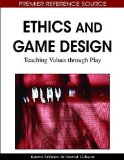
 for PS3). The caller wondered if games should offer better rewards for “good” or “evil” choices, which generated a great discussion among the podcasters. Julian “Rabbit” Murdoch noted/complained that in games, “evil” is often the quick and easy path, while “good” often coincides with patience (and larger long-term rewards). His observation makes me wonder whether such gameplay implicates not so much morality (right vs wrong) than virtue – specifically, the virtue of patience. This particular approach to virtue is particularly interesting given that video games have a reputation as tools of twitchy, instant gratification.
 scenario — when the soldier doesn’t even realize he is fighting a real battle — possible?
 are, in fact, interface innovations. But if interfaces can dehumanize, can they also re-humanize? Video games are not known for their emotional range, but I agree with those who believe that’s a matter of historical accident, not destiny. If video games can