Feed on
Posts
Comments

Sketches for Boz

Best known as a novelist, William Makepeace Thackeray (1811-1863) also attempted a career as an artist. In 1836, Thackeray created a series of sketches in an attempt to illustrate the serialized version of Charles Dickens’ The Posthumous Papers of the Pickwick Club.

Dickens was still rather unknown to the literary world (Pickwick Papers would propel him to fame), and had already published the first two parts of Pickwick when illustrator Robert Seymour committed suicide. A new illustrator, Robert Buss, was hired, but his illustrations displeased Dickens and his publishers, who subsequently fired him. Several artists approached Dickens in his lodgings at Furnival’s Inn, vying for the new position.

Edgar Johnson, in Charles Dickens: his tragedy and triumph, recounts what is believed to have been the first meeting between Dickens and Thackeray, who were both 24 years old:

“Dickens saw several other applicants in Furnival’s Inn. Among them came a young Anglo-Indian giant with a broken nose, one William Makepeace Thackeray, who showed him two or three sketchy line drawings completely different in style from Seymour’s elaborate etchings…Dickens found his drawings quite unsuitable.”

finalthackeray1.jpg

To Thackeray’s dismay, Dickens ultimately chose Hablot K. Browne to illustrate the next part of the work (Browne used the pseudonyms “Nemo” and “Phiz,” and went on to illustrate a number of Dickens’s works). The exchange between the two men, which Thackeray later termed “Mr. Pickwick’s lucky escape,” signaled a major turning point in his life. Thackeray later admitted that, had it not been for Dickens, “I should have tried to be not a writer, but a painter, or designer of pictures.”

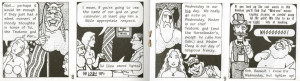
The set includes the three drawings on two sheets of paper that Thackeray showed to Dickens. The sketches depict characters from Dickens’ 1836 work, Sketches by Boz. Boz is in the center, surrounded by characters from the book, which Thackeray has marked in the third drawing as “Mrs. Tibbs,” “Mrs. Bloss,” “Bung” and “Lillerbell.”
thackeray-2.jpg

thackeray-3.jpg

All three sketches are pencil on drawing paper.

Houghton’s collections include a number of additional drawings by Thackeray, which can be found by searching HOLLIS, or browsing OASIS.

*2007M-53. Purchased with the Louis J. Appell Jr. Fund for British Civilization in HCL and The Class of 1952 Fund.  Images may not be reproduced without permission.

“The Wind begun to rock the Grass,” by Emily Dickinson (1830-1886) is one of the most textually interesting in her corpus. She revised it over a period of nearly twenty years, and five versions survive: four in autograph, and one transcript of a lost autograph original. That “lost” original has now been recovered, and has found a home at Houghton.

This new four-page manuscript, most likely written ca. 1873, was probably sent to her friend and future editor Thomas Wentworth Higginson, whose wife, Mary Thacher Higginson, transcribed it (the transcription is now at the Boston Public Library in the Higginson Papers). Ralph Franklin believed that the original had been sent to Higginson along with a note and three other poems (see Fr 796); but the new autograph is on different paper (watermarked “A. Pirie and Sons 1871″) than the three still in the Higginson Papers (BPL MS Am 1093 (48), (40), and (50)). Higginson also refers to this poem in a letter to his co-editor Mabel Loomis Todd (1891 May 13); this, in combination with the transcript, makes it seem probable that the present manuscript was at one time in his possession.

But how did it leave his possession? The details of the manuscript’s provenance are not yet fully established, but it seems likely that Higginson gave it to Gretchen Osgood (Mrs. Fiske) Warren (1868-1961), whom he would have known through the Museum of Fine Arts. The present manuscript, reputedly from Mrs. Fiske Warren’s estate, appeared for sale at Skinner’s in Boston on 10 November 2001.

Houghton Library holds a variant of this poem, sent by Dickinson to her sister-in-law Susan (Houghton MS Am 1118.3 (356)), which begins “The Wind begun to knead the Grass.” Now possible to view the two side by side, the manuscripts bring home to students and experienced textual scholars alike the physicality of Dickinson’s continual reworking of her poems, and her distribution of them to her friends.

The poem was written on one piece of paper folded in half. The first image below shows pages 4 and 1, and the second image shows pages 2 and 3. (Click on the images twice to see more detail.)

ed-thunderstorm-1.jpged-thunderstorm-2.jpg

This version of the poem reads:

The Wind begun to rock the Grass
With threatening Tunes and low –

He flung a Menace at the Earth –
A Menace at the Sky –

The Leaves unhooked themselves from Trees
And started all abroad –
The Dust did scoop itself like Hands
And throw away the Road -

The Wagons quickened on the streets -
The Thunder hurried slow –
The Lightning showed a yellow Beak -
And then a livid Claw –

The Birds put up the Bars to Nests –
The Cattle fled to Barns –
There came one drop of Giant Rain
And then as if the Hands

That held the Dams - had parted hold
The Waters Wrecked the Sky -
But overlooked My Father’s House –
Just quartering a Tree –

*2007M-74. © The President and Fellows of Harvard College. Purchased with the Dickinson Collection Fund. Images may not be reproduced without permission.

Casa Editorial Cenit was a leading independent radical publishing house that operated in Madrid from 1928-1936, a turbulent period in Spanish history. It was founded in an effort to educate the impoverished, disenfranchised masses, and bring democratic values to a new republic.

Cenit published works in thematic groups, such as Crítica Social, La Novela de la Guerra, La Novela Proletaria, Teatro Político, and Panorama Literario Español e Hispano-Americano. Cenit published translations of works by authors such as Sherwood Anderson, Hermann Hesse, Karl Marx, and Leon Trotsky, as well as original works by Spanish authors. Close attention was paid to the typography, format, and cover design of the books as well, to create a complete, artistic reading experience.

We recently acquired a collection of 68 Cenit publications, four of which are pictured below. All four covers were designed by Julio Puyol. Clockwise from left:

*2007C-47. C.F. Ramuz, Cumbres Espanto. 1930.
*2007C-26. Hermann Hesse, Demian. 1930.
*2007C-12. Ferreira de Castro, Emigrantes. 1930.
*2007C-13. Lion Fenchtwanger, La Duquesa Fea. 1931.

cenit-covers.jpg

Cenit’s logo, printed in colors corresponding to the cover design on the back of each book, can be seen here:

cenit-stamp.jpg

*2007C-1 — *2007C-68. Purchased with the Bennett Hubbard Nash Fund, the Harmand Teplow Class of 1920 Fund, and the Andrew Preston Peabody Fund. Images may not be reproduced without permission.

We recently acquired a comprehensive collection of material by and relating to American novelist and almost-Harvard-graduate James Gould Cozzens (1903-1978). The collection includes a selection of Cozzens’s correspondence, manuscript drafts, photographs, and diaries, including the diary he kept while a Harvard student, and while he was working on his first novel, Confusion. With this collection came all of Cozzens’s published works, in multiple editions. The collection was formed by Cozzens’s bibliographers, Matthew J. and Arlyn Bruccoli, who have additionally given Houghton Cozzens’s library.

Cozzens, who attended Harvard from 1922-1924, was awarded the Pulitzer Prize in 1949 for Guard of Honor, inspired by his experiences during World War II. Cozzens wrote thirteen additional novels and numerous short stories.

The collection includes numerous editions of all of Cozzens’s works, including Guard of Honor and By Love Possessed. Pictured below are four different editions of Guard of Honor. Starting in the upper right corner, and going clockwise, these include: the 1998 Modern Library edition; an advance copy of the 1948 first American edition; a 1952 Permabooks paperback (priced at 35 cents!); and the 1949 first British edition of the novel. (Click on the image twice to enlarge it.)

guard-of-honor.jpg

Cozzens Papers, *2007M-69. Individual books will be in HOLLIS shortly. Purchased with funds from the Amy Lowell Trust. Image may not be reproduced without permission.

Popular French novelist Alphonse Daudet (1840-1897) first published his realist novel Sapho: moeurs parisiennes in 1884. Two years later, Henry Vizetelly published this first English translation of the work in London. (Vizetelly would later gain notoriety for his nearly-unexpurgated English translations of Emile Zola’s novels.)

In the novel, a young artist falls in love with his seductive model, and ultimately is destroyed by her. Partly based on his own experiences, Daudet wrote it as a cautionary tale for his sons. He was already suffering from the effects of a syphilitic paralysis that would eventually kill him.

sappho-cover-1.jpg

This edition, a beautiful example of late 19th-century English publishing, contains thirty wood engravings from designs by Louis Montegut.

sappho-title-1.jpg

sappho-268-image.jpg

*FC8.D2646.Eg886s. Purchased with the Roger Stoddard Book Fund. Images may not be reproduced without permission.

Idyllic proofs

Alfred Tennyson first published his poem “Sea Dreams. An Idyll” in Macmillan’s Magazine in its January 1860 issue (for which he was paid between £250 and £300, an enormous sum for a single poem). We recently acquired the page proofs for this printing of the poem, with numerous manuscript annotations by Tennyson. (click on the image to enlarge it.)

tennyson-sea2.jpg

At the bottom of the page, the poet wrote, “Can’t the printers manage to put this song altogether. [sic] It looks very awkward thus divided - or at least to put the 1st stanza altogether before the eye?” He was referring to the last stanza on the page, a song that begins “What does the little birdie say,” and concluded with two lines on the next page. The printer must have paid attention, as the published version of the poem appears exactly as Tennyson requested (image from Google Books):

tennyson-sea3.jpg

*2007M-64. Purchased with the Amy Lowell Fund. Houghton images may not be reproduced without permission.

Mailer at Harvard

Norman Mailer (1923-2007; Harvard class of 1943) leapt onto the literary stage in 1948 with the publication of his first novel, The Naked and the Dead, a partly autobiographical work based on his experiences during World War II. While he entered Harvard intending to major in engineering, he soon turned whole-heartedly to literature, joining the Harvard Advocate his sophomore year and winning the Story Magazine national college contest for best short story by an undergraduate. Over the course of his long career he published more than 30 books, winning the Pulitzer Prize twice. His public persona was opinionated, provocative, and sometimes violent. Yet Gore Vidal, with whom he often feuded, said of him “…of all my contemporaries I retain the greatest affection for Norman as a force and as an artist. He is a man whose faults, though many add to rather than subtract from the sum of his natural achievements.” (quoted in the New York Times obituary, 10 November 2007).

Two recent acquisitions give Mailer a continuing presence at Harvard, and testify to his concern with literary technique, and his efforts to continually improve his own writing and that of others: the papers of Richard G. Hannum, and those of Carole Mallory.

Richard Hannum collaborated with Mailer on the 1986 off-Broadway play Strawhead, about Marilyn Monroe, based on Mailer’s Of Women and Their Elegance (1980). Mailer had had a huge success with his 1973 biography of Monroe, Marilyn: A Novel Biography, in which he stated that she was murdered by agents of the FBI and CIA who resented her supposed affair with Robert F. Kennedy. Hannum’s papers include his correspondence with Mailer, and drafts and final script for Strawhead. Pictured below is a page from Hannum and Mailer’s script for Strawhead, with Mailer’s handwritten notes (click on the image to enlarge it):

mailer-strawhead.jpg

(Image copyright Richard G. Hannum and The Norman Mailer Estate.)

Carole Mallory began her career as a model, then turned actress, playing a Stepford wife along with Paula Prentiss, Katherine Ross, and Tina Louise in 1975. She met Norman Mailer in 1982, and he helped her to begin a career as a writer and journalist. She published a novel, Flash (1987) described by Gloria Steinem as “fast, smart, irresistible to read.” Her interviews—of Gore Vidal and Mailer; Mikhail Baryshnikov; and Warren Beatty, among others, appeared in Esquire, Elle, G.Q., Cosmopolitan, and others. The collection consists primarily of material relating to Norman Mailer, including correspondence, Mallory’s unpublished novel, heavily edited by Mailer, along with his edits to her interviews of him; transcripts and printed interviews of other notables; publishing contracts; and printed material. (Permission to show images is pending.)

Both collections add to the wealth of material available for research and teaching about the writer’s craft: how writers develop their style and substance, often, as in these cases, through layers of revision. Mailer, in particular, thought of his writing as “a job. . .you have to work at it every day” and both of thrse collections testify that it was a job he took seriously.

*b 2007M-59 and *2007M-63. Images may not be reproduced or quoted from without permission.

Ėlektropoėma

Mikhail Gerasimov (Михаи́л Гера́симов, 1889-1939) was one of the most popular Russian writers of the early twentieth century. A member of the working class, Gerasimov joined the Communist Party in 1913, and published work extensively in Bolshevik journals. (He became disillusioned with the Party and left it in 1921.) He was also a leader in Proletkult, a Russian movement to promote the proletariat and suppress bourgeois elements in art.

Gerasimov’s work often focuses on modernist topics, such as the melding of the industrial and artificial with the natural. Rather than denounce the new industrial age, Gerasimov seems to have wanted to reconcile both a simpler past and a progressive present.

Ėlektropoėma is a collection of Gerasimov’s poems published in Moscow in 1923. The work is bound in a colorful, decorative cloth:

elektropoemacover.jpg

The title page is characteristic of Russian avant-garde book design, which often included the use of red and black angular designs:

elektropoematitle.jpg

*2007-612. Purchased with the Bayard L. Kilgour, Jr. Fund for Russian Belles Lettres. Images may not be reproduced without permission.

The Dating Game

At a loss for a new rainy day activity? Need to work on your dating skills? Try this parlor game from the 1820s…

The set, which arrived in its original box, includes forty hand-colored cards depicting men and women. The twenty cards picturing men each contain a member of a different profession and a rhyming, nineteenth-century, pick-up line. The cards featuring women contain various polite (and not-so-polite) rejections, along with a few acceptances. Presumably, players could match different cards to form various comic, romantic scenarios, thus practicing for their own courtships.

Included in the images below are examples of six different cards. (I’ve added some punctuation for clarification.)

finalplaying-cards2.jpg

Soldier: With sword, gorget, and sash, can you love Captain Flash?

Woman: Upon my word, you graceless Elf, I’ll keep that answer to myself.

finalplaying-cards1.jpg

Man: Reading improves the mind they say. Are you fond of Reading, pray?

Woman: How provoking you are thus to torment me so. But I’ll give you my answer - it is certainly No.

finalplaying-cards3.jpg

Man: The Bee is a pattern to all in this Life. Can you be a good & industrious Wife?

Woman: Well that’s very civil, I thank you for this. And I’ll be as civil; I answer Sir, Yes.

More playing cards can be found in the James Edward Whitney collection.

*EC8.A100.820p. Purchased with the Melvin R. Seiden Houghton Library Book Fund for Music. Images may not be reproduced without permission.

East meets West

This is the first of four parts of a juvenile geography, titled Di li shü lin væn-koh kwu-kying z-tì yiu-tin kong-tsing, and published in China in 1852. Its author, William Alexander Parsons Martin (1827-1916), was an American Presbyterian minister who lived and worked in China and Japan for almost forty years.

The book is block-printed in a Chinese colloquial dialect spoken in Ningbo, in the northeastern Zhejiang province. The Chinese has been transliterated into Roman characters, although the titled page is in both Chinese and Roman characters.

This copy is inscribed by Martin to the Rev. E. W. Syle, a pioneer in education for the blind in China and Japan.

chinesegeogtitle.jpg

The book also contains several folding woodcut maps, including this one (click on the map to see a larger image):

chinesemap.jpg

*2007-631. Purchased with the Sydney J. Watts Fund. Images may not be reproduced without permission.

Head Case

On June 14, 1865, the following telegram was sent from Inspector General James Allen Hardie (1823-1876) to Dr. John Gray:

lincoln-telegram.jpg

The telegram reads: “The secretary of war requests that you come immediately to Washington for the purpose of making a medical examination of Payne the man who attempted to assassinate Sec. Seward please answer how soon you can start & reach this city. J A Hardie, Inspec. Genl. U.S.A.”

Dr. Gray was called in to examine Lewis Paine, who had been arrested for his involvement in the plot to assassinate President Lincoln. Paine (an alias of Lewis Powell, (1844-1865)) was in league with John Wilkes Booth and a group of other individuals, and had attempted to assassinate Secretary of State William Seward on April 14, 1865 (the same night Lincoln was shot). Powell was captured and imprisoned several days later.

John Purdue Gray (1825-1886) was one of the foremost forensic psychiatrists in the second half of the nineteenth century, and was involved in several notable murder trials where the mental stability of a defendant was in question. Gray was one of at least six physicians called to examine Powell when Powell’s attorney wished to use an insanity defense. The doctors could not find proof of any mental instability, and Powell was ultimately hanged for his part in the conspiracy.

This telegram is one item in a large collection of Lincolniana held at Houghton. Other items may be found by perusing Hollis, Harvard’s online library catalog.

*2007M-42. Purchased with the Bayard Livingston and Kate Gray Kilgour Fund. Image may not be reproduced without permission.

Animal Kingdom

const-monarch-wrapper.jpg

Benedict von Wagemann (1763-1835?), a physician in Ehingen, Germany, published Die konstitutionelle Monarchie der Thiere in 1823. The work describes, in rhyming verse, a council of animals who meet to discuss their current political situation. The animals rebel against their king, design a constitution, and elect representatives to govern themselves.

The engraved frontispiece depicts this council, with over twenty cloaked and spectacled animals of various species discussing their new government:

const-monarch-frontis.jpg

It is possible that this work inspired a somewhat more famous 20th-century political allegory featuring animals, however, this seems to be the only known copy outside of Germany and the Netherlands. (Feel free to contradict me if you happen to know more; there is very little bibliographic information on this book that I could find.)

As always, clicking on the images will make them larger.

*GC8.W1227.823k. Purchased with the Harry K. Mansfield Book Fund. Images may not be reproduced without permission.

rose-tattoo-1.jpg

In 1950, in Key West, playwright Tennessee Williams finished a second draft of “The Rose Tattoo,” a play he had begun the year before in Rome. Williams called this draft the “kitchen sink” draft, reasoning that “I have thrown into it every dramatic element I could think of. Perhaps all of them will work. Perhaps none of them will work. Probably a few of them will work.”

A few of Williams’ annotations in pencil can be seen on this draft:

rosetattooedit.jpg

Williams showed this draft to director Elia Kazan, who felt it still needed work. Williams went through several more drafts before the play opened on Broadway on February 3, 1951. The play subsequently won Williams a Tony award for Best Play in 1951.

Williams stated in his note to the draft that he wanted “the male part to be offered to Marlon Brando.” Eli Wallach was cast instead, opposite Maureen Stapleton, who both went on to win Tony awards for their performances in the play.

b*2007M-15. Purchased with the Douglass Roby Fund for the Harvard College Library and with funds from the Amy Lowell Trust. Images may not be reproduced without permission.

A Rare Testimony

We recently added this first edition of Alfonso Reyes’s El Testimonio de Juan Peña to our collections of Latin American writers and artists:

juan-pena-cover.jpg

A Mexican writer, philosopher, and diplomat, Reyes served as Mexican Ambassador to Brazil from 1930-36, publishing this work in Rio de Janeiro in 1930. The story is semi-autobiographical, and explores ideas of cultural nationalism through the experiences of a young man.

Reyes remains an important figure in Latin American literature. His 1912 short story “La Ceña” is considered a forerunner of surrealism and of Latin American magical realism. Jorge Luis Borges referred to him as “the best prose writer in the Spanish language of any period.”

Our copy, unopened, and in wrappers, was inscribed by Reyes to Cuban/French poet and book collector Armand Godoy (1880-1964):

pena-inscription.jpg

“Para Armando Godoy, siempre muy querido, recordado y admirado. Alfonso Reyes, Rio 1931.”

*LMC9.R3305.930t. Purchased with the Bennett Hubbard Nash Fund. Images may not be reproduced without permission.

In 1910, Horace de Vere Cole and five friends, including Virginia Stephen (who would marry Leonard Woolf in 1912) and her brother Adrian Stephen (a classmate of Cole’s), coordinated and successfully carried out an elaborate hoax against the Royal Navy.

Cole began by sending a telegram to the HMS Dreadnought, moored in Dorset, telling the crew to expect a visit from a group of North African princes.

Dressed as the “The Emperor of Abyssinia” and his attendants, the group was received by the Dreadnought’s crew, and was given a tour of the ship. The group spoke to each other in broken Latin, and shouted made-up words to show their appreciation.

Following the event, Cole sent this photograph to the Daily Mail to reveal the ruse. When the Royal Navy demanded that Cole be punished, he countered that it was they who should be punished for allowing themselves to be fooled.

In the photo of the group, Virginia Stephen can be seen, in beard and turban, on the far left. (Click on the image to see an enlarged version.)

dradnoughtpic.jpg

An account of the “Dreadnought Hoax” was written by Adrian Stephen and published in 1936 by Virginia and Leonard Woolf’s Hogarth Press. 2530 copies of the book were printed, though 1530 copies were later pulped.

Unlike earlier Hogarth publications which were handprinted by the Woolfs and decorated with unique handmade papers, The Dreadnought Hoax is rather simple, printed commercially, and decorated only with photos of the adventure. The photo above is the frontispiece.

*2007-556. Purchased with the Theodore Sedgwick Library Fund. Image may not be reproduced without permission.

Dainty science

For our inaugural post, may we present:

musee-des-dames-box.jpg

Published in the mid-1820s, Musée des Dames et des Demoiselles includes six small books covered in lavender paper and packed together in a blue and gilt paper gift box. Each book covers a different area of science appropriate for delicate demoiselles: fruit, flowers, minerals, butterflies, insects, and birds. Along with a hand-colored paper onlay on each cover, each book includes a stipple-engraved hand-colored frontispiece.

purpleinbox.jpg

Books like these encouraged women to explore the natural world. The three women pictured on the box are in motion, interacting with various items discussed in the books. (Notice, too, that the “natural” items pictured are all confined and domesticated - the birds in cages, the trees in planters, and even the butterfly about to be caught - leaving this realm of nature somewhat less wild for the “gentler” sex.)

Our copies look as if their particular demoiselle was perhaps uninterested in nature - but we were delighted to find how new they looked!

(Click on the images to magnify them.)

musee-fruits-orig.jpg

musee-mineraux.jpg

*FC8.A100.825m. Purchased with the Andrew Oliver Book Fund and the Melvin R. Seiden Houghton Library Book Fund.

Images may not be reproduced without permission. See our permissions webpage for details.


Welcome!

Welcome to the new acquisitions blog for Modern Books & Manuscripts at the Houghton Library.  Check back here to see what we’ve added to our collections!

Protected by AkismetBlog with WordPress