Inspiration and Influence
Nov 21st, 2008 by houghtonmodern
By examining a reader’s annotations in the margins of a book, it can be possible to obtain insight into what might have influenced that reader’s own writing. We recently acquired both a copy of J.W. Mackail’s Latin Literature owned and annotated by T.S. Eliot, as well as Allen Ginsberg’s copy of T.S. Eliot’s Collected Poems, in which Ginsberg extensively annotated “The Waste Land.”
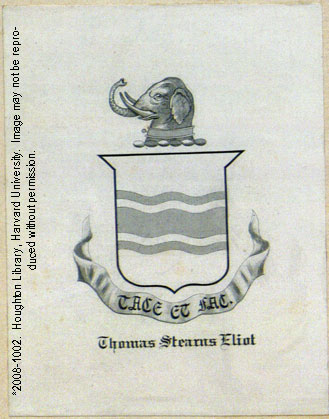
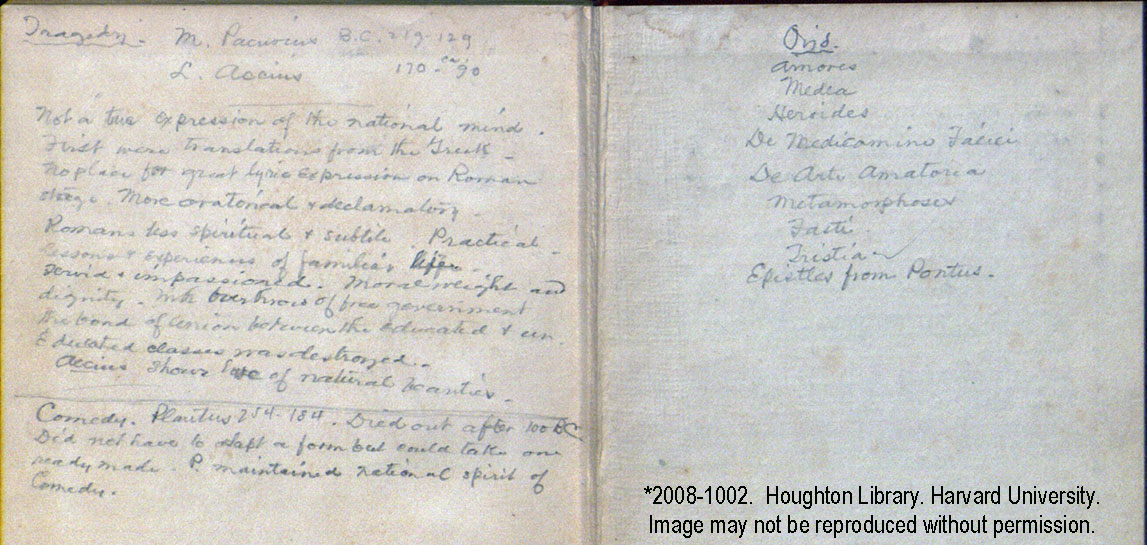
Poet, dramatist, Harvard graduate and Nobel Prize winner T.S. Eliot (1888-1965) began to study Latin while a student at Smith Academy from 1898-1905, and continued to study languages, both modern and ancient, through college. Eliot probably acquired J.W. Mackail’s Latin Literature while studying at Harvard. While he made few annotations to the text itself, Eliot also made extensive notes in pencil on several blank pages throughout the book. Eliot’s bookplate is also pasted inside the front cover (Eliot’s bookplate includes his family’s motto Tace et fac, “be silent and act.”) Examples of Eliot’s early handwriting are uncommon, and as Eliot made extensive use of his linguistic skills within his poetry, it is always interesting to catch a glimpse into his study of them. (Click on the images to magnify them.)
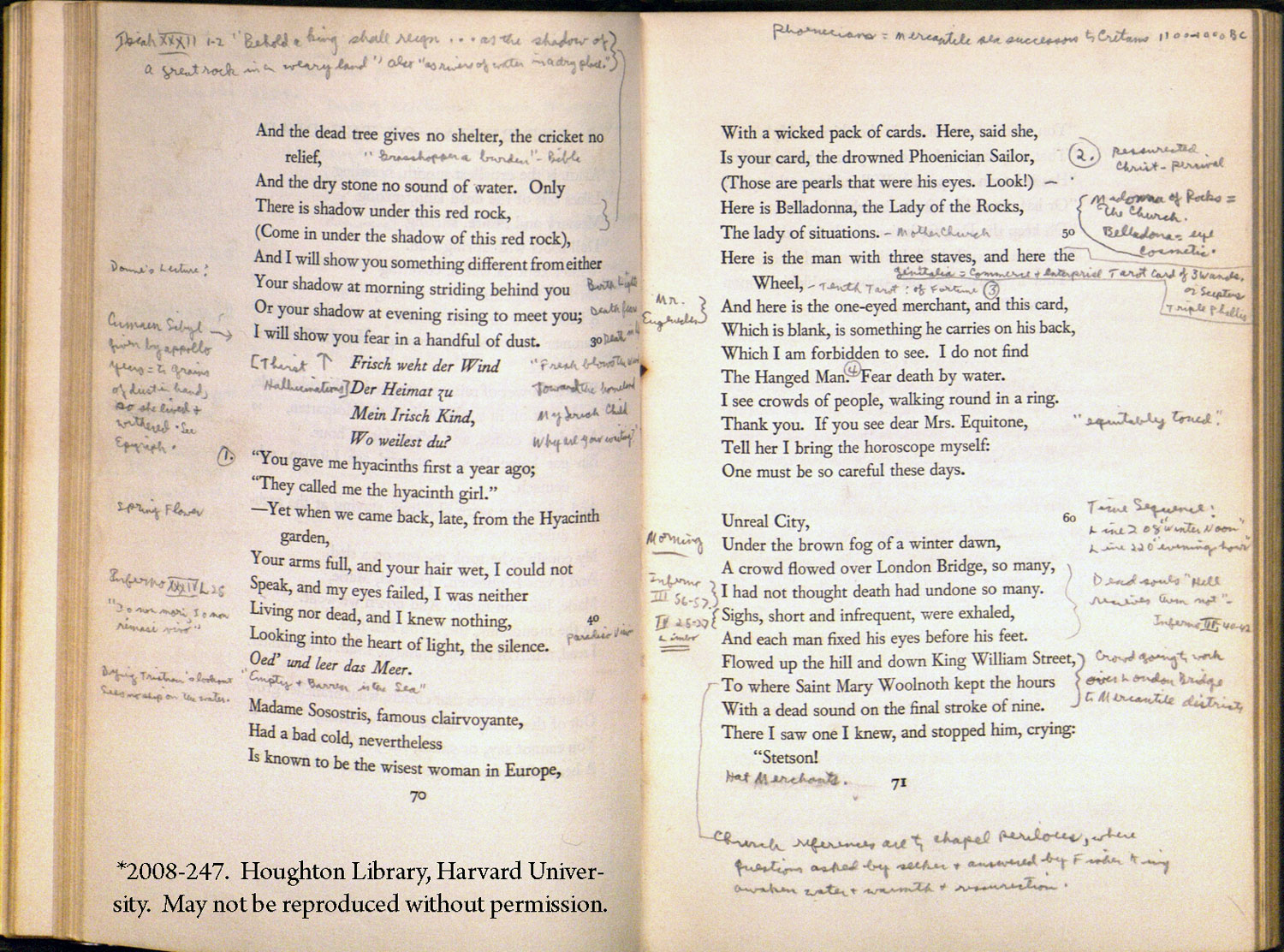
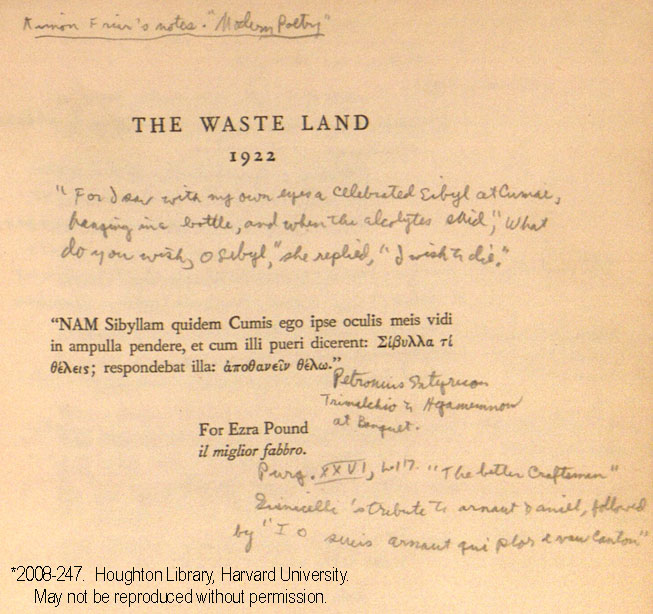 Allen Ginsberg (1926-1997) was one of the most important figures in the Beat movement of the mid-twentieth century. Two years after graduation from Columbia University, while working in New York as a market researcher, Ginsberg purchased this 1936 edition of Eliot’s Collected Poems 1909-1935, which he signed “Allen Ginsberg / October 1950” on the front free endpaper. Ginsberg’s extensive annotations to The Waste Land document his efforts to work through the poem.
Mackail, Latin Literature. New York: Scribners, 1895.*AC9.Eℓ464.Zz907m.
Eliot, Collected Poems, 1909-1935. New York: Harcourt, Brace & Co. [1936] *AC95.G4351.Zz936e.
3 Responses to “Inspiration and Influence”
This is incredibly fascinating, as both T.S. Eliot and Allen Ginsberg are among my favorite poets! I would love to be able to read some of Ginsberg’s notes and annotations.. it would surely offer great insight into his own work as well as Eliot’s influence upon it.
[…] My Comments: 1. , 2. , 3. , 4. , 5. , 6. , 7. […]
Hi
I’m really interested in the Waste Land (I’ve been reading it almost non-stop in the last 5 months) and the Ginsberg note’s are really fascinating. Has the whole book with the notes been digitalized? Is it possible to consult it?