“If God appeared in 19th Century America,” Harold Bloom told me, “it was as Ralph Waldo Emerson. In the 20th Century it would have been as Charlie Parker.”
Who knew that Yale’s monumental literature man was a bebopper? No mere  record collector, either. Bloom remembers haunting Minton’s and other Harlem hatcheries of the new jazz in the 1940s. A half century ago he handed the collected poems of one idol, Hart Crane, to another, the pianist Bud Powell, whose “Un Poco Loco” is short-listed with, say, Moby Dick and The Scarlet Letter among Bloom’s all-time all-American aesthetic statements. And in our long conversation Professor Bloom spelled out exactly what he thinks the connections are.
The Sage of New Haven helped revive the late Sage of Concord in the 1960s. This summer, Emerson’s 200th, it is Bloom’s effusive devotion that rules the international birthday party. Bloom does not quite confer supremacy on Emerson, though he believes Emerson made our greatest writer, Walt Whitman, possible. Emerson made the rest of our literary culture (Emily Dickinson to Henry James to Robert Frost to Don DeLillo) possible, necessary and perhaps inevitable. “The whole phenomenon of American culture,” said Bloom, “on every level down to popular culture… is a profoundly Emersonian affair. He has prophesied everything… He is the mind of America. He is not only the first absolutely original mind to appear in the United States, but he usurped everything that could be peculiarly American about thought as such.”
It is Bloom’s way to digress, and by the end of an afternoon we had littered acres of artistic ground with scores and scores of dropped names. Part One of this conversation is a modern walk in the Emersonian woods,  lit by Bloom’s astonishing memory for people and lines and history, and with several touches of Bloom’s high style of invective. Richard Rorty and the late Bart Giamatti come up as good guys; Dubya, Cheney and Rummy as fools; Robert Penn Warren and Allen Ginsberg as departed friends with whom the voluble Bloom is still arguing. Part Two is not least a catalog of people who hated Emerson (Southerners in his lifetime and ever after, including C. Vann Woodward, Allen Tate and “Red” Warren; but also T. S. Eliot and even Herman Melville, who mocked Emerson in his fiction) and those who loved him and/or owed him (including W. E. B. DuBois, William James, Justice Oliver Wendell Holmes, Henry David Thoreau, Wallace Stevens, the Argentinian Jorge Luis Borges and the American novelist of Invisible Man, Ralph Waldo Ellison). Part Three is contemporary and personal. It was my Emersonian confession, “he speaks to me,” that prompted Harold Bloom. Lost and depressed in his own dark wood in his mid-thirties, Bloom said, he had read forward and back in Emerson’s Journals “morning noon and night and all night long,” and “I felt that every phrase he had ever written he was speaking directly to me… I still feel that way,” he said. “There are many many sentences in which I feel that Emerson is more than speaking to me. He has gotten inside my inner ear and has become indeed the the best and oldest part of myself. Indeed, it is the God within, as it were, that speaks.”
Who speaks with Emerson’s range and affirmation in our lifetimes? I tried on Professor Bloom my notion that Duke Ellington cut his own original Emersonian figure for the 20th Century. 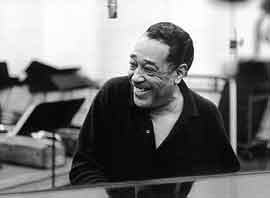 An enabler who was both major composer and itinerant performance artist, in long forms and short, for dance halls and cathedrals, Ellington was a blues man of surpassing public style and inner ecstasies. It intrigues me that both Emerson and Ellington were towering individualists set each in his own band of eccentric voices–Ellington in his orchestra, Emerson in the Concord circle. Harold Bloom was wide open to transferring the modern Emerson search into the music world, but his taste is for the blazing solo voices from Louis Armstrong to Sonny Rollins, with Charlie Parker presiding over the Pantheon. Listen in. One. Two and Three.
{ 18 } Comments