• Home
  • About MESH
  • Members
  • Papers
  • Contact

Middle East Strategy at Harvard

National Security Studies Program :: Weatherhead Center

Feed on
Posts
Comments

Fundamental flaw in the NIE

Dec 22nd, 2007 by MESH

From Mark T. Clark

The controversial National Intelligence Estimate (NIE) on Iran’s nuclear program raises more questions than it answers. Critics—and criticisms—are aplenty. These have focused on three levels: tactical (the kind of intelligence we have), strategic (understanding Iran’s intentions) and political (the fallout on U.S. and international policies in curbing Iranian nuclear ambitions). Given the recent disastrous failures of intelligence, this reversal of previous estimates also does little to restore public confidence in the intelligence process.

There are other grounds for concern about this NIE, especially the timing of its public release and whether it has inadvertently signaled a “green light” to Iran to restart or continue its nuclear weapons development program. At the very least, it will make it extremely difficult for the U.S. to reverse itself once again and muster a domestic and international consensus for diplomatic or military pressure against the Iranian program, should it be found again to have an active weapons component.

Central to the problem of this NIE is its assessment of the Iranian decision-making process. The NIE reports:

Our assessment that Iran halted the program in 2003 primarily in response to international pressure indicates Tehran’s decisions are guided by a cost-benefit approach rather than a rush to a weapon irrespective of the political, economic, and military costs [emphasis added].

That is to say, the Iranian leadership is a rational actor. Some combination of threats and inducements can and does alter its decision-making process in the development of its nuclear weapons program.

Raymond Ibrahim points out correctly that common sense tells us Iran wants to acquire nuclear weapons and that it is very difficult for leaders in states that have nuclear weapons to understand the intense desire of non-nuclear states to acquire them. Why then this disparity between common sense and “intelligence”?

The problem may be with our understanding of “cost-benefit” analysis. While a rational actor approach may be useful for some theoretical approaches to international politics, it may actually mask or misstate the approach of human policy-makers. In fact, for the real world of decision-makers, a cost-benefit analysis oversimplifies the whole process. When it comes to acquiring nuclear weapons, it is not a simple either/or: either build or avoid building a nuclear weapon. The decisions may include how to build, whether to build on a civilian program, whether to deceive opponents in the process, and how to mask the deception.

The “cost-benefit” approach may also oversimplify nuclear deterrence. In my case study of four small nuclear powers, including Israel, India, Pakistan and the Republic of South Africa, I showed how all pursued nuclear weapons despite international opprobrium and all displayed a nuanced appreciation of the conditions under which they might actually use them (see Figure 1: Nuclear Deterrence/Threat/Use Continuum, below).
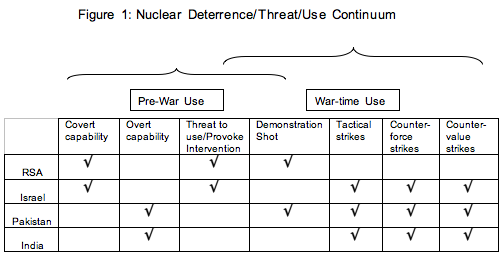
There I quoted a Pakistani nuclear strategist who indicated that “mutual suicide” could be a rational choice for Pakistan if other options were closed, further shaking our confidence in the “cost-benefit” calculus of rationality.

There are related problems in a “cost-benefit” approach to analyzing Iranian decision-making in pursuit of a nuclear arsenal: the potential for self-deception as well as strategic deception by Iran.

The self-deception comes from “mirror-imaging” how our adversaries decide policy: that is, interpreting another’s decision-making process in light of our own. Such an approach ignores the intensity of the desire an opponent may have to acquire nuclear weapons and its strategic calculus in doing so. It pays to recall the lesson of the first Gulf War, after which one Indian general concluded: “Never fight the Americans without nuclear weapons.” It is likely that Iranian decision-makers have seen and understood the very different treatment North Korea and Iraq received from the U.S., attributing it to North Korea’s possession of a nuclear arsenal.

Strategic deception is also possible. As in the case of the four small nuclear powers, all masked their weapons programs or hid them behind civilian nuclear energy programs. All of these states actively sought to discourage U.S. and international discovery of their weapons programs. The Soviet Union was famous for its efforts at strategic deception and perceptions management. Even tactically, we can be surprised. Indian scientists bragged at being able to spoof U.S. satellites at Pokhran the day of the first overt nuclear weapons detonations in May 1998.

The NIE has raised eyebrows for a number of reasons. But the approach it takes to understanding the decision-making calculus of Iran may be the most fundamental flaw of the estimate, one that has lead to all the other problems. When professors get it wrong, little or no harm is done. But it is a completely different matter when our best intelligence officials err. Everyone is liable to suffer.

  • E-mail this story to a friend!
  • Facebook
  • Twitter
  • del.icio.us
  • Digg
  • Google Bookmarks
  • Technorati
  • StumbleUpon
  • Reddit

Posted in Intelligence, Iran, Mark T. Clark, Nuclear | No Comments

Comments are closed.

  • This Site

    Middle East Strategy at Harvard (MESH) is a project of the National Security Studies Program at the Weatherhead Center for International Affairs.
    • Read about MESH
    • Search MESH with Google
    • Receive MESH by email
  • Latest Posts

    • • Lebanon on UN Security Council by David Schenker
    • • Whither Yemen? by Mark N. Katz
    • • Saudis into Yemen by Daniel Byman
    • • Disrupting Iran’s weapons smuggling by Matthew Levitt
    • • MESH seeks support
    • • How the Saudis radicalized U.S. troops by Gal Luft
  • Comments

    MESH invites comments from its members and other analysts.
    • Read about comments
  • Latest Comments

    • Walter Reich on Bungled again: Israel and Goldstone
    • J. Scott Carpenter on Farewell and thanks
    • Michele Dunne on Farewell and thanks
    • Robert Satloff on Farewell and thanks
    • Stephen Peter Rosen and Martin Kramer on Farewell and thanks
  • Subscribe

    Subscribe to MESH by email Posts+Comments
    Feed Posts+Comments
    Subscribe to MESH by email Posts+Comments
    Posts+Comments
    AddThis Feed Button
  • RSS MESH Pointers

    • • Warming increases the risk of civil war in Africa
    • • Morocco: Jail Sentence for HR Activist
    • • Democracy Promotion: A New Approach
    • • Iran: Amnesty International and Others Urge an Independent Investigation into the Mysterious Death of an Iranian Doctor
    • • Washington and the Ivory Tower: How Government Can Engage Academe in the Service of U.S. Middle East Policy
  • Posts by Category

    • Administration (5)
    • Announcements (23)
    • Countries (245)
      • Afghanistan (11)
      • Arab Gulf (11)
      • Bahrain (1)
      • Caucasus (5)
      • Central Asia (2)
      • China (3)
      • Egypt (25)
      • France (2)
      • India (1)
      • Iran (77)
      • Iraq (35)
      • Israel (95)
      • Jordan (9)
      • Lebanon (28)
      • Pakistan (8)
      • Palestinians (52)
      • Qatar (1)
      • Russia (12)
      • Saudi Arabia (14)
      • Syria (18)
      • Turkey (15)
      • United Kingdom (3)
      • Yemen (5)
    • Members (266)
      • Adam Garfinkle (22)
      • Alan Dowty (19)
      • Andrew Exum (11)
      • Barry Rubin (14)
      • Bernard Haykel (9)
      • Bruce Jentleson (6)
      • Charles Hill (3)
      • Chuck Freilich (15)
      • Daniel Byman (17)
      • David Schenker (16)
      • Gal Luft (9)
      • Harvey Sicherman (11)
      • Hillel Fradkin (8)
      • J. Scott Carpenter (15)
      • Jacqueline Newmyer (6)
      • Jon Alterman (13)
      • Josef Joffe (17)
      • Joshua Muravchik (10)
      • Mark N. Katz (21)
      • Mark T. Clark (15)
      • Mark T. Kimmitt (6)
      • Martin Kramer (24)
      • Matthew Levitt (15)
      • Michael Doran (4)
      • Michael Horowitz (9)
      • Michael Mandelbaum (12)
      • Michael Reynolds (14)
      • Michael Rubin (8)
      • Michael Young (16)
      • Michele Dunne (16)
      • Philip Carl Salzman (32)
      • Raymond Tanter (16)
      • Robert O. Freedman (20)
      • Robert Satloff (17)
      • Soner Cagaptay (4)
      • Stephen Peter Rosen (13)
      • Steven A. Cook (14)
      • Tamara Cofman Wittes (18)
      • Walter Laqueur (20)
      • Walter Reich (11)
    • Subjects (269)
      • Academe (3)
      • Books (39)
      • Counterinsurgency (13)
      • Culture (21)
      • Democracy (16)
      • Demography (5)
      • Diplomacy (19)
      • Economics (1)
      • European Union (3)
      • Geopolitics (42)
      • Hamas (21)
      • Hezbollah (25)
      • Intelligence (9)
      • Islam in West (5)
      • Islamism (16)
      • Maps (27)
      • Media (5)
      • Military (19)
      • Nuclear (26)
      • Oil and Gas (13)
      • Public Diplomacy (10)
      • Qaeda (23)
      • Sanctions (6)
      • Taliban (3)
      • Technology (2)
      • Terminology (9)
      • Terrorism (30)
      • United Nations (7)
  • Archives

    • November 2009 (12)
    • October 2009 (8)
    • September 2009 (9)
    • August 2009 (9)
    • July 2009 (9)
    • June 2009 (12)
    • May 2009 (16)
    • April 2009 (11)
    • March 2009 (16)
    • February 2009 (11)
    • January 2009 (10)
    • December 2008 (12)
    • November 2008 (11)
    • October 2008 (19)
    • September 2008 (15)
    • August 2008 (17)
    • July 2008 (18)
    • June 2008 (12)
    • May 2008 (17)
    • April 2008 (20)
    • March 2008 (27)
    • February 2008 (19)
    • January 2008 (18)
    • December 2007 (19)
  • MESH Bookstore


    Recently featured:


  • Maps

    • Online atlas in construction
    Latest additions:
    Scriptless Flickr Badge Scriptless Flickr Badge
    Scriptless Flickr Badge Scriptless Flickr Badge
    Scriptless Flickr Badge Scriptless Flickr Badge
  • RSS Latest Iran

    • • IAEA chief: Iran investigation at 'dead end' (AP)
    • • ElBaradei slams Iran at his last IAEA meeting (AFP)
    • • US aides pressured China on Iran: report (AFP)
    • • New spy charge against jailed Iranian-American (AP)
    • • World powers demand Iran mothball nuclear site (Reuters)
  • RSS Latest Levant

    • • Hamas says 'tangible progress' in prisoner swap (AFP)
    • • Israel dismisses Palestinian rejection of freeze (Reuters)
    • • Palestinians urge US to raise pressure on Israel (AP)
    • • 'Ball in Palestinian court' after settlement offer: Israel (AFP)
    • • Palestinian stabs two Israelis in West Bank: army (AFP)
  • RSS Latest Iraq

    • • US troops in Iraq reflect amid Thanksgiving celebrations (AFP)
    • • Iraq attacks kill seven, hit Christian sites (AFP)
    • • Iraqi PM: Election dispute poses risks to security (AP)
    • • Blair's stance 'hardened' after Bush talks: probe (AFP)
    • • Ex-UK envoy: US focused on Iraq hours after 9/11 (AP)
  • RSS New York Times

    • • Iran Nuclear Program Inquiry Is at ‘Dead End,’ U.N. Says
    • • Iraqi Lawmakers Hunt for Election Compromise
    • • News Analysis: Half-Truths Dim Chances for Mideast Talks
    • • Memo From Alexandria: Harnessing Darwin to Push an Ancient Intellectual Center to Evolve
    • • In Iraq, 2 Attacks Raise Fears of Sectarianism
  • RSS Washington Post

    • • Iraqis reach tentative agreement on elections law
    • • U.S. hails Israeli plan on West Bank settlement building
    • • Investment scandal hurts Hezbollah's image, even among backers
    • • China's backing on Iran followed dire predictions
    • • At least 10 people reported killed in violence in Iraq
  • RSS NPR

    • • Jerusalem's Palestinians Allege Expulsion Campaign
    • • Iran Reportedly Seizes Activist's Nobel Medal
    • • Israel Declares A 10-Month Settlement Freeze
    • • At Gaza Zoo, The Wild Things Return
    • • U.K. Begins Iraq War Inquiry
  • Harvard Events

    Check upcoming events from the calendars of...
    • Weatherhead Center for International Affairs
    • Center for Middle Eastern Studies (CMES)
    • Belfer Center for Science and International Affairs
  • RSS Weatherhead

    • • Canada, The United States and Cuba: The Triangular Relation between 1959 and 1962 as seen in Cuban Diplomatic History Co-sponsored by...
    • • The Capabilities: View of Development
    • • Special Series on International Relations of East Asia The United States and Kaji Wataru in Wartime China and Occupied Japan Co-sponsored...
  • RSS CMES

    • • From Social Democracy to Islamic-Ottoman Multiculturalism: Origins of the Historic Reforms in State Policies Towards Ethnicity
    • • Turkey’s Opening: Negotiations with Iraqi Kurdistan and US Redeployment from Iraq
    • • Modernity's Aesthetic Turn: Art Education and the Nation in Japan and Egypt
    • • 2009-2010 Egypt Forum program
    • • Destinies Apart: Jewish Immigrants from the Atlas Mountains and from Ethiopia, Moshe Shokeid
    • • The Cartoons that Shook the World
    • • Middle East Film Screening: Edge of Heaven (2007, Turkey/Germany)
  • RSS Belfer

    • • Why Arab States Fear Islamist Regimes: Threat Perception and Soft Power Politics
    • • Youth Civic Engagement & Diversity through Social Entrepreneurship in Egypt
    • • REFLECTIONS ON THE REVOLUTION IN EUROPE: Immigration, Islam, and the West
    • • Political Costs of Nuclear Threats: Implications for Crisis Stability in South Asia
    • • Are Ambassadors Still Important?
    • • Air Supremacy and the Air Force, Closure and Introduction of Spring semester
    • • "Northern Ireland Peace Process: What Then, What Now, What Next?”
    • • "Let the Historians Decide"? Politics and the Past in Turkey and Japan
    • • Saudi Arabia and “Rentier Exceptionalism”: Oil Price Fluctuations, State Responses and Political Mobilization
    • • Two Concepts of Liberty: American Grand Strategy and the Liberal Tradition
  • Sponsor

  • Host

  • Rights

    Copyright © 2007-2009 President and Fellows of Harvard College
    Site Meter

Theme: MistyLook by Sadish


Protected by Akismet • Blog with WordPress

Bad Behavior has blocked 1 access attempts in the last 7 days.