• Home
  • About MESH
  • Members
  • Papers
  • Contact

Middle East Strategy at Harvard

National Security Studies Program :: Weatherhead Center

Feed on
Posts
Comments

Clashes in Beirut

May 11th, 2008 by MESH

From Philip Carl Salzman
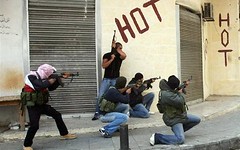
After modest initiatives in recent days by the Lebanese government to restrict the independent operations of Hezbollah, fighters of Hezbollah and Amal flooded into the streets of west Beirut, attacked and dispersed government fighters, set up road blocks, and occupied government and media offices. The Druze and Christian militias did not act, and the Sunni militia limited itself to minor engagement. The Lebanese Army remained on the sidelines, respecting “neutrality.”

On May 8, Hezbollah Secretary-General Hasan Nasrallah gave a speech in which he said: “…whoever declares, and starts, war against us, be it a mother, a father, or a brother—we have a right to counter him and defend our rights, our weapons, our existence, and our resistance.” The other militias take the same view. The overall pattern is a set of quasi- or fully independent political corporations, based on identity and fierce loyalty, each armed and maintaining the right to act militarily in its own interests and those of its constituents. Each political corporation seeks dominance over the others, or, if that is not possible, a balance in which its interests and those of its constituents are not violated by the others. “National” institutions are weak, undermined by partisan loyalties and the independent corporations. Consequently, there is no overarching, inclusive loyalty, no rule of law, and no peaceful procedures for resolving basic conflicts.

How can we understand this factional pattern of institutionalized fragmentation and oppositional conflict? My suggestion is that this pattern reflects the “tribal spirit” of Arab culture, manifested in self-help corporations for defense and the advancement of interests, and for which men have a primarily obligation to engage in military action. Each man has a duty to be a warrior, and most take pleasure in the glory of it. In the view of the members of a corporation, there is no presumption of rights for members of other corporations, and there is no recognition of legitimate authority outside of the corporations and above them.

In Lebanon, of course, these corporations are primarily defined by sect—Sunni, Shi’a, Christian, Druze—as are some of the corporations found in Iraq, such as Sadr’s “Mahdi Army” Shiite militia, while others are ethnic, such as the Kurdish Peshmerga. These sect- and ethnicity-defined corporation-militias are often found in Arab cities—Beirut, Bagdad, and Basra are those most recently in the news—but descent-based corporations, actual tribes, are prevalent in rural trouble spots, such as Anbar Province of Iraq, throughout Afghanistan, in the mountains and deserts of Pakistan, and in currently quiescent places, such as Libya, in both town and country. The sect-based corporations have inherited presumptions and structures from the descent-based tribes, applying them in corporations based upon a different principle of identity: religion rather than descent. The same, of course, applies to Islam in general, in its militant opposition of the dar al-Islam to the dar al-harb.

Politically stable countries in the Arab world, such as Iraq under Saddam and Syria under the Alawites, demonstrate the factional opposition at a different phase, one in which one corporation has succeeded in establishing dominance over the others, using the state as a weapon to suppress any opposition. As we have seen in Iraq, remove the successful oppressor, and factional opposition ignites with fury. All of which is highly reminiscent of the tribal wars throughout Middle Eastern and North African history.

Posted in Culture, Lebanon, Philip Carl Salzman, Terrorism | No Comments

Comments are closed.

  • This Site

    Middle East Strategy at Harvard (MESH) is a project of the National Security Studies Program at the Weatherhead Center for International Affairs.
    • Read about MESH
    • MESH blog
    • Search MESH with Google
    • Download entire blog (pdf)
  • Last Post

    • • MESH in hibernation by Stephen Peter Rosen and Martin Kramer
  • Subscribe

    Subscribe to MESH by email Posts+Comments
    Feed Posts+Comments
    Subscribe to MESH by email Posts+Comments
    Posts+Comments
    AddThis Feed Button
  • RSS MESH Pointers

    • • Iraq: Appeals Court Modifies Election Reinstatement
    • • Egypt: Shake-Up in Human Rights Council
    • • Army Deployments to OIF and OEF
    • • NYT: Iran's Two-Edged Bomb
    • • Joint Statement By the European Union and the United States Calling on the Iranian Government to Fulfill its Human Rights Obligations, February 2010
  • Posts by Category

    • Administration (5)
    • Announcements (24)
    • Countries (248)
      • Afghanistan (11)
      • Arab Gulf (11)
      • Bahrain (1)
      • Caucasus (5)
      • Central Asia (2)
      • China (3)
      • Egypt (25)
      • France (2)
      • India (1)
      • Iran (79)
      • Iraq (36)
      • Israel (95)
      • Jordan (9)
      • Lebanon (28)
      • Pakistan (8)
      • Palestinians (52)
      • Qatar (1)
      • Russia (13)
      • Saudi Arabia (14)
      • Syria (18)
      • Turkey (15)
      • United Kingdom (3)
      • Yemen (5)
    • Members (270)
      • Adam Garfinkle (22)
      • Alan Dowty (19)
      • Andrew Exum (11)
      • Barry Rubin (14)
      • Bernard Haykel (9)
      • Bruce Jentleson (6)
      • Charles Hill (3)
      • Chuck Freilich (15)
      • Daniel Byman (17)
      • David Schenker (16)
      • Gal Luft (9)
      • Harvey Sicherman (11)
      • Hillel Fradkin (8)
      • J. Scott Carpenter (15)
      • Jacqueline Newmyer (6)
      • Jon Alterman (13)
      • Josef Joffe (17)
      • Joshua Muravchik (10)
      • Mark N. Katz (22)
      • Mark T. Clark (15)
      • Mark T. Kimmitt (6)
      • Martin Kramer (25)
      • Matthew Levitt (15)
      • Michael Doran (4)
      • Michael Horowitz (9)
      • Michael Mandelbaum (12)
      • Michael Reynolds (14)
      • Michael Rubin (8)
      • Michael Young (16)
      • Michele Dunne (16)
      • Philip Carl Salzman (32)
      • Raymond Tanter (17)
      • Robert O. Freedman (20)
      • Robert Satloff (17)
      • Soner Cagaptay (4)
      • Stephen Peter Rosen (13)
      • Steven A. Cook (14)
      • Tamara Cofman Wittes (18)
      • Walter Laqueur (21)
      • Walter Reich (11)
    • Subjects (274)
      • Academe (4)
      • Books (40)
      • Counterinsurgency (14)
      • Culture (21)
      • Democracy (16)
      • Demography (5)
      • Diplomacy (20)
      • Economics (1)
      • European Union (3)
      • Geopolitics (42)
      • Hamas (21)
      • Hezbollah (25)
      • Intelligence (10)
      • Islam in West (5)
      • Islamism (16)
      • Maps (27)
      • Media (5)
      • Military (19)
      • Nuclear (27)
      • Oil and Gas (14)
      • Public Diplomacy (10)
      • Qaeda (23)
      • Sanctions (8)
      • Taliban (3)
      • Technology (2)
      • Terminology (9)
      • Terrorism (30)
      • United Nations (7)
  • Archives

    • December 2009 (5)
    • November 2009 (13)
    • October 2009 (8)
    • September 2009 (9)
    • August 2009 (9)
    • July 2009 (9)
    • June 2009 (12)
    • May 2009 (16)
    • April 2009 (11)
    • March 2009 (16)
    • February 2009 (11)
    • January 2009 (10)
    • December 2008 (12)
    • November 2008 (11)
    • October 2008 (19)
    • September 2008 (15)
    • August 2008 (17)
    • July 2008 (18)
    • June 2008 (12)
    • May 2008 (17)
    • April 2008 (20)
    • March 2008 (27)
    • February 2008 (19)
    • January 2008 (18)
    • December 2007 (19)
  • Maps

    • Online atlas in construction
    Latest additions:
    Scriptless Flickr Badge Scriptless Flickr Badge
    Scriptless Flickr Badge Scriptless Flickr Badge
    Scriptless Flickr Badge Scriptless Flickr Badge
  • RSS Latest Iran

    • • Iran boosts nuclear enrichment, drawing warnings (AP)
    • • Obama turns up the heat on Iran (AFP)
    • • Obama says world moving quickly on Iran sanctions (Reuters)
    • • Iran sentences another activist to death (AP)
    • • Defiant Iran starts enriching uranium to 20 percent (AFP)
  • RSS Latest Levant

    • • NY Times editor rejects call to remove Jerusalem bureau chief (AFP)
    • • Netanyahu's government tries to save settler house (AP)
    • • Police arrest rock-throwing Palestinians in Jerusalem (AFP)
    • • Israel FM says talks with Palestinians likely soon (AFP)
    • • Palestinian force makes gains in West Bank (AP)
  • RSS Latest Iraq

    • • US military deaths in Iraq war at 4,375 (AP)
    • • Iraq to open 10-15 posts in Jordan as part of worldwide vote (AFP)
    • • Iraq launches fourth state oil firm (AFP)
    • • British PM to face Iraq inquiry in early March (AFP)
    • • Most banned Iraqi poll candidates' appeals rejected (Reuters)
  • RSS New York Times

    • • U.S. Eyes Sanctions on Revolutionary Guards to Curb Iran’s Nuclear Plans
    • • Arrests by Iran in Bid to Quell Wide Protests
    • • Small Step in Iran’s Nuclear Effort Suggests Ambitions for a Weapon, Experts Say
    • • In Northern Iraq, a Vote Seems Likely to Split
    • • World Briefing | Middle East: Egypt: Police Arrest 3 Top Figures of a Powerful Opposition Group
  • RSS Washington Post

    • • Former boy soldier, youngest Guantanamo detainee, heads toward military tribunal
    • • More tolerance for gay troops as end of 'don't ask, don't tell' is debated
    • • U.S., allies moving quickly on sanctions against Iran, Obama says
    • • Analysis: Iranian plan will put nation a step closer to having material for bomb
    • • Iran's president orders production of higher-enriched uranium
  • RSS NPR

    • • Obama: U.S. Preparing 'Significant' Sanctions On Iran
    • • Understanding Iran, 31 Years After Revolution
    • • Seeking A Kinder, Gentler Image For Israel
    • • Iran Takes Next Step In Uranium Enrichment
    • • Iran's Nuclear 'Good-Cop, Bad-Cop' Routine
  • Harvard Events

    Check upcoming events from the calendars of...
    • Weatherhead Center for International Affairs
    • Center for Middle Eastern Studies (CMES)
    • Belfer Center for Science and International Affairs
  • RSS Weatherhead

    • • An Anatomy of International Trade: Evidence From French Firms
    • • Lessons from the Global Financial Crisis
    • • From Farmer to Agro-Industrialist: the Evolution of the Argentine Agriculture and Its Future
  • RSS CMES

    • • Lecture by Stephen P. Cohen
    • • Why History Matters: International Law and the Origins of the Arab-Israeli Conflict
    • • Building the Big Tent: Islamist Politics and the Imperative of Inclusion
    • • Reading by Stephanie Saldana: The Bread of Angels, A Journey to Love and Faith
    • • LGBT Rights in Israel, Aeyal Gross
    • • Women and Fiqh
    • • Teaching Resources on the Ancient Middle East Region
  • RSS Belfer

    • • Building a Next Generation Nuclear Material Security Framework
    • • CANCELLED A Transitional Strategy for Success in Afghanistan
    • • Israel, the Palestinians and the One-State Agenda
    • • Justice Denied: Amnesty, Pardons, and Prosecutions in Post-apartheid South Africa
    • • Caspian Energy: Phase II
    • • History and Policy in the Nuclear Age
    • • No One in Charge: Coordination in Stabilization and Reconstruction Operations and Peacebuilding
    • • TICKETED FORUM: A conversation with Valerie Jarrett
    • • A public address by: The Honorable Henry Paulson
    • • Balancing at Sea: Do States Ally Against the Leading Global Power?
  • Sponsor

  • Host

  • Rights

    Copyright © 2007-2009 President and Fellows of Harvard College
    Site Meter

Theme: MistyLook by Sadish


Protected by Akismet • Blog with WordPress

Bad Behavior has blocked 1 access attempts in the last 7 days.