Regime change, Iranian-style
Jul 28th, 2008 by MESH
From Jacqueline Newmyer and Stephen Peter Rosen
 Seymour Hersh has recently alleged that the United States government is engaged in clandestine activities to destabilize Iran through appeals to ethnic and religious minorities. We hope that he is mistaken, not because we oppose regime change in Iran but because the history of Iran teaches that governments rise and fall according to a logic very different from the familiar narrative of ethnic separatism.
Immediately after World War One, Iran experienced the rapid rise and equally rapid collapse of two mini-republics, one involving the Azeri ethnic group around Tabriz and the other in Iran’s Gilan province on the Caspian Sea. These mini-republics might be thought to reflect proto-national separatist movements, but that would be incorrect. They were directed by men who capitalized upon events—concessions to the British and unequal treaties—that mobilized broad anti-foreign sentiment in Iran and in their regions. Both mini-republics failed after a few months, when foreign support for them evaporated.
What these examples illustrate is the rapid rise and fall of governments in Iran. Reza Khan rose quickly to power in the 1920s as a foreign-trained military officer who was able to suppress internal rebellions, but he was exiled in World War Two. Prime Minister Mossadegh rejected the terms of oil contracts imposed by the British and mobilized broad sentiment in Iran in support of this effort, but he was then easily deposed by the United States. Reza Khan’s son was brought back to Iran and was installed as monarch, until he was displaced by the Khomeini revolution, when American support for the Shah was perceived in Iran to have weakened as a result of increased concerns with human rights. This historical record demonstrates the extraordinary fluidity of Iranian politics, in which mass sentiment, foreign support, and charismatic leadership can make regimes, but cannot sustain them.
What explains this fluidity? The Iranian sociologist Homa Katouzian has suggested that the absence of any independent property rights over land in Iran precluded the emergence of stable social structures independent of the state. Administrations exist, but not a stable governing system because Iran has never had an institutionalized legal system based on the support of groups with independent property rights. Such groups do not exist in Iran.
So particular administrations govern while they can capitalize on mass social sentiment—against foreign oppression, for example—but they have no grounds of support that transcends particular personalities or geopolitical circumstances. In Europe, a foundation of stable property based interests allowed for shared public action on behalf of working, middle, and upper classes. Iran has had no equivalent tradition of independent property rights that would nurture a system of laws to protect them, divorced from the identity of a particular ruler or rulings of an elite juridical class.
The characteristic political leader in Iran is thus the same as the characteristic hero of the Thousand and One Nights, the tales told to a Persian king, Shahryar, by his wife, Scheherazade. In those stories, a young, gifted man who comes from nowhere, with nothing, rises to wealth and power by chance, and is then cast down by betrayal. So, too, did the Shah, Khomeini, and even Ahmadinejad seemingly come from nowhere, and, by virtue of charisma or foreign support, gain power.
If this view of Iranian politics is correct, we should not expect class-based social revolution, religious opposition, or ethnic opposition to topple the existing regime. The reign of Ahmadinejad was originally propelled by a reputation for probity and a populist appeal that have been eroded now that they have not materialized into benefits for the people. While this makes his administration a failure, the shared civic interests and independent political institutions that might transform disaffection into coherent political action does not yet exist. Meanwhile, Ahmadinejad’s nuclear endeavors and diplomatic offensives constitute a way for him to replenish his legitimacy.
Political change should only be expected, therefore, when some widely visible event causes social sentiment to coalesce into opposition to a regime that has come to be perceived as weak. The fact that the regime is corrupt means little—all governments are expected to steal and to be indifferent to the welfare of the people. But visibly outrageous behavior (for instance, flagrant affronts to religious principles) create a climate in which a new charismatic figure may emerge to rally an alienated populace. Leading indicators of this possibility would include social behavior that is universally considered deviant—for instance, reported sexual abuse by clerics and an increasing incidence of prostitution by married women whose husbands are aware of and condone the activity, according to Iranian academics.
However, social outrage is likely to flare and fade unless focused by a charismatic figure. Such a figure will not be associated with the current establishment but will have to have engaged in activities that demonstrate a commitment to the good of the nation and personal rectitude that have brought him to the attention of the Iranian population. Therefore, we should be looking for mayors of major cities (as Ahmadinejad once was), mid-level military commanders with histories of success (as was the case with Reza Khan), and clerics with reputations for piety. Most currently discussed potential rivals of Ahmadinejad do not fit these criteria because they are already tainted by scandal or association with the regime.
Does this mean that American military or covert action against the government of Iran will mobilize support for Ahmadinejad or indicate the weakness of the regime? That depends on the character of the action. Military strikes against Iranian nuclear installations will be perceived as foreign humiliation and may lead to internal opposition to the government, but in the name of stronger resistance to foreign domination. Actions that are not clearly tied to foreign governments and that lead to increasingly ineffective police and military control over society will contribute to the perception that the regime is weak. But, again, a dramatic event will be necessary to catapult a charismatic leader into power. This leader will almost certainly not be visibly pro-American. He is more likely to adopt highly nationalist rhetoric. That said, he will have opportunity and incentive to make a new start with the Iranian people, and improved economic and political relations with the West will be a part of what he has to offer Iran.
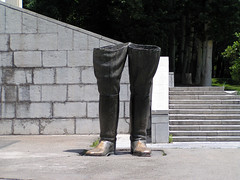
Illustration: Unfinished statue of Reza Shah, Saadabad Palace, Iran.
Comments are limited to MESH members and invitees.
One Response to “Regime change, Iranian-style”
 Posts+Comments
 Posts+Comments
 Posts+Comments
 Posts+Comments
Ethnically and structurally, Iran’s geography is a bit like a doughnut inside a larger doughnut. The hole is the central desert. The smaller doughnut is the inner ring of Persian cities and many villages (one figure is 60,000) occupied by Farsi-speaking, Shi’a Muslims. The larger doughnut is the outer ring, largely mountainous, of ethnic and tribal territories: Sunni Turkmen in the northeast; Sunni Baluch in the southeast; Turkic Qashqai and Arab tribesmen in the southwest; Lur-speaking tribesmen in the west; Kurds in the northwest; and Azeri Turks in the north-northwest.
Every time a government falls or is very weak, the tribes and ethnic minorities rebel and try to separate. Each newly established government—Reza Shah, Mohammed Reza Shah, the Islamic Republic—had to send its armed forces and conquer the rebels (usually starting in the southwest and proceeding clockwise). The Persian urbanites and villagers had reason to fear the tribes, which were enthusiastic predatory raiders for goods, livestock, and slaves. And, let us not forget, the tribes have been political actors from time to time: the occupation of Shiraz by the Qashqa’i was part of the process that brought Mossadegh down.
The inner ring of Farsi speakers was fragmented vertically: Political appointees and other absentee landlords squeezed the peasant majority, who commonly received 20 percent of the crop for their labor, and invested little in improvement of the factors of production.
Like most pre-industrial states, Persia/Iran has been held together by military force. Only religion has been capable of unifying fairly broadly, but even this has proved ephemeral. As Charles Lindholm has argued, in the Islamic Middle East, there is no legitimate basis for rulership, other than religion; but then religion, once in government, becomes de-sacralized and corrupt, and loses legitimacy.
This has already happened in Iran. Religion no longer carries political legitimacy. Many political actors who literally took on clerical garb have long since laid it aside. The populace, certainly the urban and tribal, has struggled to avoid religious restrictions and has begun to consciously re-construct non-religious identities. The Sunnis reemphasize the Sunni-Shi’a divide and tribesmen their tribal roots; the urbanites, certainly the young, draw on the internet and clandestine mass media to incorporate elements of modern and Western culture. Some have gone so far as to reject Islam, now refusing to greet with Salaam aleikom, but instead offer the pre-Islamic Persian terms for hello and goodbye: darood and bedrood.
With all of this in mind, how does one advance the possibility of regime change? Into which fissures does one insert the lever? Would a new potential leadership be important? Undoubtedly; Persians put great weight on strong leaders. In addition to the chronically discontented tribes and ethnics, would the Farsi-speaking majority have to be attracted? Most likely. To which addresses should outsiders send funds? I only give those out under contract.
Philip Carl Salzman is a member of MESH.