• Home
  • About MESH
  • Members
  • Papers
  • Contact

Middle East Strategy at Harvard

National Security Studies Program :: Weatherhead Center

Feed on
Posts
Comments

China in the Middle East

Aug 7th, 2008 by MESH

From Jon Alterman

As someone who normally focuses on the Middle East, why would I spend time thinking about China? The reason is simple: It is hard to imagine a future in the Middle East in which China does not play a more substantial role.

The Middle East emerged as a U.S. bailiwick in the early Cold War, and after the fall of the Soviet Union, no extra-regional state has thought to challenge U.S. preeminence. European nations have acquiesced to the U.S. lead, in part because they recognize that they cannot secure their interests in the ways that the United States does.

China, however, has felt less of a burden to comply with U.S. wishes, and the government often sees a range of reasons to depart from the U.S. script. Far more than the United States, China is dependent on Middle Eastern oil. More than 50 percent of China’s imported oil comes from the Middle East, versus some 25 percent in the United States. Further, China’s oil needs are growing, while U.S. oil consumption has flattened. China’s strategic thinkers see the country’s continued reliance on Middle Eastern oil to be a strategic liability, not only because the Middle East itself is an unstable region, but also because they have little faith in their own ability to secure the sea lanes needed to transport the oil in the event of tensions with the United States.

As China looks to U.S. management of the Middle East, the country’s leaders grow concerned. The Iraq war and continued sparring with Iran have heightened tensions in the Gulf and helped drive up oil prices around the world. China is largely indifferent to issues of domestic governance among its trading partners, and it appreciates their indifference when it comes to internal conditions in China. China judges that whomever is in power in these countries will sell them oil, and they need not be concerned beyond that. After decades as an avowedly revolutionary power, China has become an intensely status quo power, and Chinese see the United States as tilting the world dangerously toward instability. The notion of spurring internal change in hostile countries such as Iran, or even in friendly countries such as Saudi Arabia, is anathema.

For all of its skepticism toward U.S. actions in the region, however, China is not indifferent to the U.S. lead. Indeed, the Sino-American relationship is the premier strategic question in China, and there is great sensitivity to the possibility of alienating the United States in a region that is clearly of strategic importance to both countries.

Up to now, China and its Asian neighbors have been the beneficiaries of U.S. efforts to secure the Gulf and its rich oil supplies. The United States has supplied the troops and the ships, and the Chinese have bought the oil. Some estimates price U.S. expenditures to secure Gulf oil at more than $30 billion per year—and that was before the military campaign in Iraq. The United States has borne those costs as part of its efforts to build global security.

Critics charge that China has been content to be something less than a full partner on Gulf security, entering into deals for Iranian oil and gas in the face of U.S. efforts to isolate the Iranians. While China certainly thinks that efforts at isolation are unwise, it has often yielded to strong U.S. protests (prolonging negotiations with U.S. adversaries rather than walking away from the negotiating table). Such strong U.S. demands have also prompted China to trim its weapons sales to Iran. Similarly, China has gone along with U.N. Security Council efforts to try to persuade Iran to be more transparent about its nuclear program, although it has often been reluctant to impose additional sanctions and has counseled much more patience. This is not a hopeless case.
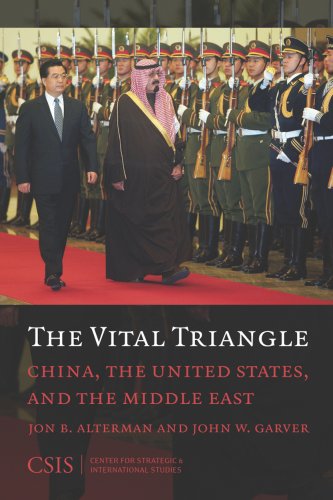
Cooperation up to now has been incremental. Now, it is in the interests of both China and the United States that it become more systematic. The CSIS Middle East Program has just issued a book, The Vital Triangle: China, the United States and the Middle East (purchase here; free download here) that explores these questions more deeply. (John W. Garver and I are co-authors.) The bottom line is this: The United States and China share a wide range of interests in the Middle East, and efforts by either the United States, China or Middle Eastern countries to freeze out any of the others will surely lead to all parties emerging as losers. Small steps toward burden-sharing—cooperation on naval measures in the Gulf, such as ship identification protocols and disaster response coordination—can help steer China’s deepening interest in the Middle East in a positive direction. More robust diplomatic coordination can go a long way as well. There is an opportunity here, and the alternative to success is not a happy one.

  • E-mail this story to a friend!
  • Facebook
  • Twitter
  • del.icio.us
  • Digg
  • Google Bookmarks
  • Technorati
  • StumbleUpon
  • Reddit

Posted in China, Jon Alterman | No Comments

Comments are closed.

  • This Site

    Middle East Strategy at Harvard (MESH) is a project of the National Security Studies Program at the Weatherhead Center for International Affairs.
    • Read about MESH
    • Search MESH with Google
    • Receive MESH by email
  • Latest Posts

    • • How the Saudis radicalized U.S. troops by Gal Luft
    • • Farewell and thanks by Tamara Cofman Wittes
    • • Obama’s missive to Iran by Philip Carl Salzman
    • • The real linkage: Afghanistan and Iran by Adam Garfinkle
    • • Bungled again: Israel and Goldstone by Alan Dowty
    • • Iran’s second front in Afghanistan by Raymond Tanter
  • Comments

    MESH invites comments from its members and other analysts.
    • Read about comments
  • Latest Comments

    • J. Scott Carpenter on Farewell and thanks
    • Michele Dunne on Farewell and thanks
    • Robert Satloff on Farewell and thanks
    • Stephen Peter Rosen and Martin Kramer on Farewell and thanks
    • Raymond Tanter on Obama’s missive to Iran
  • Subscribe

    Subscribe to MESH by email Posts+Comments
    Feed Posts+Comments
    Subscribe to MESH by email Posts+Comments
    Posts+Comments
    AddThis Feed Button
  • RSS MESH Pointers

  • Posts by Category

    • Administration (5)
    • Announcements (22)
    • Countries (241)
      • Afghanistan (11)
      • Arab Gulf (11)
      • Bahrain (1)
      • Caucasus (5)
      • Central Asia (2)
      • China (3)
      • Egypt (25)
      • France (2)
      • India (1)
      • Iran (76)
      • Iraq (35)
      • Israel (95)
      • Jordan (9)
      • Lebanon (27)
      • Pakistan (8)
      • Palestinians (52)
      • Qatar (1)
      • Russia (12)
      • Saudi Arabia (13)
      • Syria (18)
      • Turkey (15)
      • United Kingdom (3)
      • Yemen (3)
    • Members (262)
      • Adam Garfinkle (22)
      • Alan Dowty (19)
      • Andrew Exum (11)
      • Barry Rubin (14)
      • Bernard Haykel (9)
      • Bruce Jentleson (6)
      • Charles Hill (3)
      • Chuck Freilich (15)
      • Daniel Byman (16)
      • David Schenker (15)
      • Gal Luft (9)
      • Harvey Sicherman (11)
      • Hillel Fradkin (8)
      • J. Scott Carpenter (15)
      • Jacqueline Newmyer (6)
      • Jon Alterman (13)
      • Josef Joffe (17)
      • Joshua Muravchik (10)
      • Mark N. Katz (20)
      • Mark T. Clark (15)
      • Mark T. Kimmitt (6)
      • Martin Kramer (24)
      • Matthew Levitt (14)
      • Michael Doran (4)
      • Michael Horowitz (9)
      • Michael Mandelbaum (12)
      • Michael Reynolds (14)
      • Michael Rubin (8)
      • Michael Young (16)
      • Michele Dunne (16)
      • Philip Carl Salzman (32)
      • Raymond Tanter (16)
      • Robert O. Freedman (20)
      • Robert Satloff (17)
      • Soner Cagaptay (4)
      • Stephen Peter Rosen (13)
      • Steven A. Cook (14)
      • Tamara Cofman Wittes (18)
      • Walter Laqueur (20)
      • Walter Reich (10)
    • Subjects (268)
      • Academe (3)
      • Books (39)
      • Counterinsurgency (13)
      • Culture (21)
      • Democracy (16)
      • Demography (5)
      • Diplomacy (19)
      • Economics (1)
      • European Union (3)
      • Geopolitics (42)
      • Hamas (21)
      • Hezbollah (25)
      • Intelligence (9)
      • Islam in West (5)
      • Islamism (16)
      • Maps (27)
      • Media (5)
      • Military (19)
      • Nuclear (26)
      • Oil and Gas (13)
      • Public Diplomacy (10)
      • Qaeda (23)
      • Sanctions (6)
      • Taliban (3)
      • Technology (2)
      • Terminology (9)
      • Terrorism (30)
      • United Nations (6)
  • Archives

    • November 2009 (7)
    • October 2009 (8)
    • September 2009 (9)
    • August 2009 (9)
    • July 2009 (9)
    • June 2009 (12)
    • May 2009 (16)
    • April 2009 (11)
    • March 2009 (16)
    • February 2009 (11)
    • January 2009 (10)
    • December 2008 (12)
    • November 2008 (11)
    • October 2008 (19)
    • September 2008 (15)
    • August 2008 (17)
    • July 2008 (18)
    • June 2008 (12)
    • May 2008 (17)
    • April 2008 (20)
    • March 2008 (27)
    • February 2008 (19)
    • January 2008 (18)
    • December 2007 (19)
  • MESH Bookstore


    Recently featured:


  • Maps

    • Online atlas in construction
    Latest additions:
    Scriptless Flickr Badge Scriptless Flickr Badge
    Scriptless Flickr Badge Scriptless Flickr Badge
    Scriptless Flickr Badge Scriptless Flickr Badge
  • RSS Latest Iran

    • • Brazil: Ties with Iran important to Mideast peace (AP)
    • • Iran condemns Oxford for honoring slain protester (AP)
    • • Iran open to idea of world nuclear fuel bank (AP)
    • • Ahmadinejad suggests Iran role in atom fuel bank (Reuters)
    • • Italian company says no launch for Iran satellite (AP)
  • RSS Latest Levant

    • • Palestinian hopes dim 5 years after Arafat death (AP)
    • • Netanyahu, Sarkozy make no settlement breakthrough (AP)
    • • Israel hints at Syria opening after Sarkozy meeting (AFP)
    • • Hezbollah leader lashes out at Obama (AP)
    • • U.S. keeps pressure on Abbas after Netanyahu visit (Reuters)
  • RSS Latest Iraq

    • • Syrian envoy denies aiding insurgency in Iraq (AP)
    • • Iraq PM warns of threat in run-up to January vote (AP)
    • • UN says ensuring Jan Iraq election 'herculean' task (AFP)
    • • Troops sue KBR over toxic waste in Iraq, Afghanistan (AFP)
    • • UN calls organizing Iraq elections a "Herculean task" (The Christian Science Monitor)
  • RSS New York Times

    • • At Arafat Memorial, Abbas Lays Out Continuing Struggle
    • • Memo From Riyadh: Influence of Egypt and Saudi Arabia Fades
    • • Iran Executes Kurdish Activist
    • • Blackwater Said to Pursue Bribes to Iraq After 17 Died
    • • Minorities in Iraq’s North Seen as Threatened
  • RSS Washington Post

    • • Saudi Arabia imposes naval blockade on coast of northern Yemen
    • • 3 Americans in Iran charged with spying
    • • Fort Hood suspect's links to imam under scrutiny
    • • Iraq passes crucial election law for 2010
    • • Iraq passes crucial election law for 2010
  • RSS NPR

    • • Iran Backpedals On Nuclear Deal
    • • Kurds Renew Vigils For 'Disappeared' In Turkey
    • • Palestinians, Israelis Weigh Future Without Abbas
    • • Iraq Panel Proposes National Elections For Jan. 21
    • • Election Law Passes In Iraq, Setting Up National Vote
  • Harvard Events

    Check upcoming events from the calendars of...
    • Weatherhead Center for International Affairs
    • Center for Middle Eastern Studies (CMES)
    • Belfer Center for Science and International Affairs
  • RSS Weatherhead

    • • Mortgage Markets in Colonial America
    • • When China Rules the World: The Rise of the Middle Kingdom and the End of the Western World
    • • Sri Lanka After the LTTE
    • • The Economics of Badmouthing: Defamation, Racketeering and the French Financial Press before World War I
  • RSS CMES

    • • Women’s Rights and Nationality Law in the GCC Countries and the Protection of Environment in Islam
    • • Documentary Screenings on Women and the 2009 Election in Iran by Rakhshan Bani Etemad
    • • Global Education, Human Rights and the Middle East Region
    • • Using Art Objects to Teach About Religion and Sacred Space
    • • Orientalist Art and Representational Realism
    • • MESA 2009 Annual Meeting Reception
    • • Muslims in Europe and the US after 9/11: A Transatlantic Comparison
  • RSS Belfer

    • • Harvard Arab Weekend
    • • Agglomeration: Sneaking up on the Balance of Power?
    • • Public-Private Partnerships for Sustainable Transit: Mexico City’s Metrobus
    • • When China Rules the World: The Rise of the Middle Kingdom and the End of the Western World
    • • Marcelo Ebrard, Mayor of Mexico City: Sustainable Mega-Cities, Mexico City's "Plan Verde"
    • • 62 Years of Unrest: Regional and International Ramifications of the Kashmir Conflict
    • • Disjointed History-- Modern Politics and the Media
    • • Disjointed History: Modern Politics and the Media
    • • From Tradition to Innovation: Leading Change in the Middle East & North Africa"
  • Sponsor

  • Host

  • Rights

    Copyright © 2007-2009 President and Fellows of Harvard College
    Site Meter

Theme: MistyLook by Sadish


Protected by Akismet • Blog with WordPress

Bad Behavior has blocked 1 access attempts in the last 7 days.