Growing U.S.-Israel gap on Iran
Sep 5th, 2008 by MESH
From Robert O. Freedman
 In recent months, a growing gap has become evident between the United States and Israel on policy toward Iran. While the Bush Administration seems increasingly reluctant to use force to stop the rapidly expanding Iranian nuclear program, the vast majority of Israelis, who see the Iranian nuclear program as a mortal threat, are increasingly willing to attack Iran’s nuclear installations, especially the centrifuge plant at Natanz, the heavy-water reactor under construction at Arak, and the nuclear reactor under construction—with the help of Russia—at Bushehr.
Two factors have intensified Israeli concern. The first is that despite occasional Iranian denials, Iran appears to be receiving the long-range SAM-300 anti-missile system from Russia, with installation of the missiles around Iran’s nuclear sites expected to be completed between March and September, 2009. Once these missiles are installed and operational, an attack by the Israeli air force against the Iranian nuclear installations will be much more difficult. Second, the recent deterioration of Russian-American relations which resulted from the Russian invasion of Georgia makes it even less likely than before that the UN Security Council will vote serious economic sanctions against Iran.
Despite a series of warnings from the United States and the European Union, and three very limited UN Security Council sanctions resolutions, Iran has moved ahead rapidly with its nuclear program, while at the same time developing intermediate range missiles that have the range to strike Israel. Iranian officials have announced that Iran has already installed 4,000 centrifuges at Natanz (3,000 are deemed sufficient to build a nuclear weapon), and is in the process of installing 3,000 more, with the eventual goal of more than 50,000 centrifuges.
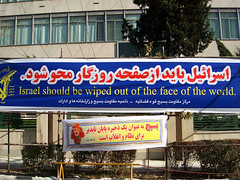
At the same time, Iranian president Mahmoud Ahmadinejad, the leading Iranian proponent of its nuclear program, continues to call for Israel’s destruction. What worries the Israelis is that Ahmadinejad claims a mystical connection to the last Shia Imam, Muhammad al-Mahdi, and appears to believe that a cataclysmic event, such as a nuclear war with Israel, might bring about his return to earth. While Ahmadinejad does not hold the top post in Iran—that position is held by the Supreme Religious Leader, Ayatollah Khamenei—the fact that Khamenei has just endorsed Ahmadinejad for reelection is yet another concern for Israel. Despite some grumbling in Iran about the difficult economic situation (high unemployment and 26.1 percent inflation),the Khamenei endorsement most likely means that Ahmadinejad will win the next Iranian presidential elections, which are scheduled for the spring of 2009. With that victory, any hope that Iran might moderate its policies toward Israel, and make concessions about its nuclear program, will evaporate.
Meanwhile, as Israeli apprehension grows, the United States appears not only unwilling to use force itself against Iran, but is also trying to put the brakes on any Israeli attack on Iran. U.S. Secretary of Defense Robert Gates has repeatedly stated that diplomacy, not military action, should be the preferred means of dealing with Iran—apparently overlooking the fact that diplomatic activity has been a total failure up until now. In June, two leading U.S. officials, Mike McConnell, the U.S. National Intelligence Director, and Admiral Mike Mullen, the Chairman of the Joint Chiefs of Staff, visited Israel, reportedly telling the Israelis that Iran was not yet able to build a nuclear weapon and, in any case, an Israeli attack would “damage US national interests.” They repeated some of the main arguments against an Israeli attack:
- It would only retard for a short time, and not eliminate, the Iranian nuclear program, because many of the installations are hidden.
- It would rally public support around the unpopular Ahmadinejad regime.
- It would have “unpredictable consequences.”
- It would undermine U.S. policy in Iraq and Afghanistan and threaten US bases in the Persian Gulf.
The first three of these arguments are weak, if not specious. The Mossad has been working for more than two decades in Iran, and if anyone knows where Iran’s secret installations are, it is Israel. Consequently, an Israeli strike, most likely carried out by Israel’s air force and cruise-missile-firing submarines, is likely to deal a long-lasting blow to Iran’s nuclear installations—one lasting far longer than the two months to two years reportedly cited by the United States.
Second, with Ahmadinejad now backed by Khamenei for reelection, public opinion in Iran doesn’t really matter because Khamenei has the power to fix an election in favor of Ahmadinejad.
The third argument, of “unpredictable consequences,” is equally problematic. What is usually meant by this is that Iran will close the Straits of Hormuz, causing oil prices to skyrocket. What is forgotten here is that if a confrontation between Iran and the United States is inevitable—as I believe it is—then the time to confront Iran is before it obtains nuclear weapons, not afterwards, when its capability of wreaking havoc with oil prices will be far greater. A non-nuclear Iran will be able to close the Straits of Hormuz for only a limited period—days or weeks at the most—while a nuclear Iran could close them indefinitely.
The final argument, that an Israeli attack could harm U.S. interests in Iraq, Afghanistan and the Persian Gulf, carries more weight. There is no question but that Iran has influence in both Iraq and Afghanistan, and that its missiles have the range to hit U.S. bases. Iranian aid to Shia forces in Iraq could complicate the improving military situation there and delay the transfer of U.S. troops from Iraq to Afghanistan. Iran could also complicate the intensifying conflict between NATO and the Taliban in Afghanistan.
Yet if Iran plays these cards—it is already smuggling weapons and instructors into Iraq—the United States would have the opportunity to attack the bases of the Iranian Revolutionary Guard from which Iranian military aid flows into Iraq; and if Iran fires missiles at U.S. bases in the Persian Gulf, the United States, even if it doesn’t intercept all the Iranian missiles, could strike a major blow at Iranian military bases throughout Iran, something that would reduce Iran’s military capability and its ability to threaten U.S. allies in the Persian Gulf. Such a response, far from rallying the Iranian population around the Islamic regime, may bring about its demise.
In sum, the dispute over attacking Iran’s nuclear installations has caused a growing gap between the United States and Israel. Whether it will cause a major crisis between Israel and its most important ally is a very open question.
Comments are limited to MESH members and invitees.
One Response to “Growing U.S.-Israel gap on Iran”
 Posts+Comments
 Posts+Comments
 Posts+Comments
 Posts+Comments
I could not agree more with Robert O. Freedman that the time to confront Iran is before it obtains nuclear weapons, not after, but the question remains what type of confrontation will be required and especially whether it will include military action. While diplomacy has certainly not succeeded in dissuading the Iranians from continuing with their program to date—indeed, they have defiantly accelerated it—I still believe that Iran may be dissuadable, given sufficient international pressure.
Iran does not wish to be an international pariah, an eventuality which fits neither its self-image as a great historical power, nor its more mundane needs as an aspiring political and economic power. Iran does care about its citizenry, and is neither a North Korea nor Saddam’s Iraq. Until now, however, it has not been called upon to pay much of a price and has thus not had sufficient reason to forgo the nuclear program, instead eating its (yellow) cake and having it too. Russia, as Freedman correctly points out, has no intention of playing ball in the Security Council, but this has nothing to do with the recent events in Georgia and has been its long-standing policy. The only way to change that might be for the United States to engage it as a legitimate partner and address its concerns and interests, rather than trying to force it to swallow totally outdated and gratuitous acts—such as NATO expansion right on its borders and an anti-missile system that might be rendered unnecessary to begin with, were the United States to bring Russia on board the anti-Iran campaign.
Notwithstanding my remarks above, it is quite possible that Iran’s strategic interests in having nukes are such that no combination of positive or negative inducements can dissuade it from its nuclear program The answer, however, to the extent that one exists, lies in extra-UN pressures, beginning with greatly heightened Western sanctions, followed by a U.S. naval blockade and—only if this fails—possible direct military action. The timeline to an Iranian nuclear capability is certainly growing shorter, and while graduated, the process will have to be relatively short: in a worst-case scenario, something on the order of a year; in a rosier one, a few years. So far the Iranian program has proven lengthier than the worst-case scenario proponents had feared, but at some point, most likely during the next administration’s first term, it will happen.
We have to be ready. The next administration should also pursue a dialogue with Iran, not because it will succeed—it will probably not—but because the serious measures that will be required will only be feasible when U.S. domestic and international opinion is convinced that all other measures have been truly exhausted.
I do not believe, as Freedman implies (possibly unintentionally), that anyone in a position of responsibility in Israel is agog at the thought of military action. Yes, Israelis probably approach it with a greater sense of resignation and willingness to contemplate the possibility, but no one in Israel is cavalier about this or deludes themselves that it will be another Osirak. It will not. As the old expression goes, nothing concentrates one’s thinking like having a loaded gun at one’s head, and this is precisely how Israel perceives an Iranian nuclear capability. That said, I believe there is a military option—one that involves fewer costs than many assume—as I explained in an earlier post.
Chuck Freilich is a member of MESH.