Waiting for the dust to settle over Gaza
Jan 24th, 2009 by MESH
From Alan Dowty
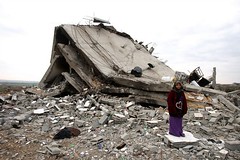 There seems to be a general sense that the Gaza war is over. The shooting has stopped, at least for the most part, at least for now. The pundits, not excluding this one, are lining up to declaim. But in some respects all this is a bit premature; the outcome is not yet totally clear. This is not over yet.
Consider the perspective of the simple central question: has Israel achieved the aims for which its campaign was presumably waged? There is the obvious problem that these aims were stated in various and even conflicting ways, but leave that aside for the moment. What would an interim assessment say about what Israel has gained or not gained?
- Stopping the rockets. For the moment the hail of rockets on Israel’s bordering areas—now extending to Beer-Sheva and Ashkelon—has ceased, and it can reasonably be claimed that a measure of deterrence has been established. (It might be pointed out that the much-criticized 2006 war on Hezbollah also achieved this.) Hamas will probably be much more hesitant to provoke another such response in the near future.
- Shutting down weapons smuggling. This is where the dust has not settled, and it will be critical to history’s judgment about whether the campaign was a success for Israel, or a victory for Hamas. The campaign ended only after Israel had obtained important agreements and assurances on precisely this issue from the United States, Europe, and above all from Egypt. But it remains to be seen whether the border with Egypt will be sealed to illicit traffic in arms; on the basis of past experience and the latest reports, one is permitted to be skeptical. The task is doable; nations that have shut down thousands of miles of international frontiers could surely cope with an eight-mile corridor. But some doubt the seriousness of Egypt in addressing the flow of weapons that come through Egyptian ports and territory. We will see.
- Weakening Hamas. This, too, remains to be seen. Obviously Hamas is significantly weakened militarily in Gaza, at least for now. We do not yet know if it is significantly weakened politically there, despite loud claims on both sides of the issue. Time will tell. We do know that Hamas appears to have been strengthened politically elsewhere and most critically in the West Bank, where the Palestinian Authority has been significantly undercut. By all accounts, it would be extremely foolish to encourage the holding of new West Bank elections anytime soon.
- Overthrowing Hamas. There is already the predictable refrain from some on the Israeli right: we didn’t go far enough. Critics claim that having invested so much in blood, treasure, and international standing, Israel again failed to complete the job by totally humiliating Hamas or by ejecting it from power. Total humiliation of a movement that defines simple survival as a victory is highly problematic, but “regime change” in Gaza, by military means, was and is a phantasm. It could be achieved only by total Israel reoccupation of Gaza, which few advocated, even among the most pedigreed hawks. No regime installed in Gaza by Israel would be tenable.
So the jury is still out. Much depends on whether the weapons trade can in fact be stifled, and the Egyptian-Gaza border re-established. To achieve this end, Israel may have to concede more than it would like on the issue of an open flow of legitimate goods across the border crossings—given the centrality of a partial blockade to the long-term aim of weakening Hamas economically and thus politically. But limiting the rearming of Hamas should, and probably will, have priority.
The long-term strategy for fostering the re-emergence of a credible Palestinian peace partner will have to revolve around the strengthening of the Palestinian Authority in the West Bank. This idea is featured in the Likud platform (not that other parties oppose it)—and this fact will probably be of increased relevance after the Israeli election on February 10.
Comments are limited to MESH members and invitees.
2 Responses to “Waiting for the dust to settle over Gaza”
 Posts+Comments
 Posts+Comments
 Posts+Comments
 Posts+Comments
Thanks to Alan Dowty for getting the speculation ball rolling. My crystal ball is always extremely cloudy, but I am cautiously hopeful on two counts.
If Israel has succeeded in stopping the rocket fire, then it has won. Having gone this far, Israel will have no choice but to take more drastic action—up to reoccupation—if the fire resumes. The range of the missiles grows, and the country cannot simply endure this endless barrage. Militarily, Hamas showed nothing, so I am inclined to doubt it will provoke another round.
As for the tunnels, I doubt that the smuggling will be stopped. There are simply too many players involved: Egypt, the United States, Europe. This diffusion of responsibility guarantees failure. But so what? If Hamas reloads its weapons but dares not fire them, how serious is that?
The other part of my optimism is that Hamas has been weakened. Never mind the quotes in today’s dailies. Never mind the feeling of the moment. Hamas has above all one thing to offer the people: that it will fight to the end to win Palestine from river to sea. If, having brought down this much destruction, Hamas is reduced to smuggling weapons it dares not fire, then it is broken. As for overthrowing Hamas, I am not optimistic. You can’t beat something with nothing. And Fatah today is next to nothing.
Joshua Muravchik is a member of MESH.
I am in agreement with Alan Dowty’s balanced analysis. As with everything else in the Middle East, there is no simple black or white answer to what really happened. I believe that Israel, by showing the cost of ongoing rocket fire, has restored some measure of deterrence, but given Hamas’s fundamental nature as an organization, that it will be short-lived, a year or two if we are really lucky. Hamas does not care about the suffering of the Gazan population, except in a utilitarian way in as much as it reflects on its own standing. Indeed, pain and destruction are an integral part of its overall and long-term strategy. So given the heavy price, they will probably play it carefully for a limited period, waiting for the opportune timing and for memories to fade a bit, before initiating the next round.
I believe the international “role” in preventing smuggling is little more than a political cover that Israel needed to declare victory. The French navy will not succeed in preventing smuggling that the Israeli navy has not been able to prevent, and the tunnels will be rebuilt in short order. Even when Israel was in full control of the Philadelphi Corrdior it was unable to uncover them all, so let’s be realistic, Hamas will be back in the smuggling game very soon. Actually, it already is.
There are two crucial points which were not raised in Dowty’s piece or Muravchik’s response: the Iranian dimension of the recent round and its impact on the future of the “peace process” which President Obama intends to prosecute “aggressively.” Operation Cast Lead is the first round with an Iranian proxy in many years that Israel can view as having been effectively waged and having ended positively–not a clear-cut victory, but a good one given the circumstances. This will give the Iranians some pause, somewhat stem the rising tide of the their successes, but will not fundamentally change the situation. They will undoubtedly draw the right (wrong) conclusions and Hamas will soon be armed with missiles capable of hitting Tel Aviv. The big issue remains the nuclear program, and this continues unabated and unaffected by the recent round.
If it was almost impossible to see how the peace process could have been promoted before recent events, the problem is even greater now and casts serious doubts on President Obama’s well-meaning if presumably futile intentions. At the same time, wars and major operations do shake things up and sometimes allow for previously unattainable movement. The immediate threat to Abu Mazen’s ongoing presidency (which officially ended in early January) has been removed by events, and he may be able to stick around for a while longer. As things stand today, Hamas would probably win presidential elections and the likelihood of a Netanyahu led government following the upcoming elections also does not bode well for greater flexibility on the Israeli side. So the focus should be on capacity-building in the West Bank, which is underway in recent months, and maybe on settlements. Anything beyond that is probably expecting too much.
Personally, I would like to see Israel end the embargo on Gaza; it has not succeeded and has only damaged Israel’s stature. There is no point sticking to a position, justified though it may be, if it does not work and Israel will in all likelihood have to go in again in the not-distant future, at which time world opinion will remain important.
Chuck Freilich is a member of MESH.