• Home
  • About MESH
  • Members
  • Papers
  • Contact

Middle East Strategy at Harvard

National Security Studies Program :: Weatherhead Center

Feed on
Posts
Comments

Hezbollah: narco-Islamism

Mar 22nd, 2009 by MESH

From Matthew Levitt

Earlier this month, the United Kingdom announced that it is reopening dialogue with the political wing of Hezbollah. Unlike the United States, the United Kingdom has only banned Hezbollah’s terrorist (External Security Organization) and military wings. The ban on the terrorist wing came in 2000, while the ban on the military wing only came in June 2008 in response to Hezbollah’s “providing active support to militants in Iraq who are responsible for attacks both on coalition forces and on Iraqi civilians, including providing training in the use of deadly roadside bombs,” for plots to kidnap British security workers in Iraq, and for its support for terrorist activity in the Palestinian Territories.

Meanwhile, the European Union has not yet designated any part of Hezbollah—military, political or otherwise—although it did label Imad Mughniyeh, the late Hezbollah chief of external operations, and several other Hezbollah members involved in specific acts of terrorism.

But despite the differences between U.S. and European perceptions of and policies toward Hezbollah, there is one critical area where all parties’ mutual interests converge, namely law enforcement. Regardless of divergent political considerations or definitions of terrorism, combating crime and enforcing sovereign laws are straightforward issues. More than any other Islamist group, Hezbollah has a long record of engaging in criminal activity to support its activities. The United States and its European counterparts have a particularly strong shared interest in combating the group’s increasing role in illicit drug trafficking.

Just this past week Admiral James G. Stavridis, the Commander of U.S. Southern Command who has now been nominated to head NATO troops as Supreme Allied Commander Europe, testified before the House Armed Services Committee about the threat to the United States from the nexus between illicit drug trafficking—”including routes, profits, and corruptive influence”—and “Islamic radical terrorism.” While Hezbollah is involved in a wide variety of criminal activity, ranging from cigarette smuggling to selling counterfeit products, the connection between drugs and terror is particularly strong. According to the U.S. Drug Enforcement Administration (DEA), 19 of the 43 U.S.-designated Foreign Terrorist Organizations are definitely linked to the global drug trade, and up to 60 percent of terror organizations are suspected of having some ties with the illegal narcotics trade.
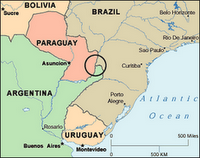
Hezbollah is no exception to this statistic, and in recent years has augmented its role in the production and trafficking of narcotics. Hezbollah has utilized the vast Lebanese Shi’a expatriate population, mainly located in South America and Africa, to its advantage. According to Michael Braun, former assistant administrator and chief of operations at the DEA, “Both Hamas and Hezbollah are active in this [Tri-Border] region [see map at right], where it is possible to make a profit of $1 million from the sale of fourteen or fifteen kilos of drugs, an amount that could be transported in a single suitcase.”

For example, Admiral Stavridis’s testified that in August 2008, the U.S. Southern Command and the DEA, in coordination with host nations, targeted a Hezbollah drug trafficking ring in the Tri-Border region of Argentina, Brazil and Paraguay. In August 2008, the United States, in cooperation with Colombian investigators, identified and dismantled an international cocaine smuggling and money laundering ring based out of Colombia. This operation, which was made up of a Colombian drug cartel and Lebanese members of Hezbollah, used portions of its profits—allegedly hundreds of millions of dollars per year—to finance Hezbollah.

Such revelations should not surprise. Back in December 2006 the U.S. Treasury listed Sobhi Fayad as a Specially Designated Terrorist. Why? Because, Treasury informed, “Fayad has been a senior TBA [Tri-Border Area] Hezbollah official who served as a liaison between the Iranian embassy and the Hezbollah community in the TBA. He has also been a professional Hezbollah operative who has traveled to Lebanon and Iran to meet with Hezbollah leaders. Fayad received military training in Lebanon and Iran and was involved in illicit activities involving drugs and counterfeit U.S. dollars.”

Africa is additionally becoming an area of concern regarding terrorist groups engaged in drug trafficking. According to Admiral Stavridis, drug traffickers have expanded their presence in West Africa as a “springboard to Europe.” Hezbollah has long maintained a strong presence in Africa, and has utilized Africa as a strategic point to from which to raise and transfer funds and to engage in criminal enterprises, such as diamond smuggling.

The nexus between drug trafficking and terrorist activities—specifically those of Hezbollah—represent an immediate law enforcement challenge for the United States and its European allies. While the Europeans may not view Hezbollah as a terrorist organization, they are certainly eager to prevent Hezbollah from running criminal enterprises within their borders. Countries are particularly determined to prevent the importation of illegal narcotics across their borders, whether by organized criminal networks, terrorists groups, or the hybrid narco-terrorist networks that DEA officials describe as “meaner and uglier than anything law enforcement or militaries have ever faced.”

So while there is no common understanding between the United States and the United Kingdom on whether or how to engage Hezbollah or even how to classify Hezbollah and its various component parts, there is no “gray area” as to whether drug trafficking is illegal. The United Kingdom and other European nations are no less eager than the United States to combat the flow of drugs into their countries and to prevent Hezbollah from operating criminal enterprises within their territory.

The British decision to openly engage Hezbollah politically is misinformed, to be sure. But do not be surprised if the Brits talk to Hezbollah “political” leaders on the one hand while arresting some of their cohorts involved in illicit narcotics on the other. Officials may openly describe these actions as targeting criminals, not Hezbollah, but the effect will be much the same.

Posted in Hezbollah, Lebanon, Matthew Levitt, United Kingdom | No Comments

Comments are closed.

  • This Site

    Middle East Strategy at Harvard (MESH) is a project of the National Security Studies Program at the Weatherhead Center for International Affairs.
    • Read about MESH
    • MESH blog
    • Search MESH with Google
    • Download entire blog (pdf)
  • Last Post

    • • MESH in hibernation by Stephen Peter Rosen and Martin Kramer
  • Subscribe

    Subscribe to MESH by email Posts+Comments
    Feed Posts+Comments
    Subscribe to MESH by email Posts+Comments
    Posts+Comments
    AddThis Feed Button
  • RSS MESH Pointers

    • • Iraq: Appeals Court Modifies Election Reinstatement
    • • Egypt: Shake-Up in Human Rights Council
    • • Army Deployments to OIF and OEF
    • • NYT: Iran's Two-Edged Bomb
    • • Joint Statement By the European Union and the United States Calling on the Iranian Government to Fulfill its Human Rights Obligations, February 2010
  • Posts by Category

    • Administration (5)
    • Announcements (24)
    • Countries (248)
      • Afghanistan (11)
      • Arab Gulf (11)
      • Bahrain (1)
      • Caucasus (5)
      • Central Asia (2)
      • China (3)
      • Egypt (25)
      • France (2)
      • India (1)
      • Iran (79)
      • Iraq (36)
      • Israel (95)
      • Jordan (9)
      • Lebanon (28)
      • Pakistan (8)
      • Palestinians (52)
      • Qatar (1)
      • Russia (13)
      • Saudi Arabia (14)
      • Syria (18)
      • Turkey (15)
      • United Kingdom (3)
      • Yemen (5)
    • Members (270)
      • Adam Garfinkle (22)
      • Alan Dowty (19)
      • Andrew Exum (11)
      • Barry Rubin (14)
      • Bernard Haykel (9)
      • Bruce Jentleson (6)
      • Charles Hill (3)
      • Chuck Freilich (15)
      • Daniel Byman (17)
      • David Schenker (16)
      • Gal Luft (9)
      • Harvey Sicherman (11)
      • Hillel Fradkin (8)
      • J. Scott Carpenter (15)
      • Jacqueline Newmyer (6)
      • Jon Alterman (13)
      • Josef Joffe (17)
      • Joshua Muravchik (10)
      • Mark N. Katz (22)
      • Mark T. Clark (15)
      • Mark T. Kimmitt (6)
      • Martin Kramer (25)
      • Matthew Levitt (15)
      • Michael Doran (4)
      • Michael Horowitz (9)
      • Michael Mandelbaum (12)
      • Michael Reynolds (14)
      • Michael Rubin (8)
      • Michael Young (16)
      • Michele Dunne (16)
      • Philip Carl Salzman (32)
      • Raymond Tanter (17)
      • Robert O. Freedman (20)
      • Robert Satloff (17)
      • Soner Cagaptay (4)
      • Stephen Peter Rosen (13)
      • Steven A. Cook (14)
      • Tamara Cofman Wittes (18)
      • Walter Laqueur (21)
      • Walter Reich (11)
    • Subjects (274)
      • Academe (4)
      • Books (40)
      • Counterinsurgency (14)
      • Culture (21)
      • Democracy (16)
      • Demography (5)
      • Diplomacy (20)
      • Economics (1)
      • European Union (3)
      • Geopolitics (42)
      • Hamas (21)
      • Hezbollah (25)
      • Intelligence (10)
      • Islam in West (5)
      • Islamism (16)
      • Maps (27)
      • Media (5)
      • Military (19)
      • Nuclear (27)
      • Oil and Gas (14)
      • Public Diplomacy (10)
      • Qaeda (23)
      • Sanctions (8)
      • Taliban (3)
      • Technology (2)
      • Terminology (9)
      • Terrorism (30)
      • United Nations (7)
  • Archives

    • December 2009 (5)
    • November 2009 (13)
    • October 2009 (8)
    • September 2009 (9)
    • August 2009 (9)
    • July 2009 (9)
    • June 2009 (12)
    • May 2009 (16)
    • April 2009 (11)
    • March 2009 (16)
    • February 2009 (11)
    • January 2009 (10)
    • December 2008 (12)
    • November 2008 (11)
    • October 2008 (19)
    • September 2008 (15)
    • August 2008 (17)
    • July 2008 (18)
    • June 2008 (12)
    • May 2008 (17)
    • April 2008 (20)
    • March 2008 (27)
    • February 2008 (19)
    • January 2008 (18)
    • December 2007 (19)
  • Maps

    • Online atlas in construction
    Latest additions:
    Scriptless Flickr Badge Scriptless Flickr Badge
    Scriptless Flickr Badge Scriptless Flickr Badge
    Scriptless Flickr Badge Scriptless Flickr Badge
  • RSS Latest Iran

    • • Iran boosts nuclear enrichment, drawing warnings (AP)
    • • Obama turns up the heat on Iran (AFP)
    • • Obama says world moving quickly on Iran sanctions (Reuters)
    • • Iran sentences another activist to death (AP)
    • • Defiant Iran starts enriching uranium to 20 percent (AFP)
  • RSS Latest Levant

    • • NY Times editor rejects call to remove Jerusalem bureau chief (AFP)
    • • Netanyahu's government tries to save settler house (AP)
    • • Police arrest rock-throwing Palestinians in Jerusalem (AFP)
    • • Israel FM says talks with Palestinians likely soon (AFP)
    • • Palestinian force makes gains in West Bank (AP)
  • RSS Latest Iraq

    • • US military deaths in Iraq war at 4,375 (AP)
    • • Iraq to open 10-15 posts in Jordan as part of worldwide vote (AFP)
    • • Iraq launches fourth state oil firm (AFP)
    • • British PM to face Iraq inquiry in early March (AFP)
    • • Most banned Iraqi poll candidates' appeals rejected (Reuters)
  • RSS New York Times

    • • U.S. Eyes Sanctions on Revolutionary Guards to Curb Iran’s Nuclear Plans
    • • Arrests by Iran in Bid to Quell Wide Protests
    • • Small Step in Iran’s Nuclear Effort Suggests Ambitions for a Weapon, Experts Say
    • • In Northern Iraq, a Vote Seems Likely to Split
    • • World Briefing | Middle East: Egypt: Police Arrest 3 Top Figures of a Powerful Opposition Group
  • RSS Washington Post

    • • Former boy soldier, youngest Guantanamo detainee, heads toward military tribunal
    • • More tolerance for gay troops as end of 'don't ask, don't tell' is debated
    • • U.S., allies moving quickly on sanctions against Iran, Obama says
    • • Analysis: Iranian plan will put nation a step closer to having material for bomb
    • • Iran's president orders production of higher-enriched uranium
  • RSS NPR

    • • Obama: U.S. Preparing 'Significant' Sanctions On Iran
    • • Understanding Iran, 31 Years After Revolution
    • • Seeking A Kinder, Gentler Image For Israel
    • • Iran Takes Next Step In Uranium Enrichment
    • • Iran's Nuclear 'Good-Cop, Bad-Cop' Routine
  • Harvard Events

    Check upcoming events from the calendars of...
    • Weatherhead Center for International Affairs
    • Center for Middle Eastern Studies (CMES)
    • Belfer Center for Science and International Affairs
  • RSS Weatherhead

    • • An Anatomy of International Trade: Evidence From French Firms
    • • Lessons from the Global Financial Crisis
    • • From Farmer to Agro-Industrialist: the Evolution of the Argentine Agriculture and Its Future
  • RSS CMES

    • • Lecture by Stephen P. Cohen
    • • Why History Matters: International Law and the Origins of the Arab-Israeli Conflict
    • • Building the Big Tent: Islamist Politics and the Imperative of Inclusion
    • • Reading by Stephanie Saldana: The Bread of Angels, A Journey to Love and Faith
    • • LGBT Rights in Israel, Aeyal Gross
    • • Women and Fiqh
    • • Teaching Resources on the Ancient Middle East Region
  • RSS Belfer

    • • Building a Next Generation Nuclear Material Security Framework
    • • CANCELLED A Transitional Strategy for Success in Afghanistan
    • • Israel, the Palestinians and the One-State Agenda
    • • Justice Denied: Amnesty, Pardons, and Prosecutions in Post-apartheid South Africa
    • • Caspian Energy: Phase II
    • • History and Policy in the Nuclear Age
    • • No One in Charge: Coordination in Stabilization and Reconstruction Operations and Peacebuilding
    • • TICKETED FORUM: A conversation with Valerie Jarrett
    • • A public address by: The Honorable Henry Paulson
    • • Balancing at Sea: Do States Ally Against the Leading Global Power?
  • Sponsor

  • Host

  • Rights

    Copyright © 2007-2009 President and Fellows of Harvard College
    Site Meter

Theme: MistyLook by Sadish


Protected by Akismet • Blog with WordPress

Bad Behavior has blocked 1 access attempts in the last 7 days.