Egypt, Iran, the United States: All politics is local
Apr 14th, 2009 by MESH
From Michele Dunne
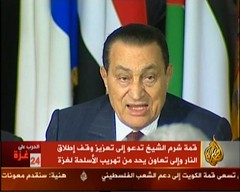 After several years in which Egypt seemed to have ceded the mantle of Arab leadership to Saudi Arabia (and even to small states such as Qatar), the octogenarian Husni Mubarak has become reenergized in the last few months. He came out swinging against Hezbollah last week, charging the Lebanese group with efforts to destabilize Egypt via terrorist attacks. He has pressed harder recently for a deal in Fatah-Hamas talks (see this article by Khaled Hroub in the Arab Reform Bulletin for more on the struggle between Egypt and Hamas). He took a forceful position in the Gaza crisis, despite deep opposition in Egypt and throughout the region.
What has changed? Has the Iranian threat to Egyptian interests finally become clear to Mubarak? Mubarak has lashed out at Hezbollah leader Nasrallah several times in the last few years, and perhaps views the current episode as a way to expose the dangers Hezbollah presents—and to get back at Nasrallah for his calls to Egyptians to rise up against Mubarak during the recent Gaza affair. Regarding the Iranian dimension, Mubarak has always been strongly suspicious of the Islamic Republic. Just last year he rebuffed the latest of repeated attempts by Iran to reestablish diplomatic relations, broken 30 years ago.
While Iran is a continuing worry, what seems to be motivating Mubarak now are two interests—one in foreign policy, one domestic—that are closely related. Mubarak’s renewed assertiveness suggests that he views the advent of the Obama administration as an opportunity to reestablish his worth as a U.S. ally. By serving as the principal channel to Hamas, Mubarak has placed Egypt at the center of the Israeli-Palestinian issue, important to the Obama administration. And by taking on Hezbollah strongly, he has placed Egypt squarely on the correct side of the regional divide between allies of Iran and allies of the United States.
The curious thing, however, is that Mubarak does not really need to try this hard. The Obama administration came into office focused on rebuilding relationships that were tested by the policy disagreements and freedom agenda of the Bush era, and already has given signals of friendly intentions toward Cairo.
This brings us to the domestic Egyptian dimension of what Mubarak is up to. The next two years promise to be interesting and challenging ones in Egyptian politics. In autumn 2010 there will be parliamentary elections, which are likely to be at least as controversial as those of 2005 (in which the Muslim Brotherhood won over 20 percent of seats, in spite of government interference). In September 2011, Mubarak’s current presidential term finishes, and (assuming he is still with us) the 83-year-old president will have to decide whether to run again for another six-year term, step aside and encourage his son Gamal to run, or step aside and encourage someone else (perhaps a military or security figure) to run. What those three options have in common is that all will be deeply unpopular with the Egyptian public, because there is no expectation that the election will be freely contested.
While there is no reason to expect that opposition in Egypt will be strong enough to force Mubarak’s hand regarding presidential succession, it certainly would be helpful to him to have unambiguous U.S. support for whichever course he chooses. Also, keeping the Muslim Brotherhood cowed and defensive (whether through direct measures against the group or against its regional allies and ideological bedfellows) helps Mubarak clear the decks for whatever he plans to do. Playing the regional power game has its value, but keeping hold of power at home is the bottom line.
Comments are limited to MESH members and invitees.
3 Responses to “Egypt, Iran, the United States: All politics is local”
 Posts+Comments
 Posts+Comments
 Posts+Comments
 Posts+Comments
I’m not sure I agree with the domestic politics argument. Skeptical as I am of arguments that the world revolves around Washington, this gesture feels to me that it’s intended for inside-the-Beltway consumption. With all of the Egyptian delegations passing through Washington in recent months, it’s hard not to notice that Egypt is waging a charm offensive, perhaps to be capped with a presidential visit in the coming weeks. But charming the new administration means demonstrating Egypt’s indispensability to U.S. policy in the Middle East, which has sometimes proven a harder sell. The current campaign has all the elements of such a play, a trifecta that highlights cooperation on Arab-Israeli security, counterterrorism, and curbing Iranian influence in the Middle East.
As I argued in my recent newsletter, though, the U.S.-Egyptian bilateral relationship suffers from not having had a shared grand project at its core for some time. The current move by Egypt seems to me to be more about tactics than strategy, reinforcing a sense that this relationship isn’t about anything in particular rather than vital to U.S. national security.
None of this is intended to deny the domestic upside of what the Egyptian government is doing, only to suggest that the more important audience is along the Potomac rather than along the Nile.
Jon Alterman is a member of MESH.
I agree with Jon Alterman that Mubarak may be using the Hezbollah threat to demonstrate Egypt’s indispensability to Washington, as I indicated in my initial post. The further question I asked was why exactly Mubarak needs to work so hard at this now, when he already has a U.S. administration that is ready to embrace him. That is where the domestic political angle comes in. The need to secure presidential succession is now coloring many other issues, whether in domestic or foreign policy, and failing to take it into account leaves out a critical factor in understanding Egyptian actions and motivations.
Michele Dunne is a member of MESH.
I agree and disagree with both Michele Dunne and Jon Alterman. It’s clear that President Mubarak wants to kiss and make up with Washington, but it is not just a function of the Obama administration. Yes, Cairo’s policy over the last few years was to wait out the Bush administration because, in the words of one official, “anything that comes next has got to be better.” But Mubarak and company’s efforts to prove Egypt’s strategic value span the last few years of the Bush era as well as the first few months of President Obama’s term. Mubarak’s seconding of King Abdallah’s now famous (or infamous) Shi’a crescent remark; his stand on the Lebanon war; his refusal to bow to political pressure during Israel’s Gaza offensive; that senior Egyptian official stating bluntly, “we want to help Washington keep the Iranians busy with themselves”—all these were about placing Egypt on the right side of the regional divide, as Michele suggests.
I agree with Jon’s friendly critique of Michele’s contention that domestic political dynamics explain Mubarak’s sudden activism. The elections of 2010 and 2011 are important, but they do not seem to be the primary factor driving the Egyptians. There is something else going on here, and it is likely the Egyptian (and Saudi) mistrust of Washington’s now-stated policy of engagement with Tehran. While neither Cairo nor Riyadh wants Washington to take military action against Iran (or authorize the Israelis to do so), they are also quite concerned that any American dialogue with the Islamic Republic will come at Egyptian or Saudi expense. The Egyptians, although not as acutely paranoid as the Saudis (who worry that Washington wants to replace Riyadh with Tehran as its primary interlocutor), are nonetheless concerned that U.S.-Iran engagement will further erode Egypt’s regional position.
Mubarak’s tough talk on Hezbollah and Iran is an implicit way of signaling to the Obama administration not to get too carried away with engagement, because Tehran remains a very bad actor. Whatever problems might have developed in the U.S.-Egypt bilateral relationship over the last eight years, the Egyptian president is reminding his American counterpart that Cairo remains critical in creating a regional environment that makes it easier for the United States to exercise its power.
Steven A. Cook is a member of MESH.