Obama and Netanyahu: the agenda
May 15th, 2009 by MESH
From Robert O. Freedman
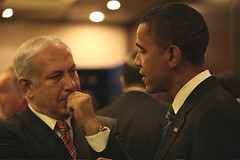 As Israeli Prime Minister Binyamin (Bibi) Netanyahu prepares to meet U.S. President Barack Obama on Monday, there are a number of issues on the table for discussion, including questions about Netanyahu’s willingness to accept a two-state solution to the Israeli-Palestinian conflict, Israel’s building of settlements and settlement outposts on the West Bank, and, of course, what to do about Iran. In addition, there is the question of rapport between the two leaders, one on the right wing of the political spectrum and the other on the left wing. Depending on how the meeting goes, the future of U.S-Israeli relations and the future of the Arab-Israeli peace process could be significantly affected.
To be sure, Obama has made a number of gestures to Israel and to the American Jewish community to set a positive tone for the meeting. Thus the United States refused to participate in the Durban II anti-racism conference because it appeared to be taking an anti-Israeli position. This decision involved some political cost to Obama because the Congressional Black Caucus was pushing for the United States to participate. In addition, The U.S. Justice Department dropped its four year old case against two ex-AIPAC staffers, Keith Weissman and Steven Rosen, who had been accused in 2005 on the very vague charge that they had conspired to disclose national defense information to those not authorized to receive it. The fact that the case was dropped on the eve of the annual AIPAC conference in Washington could only be seen as another gesture to Israel and to the American Jewish community.
While these gestures were important, the fact remains that Netanyahu is a right-of-center Israeli politician and Obama is a left-of-center American one, and there is a real question as to how they will get along. Gone are the warm personal relations between the conservative politicians George W. Bush and Ariel Sharon, and between the slightly left-of-center politicians Bill Clinton and Yitzhak Rabin. Indeed, Netanyahu faced a similar problem when he was prime minister from 1996 to 1999, when he had to deal with Clinton. Fortunately for Netanyahu at that time, he had the support of the Republican-dominated U.S. Congress, and for most of the Netanyahu period, Clinton was bogged down with the Monica Lewinsky affair. Netanyahu has no such cover this time. Obama is a very popular president with a strong Democratic Party majority in both houses of Congress, so Netanyahu’s room for maneuver is much more limited. The most Netanyahu can hope for, if he chooses to stonewall on the peace process, is that Obama will be so bogged down with the problems of the U.S. economy and the rapidly deteriorating situation in Afghanistan and Pakistan, that he will have little time to devote to the Middle East peace process.
These are the issues on the table for discussion:
1. The two-state solution to the Israel-Palestinian conflict. Obama has been pushing hard for Israel to accept the two-state solution, as has his special envoy to the Middle East George Mitchell. Vice-President Joe Biden, in comments to the AIPAC meeting stated, “Israel has to work for a two-state solution…. The status quo of the last decade has not served the interests of either the United States or Israel very well.” So far, Netanyahu has been non-committal, and with his government’s review of the peace process presumably now completed, it will be interesting to see how he responds to Obama’s pressure. Up until now, Netanyahu has been arguing that with Hamas controlling Gaza and a weak and corrupt Mahmud Abbas running the West Bank, the time is not right for the creation of a Palestinian state.
2. Settlements and settlement outposts. Obama, as many U.S. presidents before him, is strongly opposed to the expansion of settlements and the construction of settlement outposts (often more than a kilometer away from the original settlement), arguing that the expansion of the settlements takes away land that the Palestinians want for their state, and causes despair among the Palestinians. As Biden told AIPAC, “You’re not going to like me saying this, but don’t build more settlements, dismantle existing (settlement) outposts and allow Palestinians freedom of movement.” What is at issue currently is the so-called E-1 corridor between Maaleh Adumim and Jerusalem which would cut the West Bank virtually in half. Whether Obama will be willing to press Netanyahu on this will be an early test of their relationship.
3. Iran. This is perhaps the most difficult of the issues which the two leaders will face. Obama has been trying to use diplomacy to get the Iranian leadership to cease enriching uranium and answer IAEA (International Atomic Energy Agency) questions about their nuclear weaponization program. For their part, the Israelis claim that the Iranian leaders are stalling, and will continue to string out the United States in the talks until their nuclear weaponization program is completed. It will be interesting to note whether Obama and Netanyahu will agree on a deadline for Iran to comply with US wishes.
A related question is the nuclear non-proliferation treaty. Some in the Obama administration have been pressing Israel to sign the agreement so as to have its nuclear facilities inspected. The idea here seems to be that were Israel to sign, Iran would have one less excuse for its stalling. The problem from the Israeli perspective is that until Israel is at peace with all of its neighbors, including Iran, Israel needs its nuclear program as a deterrent against those countries, and especially Iran, that have sworn to destroy it.
Finally, in relation to Iran there is the question of timing. Netanyahu has been pushing for an Iran-first policy, arguing that if the Iranian nuclear program can be halted, that would weaken Hamas and Hezbollah, which are enemies of both Israel and the peace process. The Obama administration has countered that if there were a genuine Israeli-Palestinian peace process underway, it would weaken the appeal of Iran to the Sunni “Arab street,” and thus facilitate the peace process.
4. The Arab Peace Plan. The Obama administration has been praising parts of the Arab Peace Plan, which basically calls for Arab state recognition of Israel in return for Israel’s withdrawal to its pre-1967 war boundaries and a “just” settlement of the Palestinian refugee problem. The Israelis object not only to a complete withdrawal, which would conflict with Israel’s need for “secure borders” as noted in UN Resolution 242, but also to the Arab interpretation of the solution to the Palestinian refugee problem, which involves the return of the refugees to Israel, not to a Palestinian state on the West Bank and Gaza. The Obama adminstration has been pushing the Arabs to agree to aspects of normalization before a full Israeli withdrawal, but the Arab world is split on this, with Jordan favoring the U.S. idea and Syria opposing it.
5. Arab recognition of Israel as a “Jewish state.” While Netanyahu has agreed not to push for this as a prerequisite for negotiations to begin, he wants it as part of a final agreement. The Arabs, citing the 20-percent non-Jewish Arab minority in Israel, oppose it. To Netanyahu, this is a case of Israel’s legitimacy as a Jewish state and Israel’s acceptance in the Middle East, so it will be interesting to see if the United States is willing to expend any political capital to try to bring the Arabs around to the Israeli position on this.
6. U.S. aid to a Palestinian national unity government that includes Hamas representatives. Netanyahu has been opposing such aid because it would serve to legitimize Hamas, even as the organization continues to refuse to recognize Israel and calls for Israel’s destruction. The United States has gone back and forth on this issue, and Congressional pressure has limited Obama’s flexibility on it. While at the present time this is just an academic question because Hamas and Fatah are far from forming a unity government, the issue may well come up in the Obama-Netanyahu negotiations.
In sum, Obama and Netanyahu will have lots to talk about when they meet on Monday. Whether anything substantive will emerge from the discussions, or whether the two sides will decide just to set up negotiating teams to deal with these six issues, remains to be seen.
 Posts+Comments
 Posts+Comments
 Posts+Comments
 Posts+Comments