• Home
  • About MESH
  • Members
  • Papers
  • Contact

Middle East Strategy at Harvard

National Security Studies Program :: Weatherhead Center

Feed on
Posts
Comments

‘The Lebanese Army’

May 22nd, 2009 by MESH

MESH invites selected authors to offer original first-person statements on their new books—why and how they wrote them, and what impact they hope and expect to achieve. Oren Barak is senior lecturer in political science and international relations at the Hebrew University of Jerusalem. His new book is The Lebanese Army: A National Institution in a Divided Society.

From Oren Barak
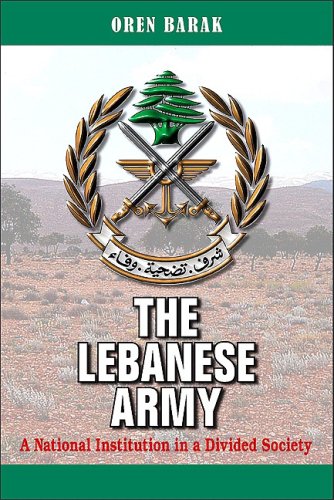
The puzzle that my book grapples with might be familiar to those who have seen Monty Python and the Holy Grail, a movie that came out in 1975, the same year that Lebanon’s civil war broke out:

Cart Master: Bring out yer dead.
[A customer puts a body on the cart]
Customer: Here’s one.
Cart Master: That’ll be ninepence.
Dead Person: I’m not dead.
Cart Master: What?
Customer: Nothing. There’s your ninepence.
Dead Person: I’m not dead.
Cart Master: ‘Ere, he says he’s not dead.
Customer: Yes he is.
Dead Person: I’m not.
Cart Master: He isn’t.
Customer: Well, he will be soon, he’s very ill.
Dead Person: I’m getting better.
Customer: No you’re not, you’ll be stone dead in a moment…

The “Dead Person” is Lebanon and the puzzle is how did this state, which so many observers had referred to as a “non-state state” (or a “failed state,” to use a more up-to-date term), manage to endure despite the long and devastating conflict (1975-90) and be resuscitated in its aftermath. The book suggests that the Lebanese Army has played a significant role in Lebanon’s survival.

Initially, I planned to write a more general account of Lebanon’s process of state formation, the causes for its “failure” in the 1970s and 1980s, and its reconstruction in the 1990s. But after some deliberation, I decided to focus on the Lebanese Army, which encapsulates these dramatic developments. After all, this was a military that was weak before the conflict, which had become paralyzed and nearly disintegrated along the lines of ethnicity, clan, and region in the initial stages of the war, but which managed to stay intact throughout this period and be successfully reconstructed in the postwar era. Indeed, today the Lebanese Army enjoys an unparalleled position in Lebanon, demonstrated not only by the widespread public support for its activities, such as the military operation that it launched against Fatah al-Islam, the radical Islamic faction in Tripoli, in 2007, but also in the election of the army commander, General Michel Suleiman, as Lebanon’s president in 2008.

It is important to note that this trajectory is markedly different from that of other military institutions in divided societies that witnessed intrastate conflict. In Yugoslavia, for example, the Yugoslav People’s Army disintegrated along with the state, and some of its men joined the various ethnic militias. Some of them, including high-ranking officers, soon perpetrated war crimes against their former compatriots. Although some Lebanese soldiers, too, joined various militias during the civil war, the bulk of the army’s personnel did not.

In order to solve the puzzle of the Lebanese Army’s endurance during the conflict, I decided to trace its origins from the creation of the first Lebanese military units by the French Army during the First World War until the attempts made by the Lebanese Army to restore Lebanon’s authority in the postwar era. Yet, when going through the vast resources that I gathered—the army’s bulletins, the Lebanese official gazette, memoirs and biographies of numerous Lebanese soldiers, Western archival material, the Lebanese and Arab press, and secondary works on Lebanon—I realized that any discussion of the history of the Lebanese Army (and of any military institution for that matter) must not limit itself to “objective” facts, but also relate to the ways that the army and its leaders—always conscious of the critical importance of history in the process of state formation—wished this past to be remembered.

Writing about a military institution in the Middle East, a region where security matters are still paramount, is no easy task. Yet, in the Lebanese case, I was struck by the wealth of resources on the army, most of which were previously untapped. Among others, this enabled me to collect biographical material on 4,453 officers who served in the Lebanese Army from its inception to the present in order to identify change and continuity in patterns of recruitment and military service. In this way, I was able to show that the Lebanese Army has gradually become more representative of the various sectors of Lebanese society—ethnic groups (or communities), large families (or clans), and regions—and this transformation preceded the political reforms that facilitated the ending of the conflict. Military institutions in divided societies, in other words, can be, and perhaps ought to be, representative institutions! I believe that this finding is relevant to other divided societies, including present-day Iraq.

In The Lebanese Army, I hope to achieve three main goals. The first is to call attention to the significant developments that have taken place in Lebanon in recent decades, and especially to the strengthening of the state’s institutions not only in the coercive sense but also in terms of their legitimacy. In my view, this process has considerable implications for Lebanon’s close neighbors, and especially for Israel, where many still treat Lebanon as a “non-state state.” A second goal is to encourage additional studies on military institutions—and on the realm of security generally—in divided societies, including most Middle Eastern countries. Finally, the book challenges scholars to rethink existing explanations for the “weakness” and “strength” of states in our times, as well as these concepts themselves. Lebanon, for one, is certainly not “dead” and there are many lessons to be learned from its experience.

Order from Publisher | Amazon | Excerpt

  • E-mail this story to a friend!
  • Facebook
  • Twitter
  • del.icio.us
  • Digg
  • Google Bookmarks
  • Technorati
  • StumbleUpon
  • Reddit

Posted in Books, Lebanon, Military | No Comments

Comments are closed.

  • This Site

    Middle East Strategy at Harvard (MESH) is a project of the National Security Studies Program at the Weatherhead Center for International Affairs.
    • Read about MESH
    • Search MESH with Google
    • Receive MESH by email
  • Latest Posts

    • • How the Saudis radicalized U.S. troops by Gal Luft
    • • Farewell and thanks by Tamara Cofman Wittes
    • • Obama’s missive to Iran by Philip Carl Salzman
    • • The real linkage: Afghanistan and Iran by Adam Garfinkle
    • • Bungled again: Israel and Goldstone by Alan Dowty
    • • Iran’s second front in Afghanistan by Raymond Tanter
  • Comments

    MESH invites comments from its members and other analysts.
    • Read about comments
  • Latest Comments

    • J. Scott Carpenter on Farewell and thanks
    • Michele Dunne on Farewell and thanks
    • Robert Satloff on Farewell and thanks
    • Stephen Peter Rosen and Martin Kramer on Farewell and thanks
    • Raymond Tanter on Obama’s missive to Iran
  • Subscribe

    Subscribe to MESH by email Posts+Comments
    Feed Posts+Comments
    Subscribe to MESH by email Posts+Comments
    Posts+Comments
    AddThis Feed Button
  • RSS MESH Pointers

    • • Wittes Named Deputy Assistant Secretary
    • • Embracing Karzai?
    • • Americans in Limbo in Turbulent Iran
    • • Free Markets, Free Muslims
    • • A Boatload of Trouble
  • Posts by Category

    • Administration (5)
    • Announcements (22)
    • Countries (241)
      • Afghanistan (11)
      • Arab Gulf (11)
      • Bahrain (1)
      • Caucasus (5)
      • Central Asia (2)
      • China (3)
      • Egypt (25)
      • France (2)
      • India (1)
      • Iran (76)
      • Iraq (35)
      • Israel (95)
      • Jordan (9)
      • Lebanon (27)
      • Pakistan (8)
      • Palestinians (52)
      • Qatar (1)
      • Russia (12)
      • Saudi Arabia (13)
      • Syria (18)
      • Turkey (15)
      • United Kingdom (3)
      • Yemen (3)
    • Members (262)
      • Adam Garfinkle (22)
      • Alan Dowty (19)
      • Andrew Exum (11)
      • Barry Rubin (14)
      • Bernard Haykel (9)
      • Bruce Jentleson (6)
      • Charles Hill (3)
      • Chuck Freilich (15)
      • Daniel Byman (16)
      • David Schenker (15)
      • Gal Luft (9)
      • Harvey Sicherman (11)
      • Hillel Fradkin (8)
      • J. Scott Carpenter (15)
      • Jacqueline Newmyer (6)
      • Jon Alterman (13)
      • Josef Joffe (17)
      • Joshua Muravchik (10)
      • Mark N. Katz (20)
      • Mark T. Clark (15)
      • Mark T. Kimmitt (6)
      • Martin Kramer (24)
      • Matthew Levitt (14)
      • Michael Doran (4)
      • Michael Horowitz (9)
      • Michael Mandelbaum (12)
      • Michael Reynolds (14)
      • Michael Rubin (8)
      • Michael Young (16)
      • Michele Dunne (16)
      • Philip Carl Salzman (32)
      • Raymond Tanter (16)
      • Robert O. Freedman (20)
      • Robert Satloff (17)
      • Soner Cagaptay (4)
      • Stephen Peter Rosen (13)
      • Steven A. Cook (14)
      • Tamara Cofman Wittes (18)
      • Walter Laqueur (20)
      • Walter Reich (10)
    • Subjects (268)
      • Academe (3)
      • Books (39)
      • Counterinsurgency (13)
      • Culture (21)
      • Democracy (16)
      • Demography (5)
      • Diplomacy (19)
      • Economics (1)
      • European Union (3)
      • Geopolitics (42)
      • Hamas (21)
      • Hezbollah (25)
      • Intelligence (9)
      • Islam in West (5)
      • Islamism (16)
      • Maps (27)
      • Media (5)
      • Military (19)
      • Nuclear (26)
      • Oil and Gas (13)
      • Public Diplomacy (10)
      • Qaeda (23)
      • Sanctions (6)
      • Taliban (3)
      • Technology (2)
      • Terminology (9)
      • Terrorism (30)
      • United Nations (6)
  • Archives

    • November 2009 (7)
    • October 2009 (8)
    • September 2009 (9)
    • August 2009 (9)
    • July 2009 (9)
    • June 2009 (12)
    • May 2009 (16)
    • April 2009 (11)
    • March 2009 (16)
    • February 2009 (11)
    • January 2009 (10)
    • December 2008 (12)
    • November 2008 (11)
    • October 2008 (19)
    • September 2008 (15)
    • August 2008 (17)
    • July 2008 (18)
    • June 2008 (12)
    • May 2008 (17)
    • April 2008 (20)
    • March 2008 (27)
    • February 2008 (19)
    • January 2008 (18)
    • December 2007 (19)
  • MESH Bookstore


    Recently featured:


  • Maps

    • Online atlas in construction
    Latest additions:
    Scriptless Flickr Badge Scriptless Flickr Badge
    Scriptless Flickr Badge Scriptless Flickr Badge
    Scriptless Flickr Badge Scriptless Flickr Badge
  • RSS Latest Iran

    • • U.S. says Iran shipped arms to Lebanese fighters (Reuters)
    • • Peres urges Brazil to counter Iran's threats (AFP)
    • • Iran frees Danish journalism student arrested during protest (AFP)
    • • Detained American's mom: Espionage claim is false (AP)
    • • Three-detained Americans entered Iran illegally: FM (AFP)
  • RSS Latest Levant

    • • U.S. says Iran shipped arms to Lebanese fighters (Reuters)
    • • Peres urges Brazil to counter Iran's threats (AFP)
    • • Palestinian vote, Abbas threat might be a bluff (Reuters)
    • • Brown, King Abdullah urge Israeli settlement halt (AFP)
    • • Netanyahu: Obama talks aided Israel security, peace (Reuters)
  • RSS Latest Iraq

    • • VA pays to settle lawsuit over Mich. vet's death (AP)
    • • Now that parliament approved elections, Iraqis are ambivalent (McClatchy Newspapers)
    • • Iraq touts for tourists at London fair (AFP)
    • • Iraqi PM: no election alliance with Shiite rivals (AP)
    • • Iraqi oil row 'unlikely to end before polls' (AFP)
  • RSS New York Times

    • An error has occurred; the feed is probably down. Try again later.
  • RSS Washington Post

    • • 3 Americans in Iran charged with spying
    • • Fort Hood suspect's links to imam under scrutiny
    • • Iraq passes crucial election law for 2010
    • • Numbness pervades a post accustomed to war, deaths
    • • Fort Hood suspect's links to imam under scrutiny
  • RSS NPR

    • • Kurds Renew Vigils For 'Disappeared' In Turkey
    • • Palestinians, Israelis Weigh Future Without Abbas
    • • Iraq Panel Proposes National Elections For Jan. 21
    • • Election Law Passes In Iraq, Setting Up National Vote
    • • Rough Road For Military Families With Special Needs
  • Harvard Events

    Check upcoming events from the calendars of...
    • Weatherhead Center for International Affairs
    • Center for Middle Eastern Studies (CMES)
    • Belfer Center for Science and International Affairs
  • RSS Weatherhead

    • • 'Conflict in Global Finance after the Meltdown: Reconciling Competing Priorities'
    • • 'When China Rules the World: The Rise of the Middle Kingdom and the End of the Western World'
    • • 'Sri Lanka After the LTTE'
  • RSS CMES

    • • Women’s Rights and Nationality Law in the GCC Countries and the Protection of Environment in Islam
    • • Documentary Screenings on Women and the 2009 Election in Iran by Rakhshan Bani Etemad
    • • Global Education, Human Rights and the Middle East Region
    • • Using Art Objects to Teach About Religion and Sacred Space
    • • Invisible Citizens: The Bedouin of the Negev
    • • Orientalist Art and Representational Realism
    • • Muslims in Europe and the US after 9/11: A Transatlantic Comparison
  • RSS Belfer

    • • Brown-bag lunch with Chrystia Freeland, U.S. managing editor, Financial Times.
    • • Prospects for the Upcoming UN Climate Conference in Copenhagen: Seminar with Ambassador Friis Petersen
    • • Counterinsurgency
    • • Afghanistan/Pakistan: Why Is Pakistan So Important? with Ambassador Nigel Sheinwald
    • • The two-state solution as the only promising solution
    • • Harvard Arab Weekend
    • • Public-Private Partnerships for Sustainable Transit: Mexico City’s Metrobus
    • • Agglomeration: Sneaking up on the Balance of Power?
    • • When China Rules the World: The Rise of the Middle Kingdom and the End of the Western World
    • • Marcelo Ebrard, Mayor of Mexico City: Sustainable Mega-Cities, Mexico City's "Plan Verde"
  • Sponsor

  • Host

  • Rights

    Copyright © 2007-2009 President and Fellows of Harvard College
    Site Meter

Theme: MistyLook by Sadish


Protected by Akismet • Blog with WordPress

Bad Behavior has blocked 1 access attempts in the last 7 days.