Disrupting Iran’s weapons smuggling
Nov 13th, 2009 by MESH
From Matthew Levitt
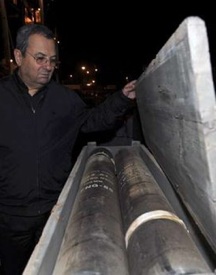 Even as the West seeks to engage Iran in negotiations over Tehran’s nuclear program, Iran continues to arm rogue regimes and terrorist groups in blatant violation of UN Security Council Resolution 1747. Such aggressive behavior on the part of Iran in support of terrorist groups and rogue regimes highlights a critical shortcoming of current international sanctions on Iran. In the latest case, last week, the Israeli Navy intercepted the Francop, a vessel carrying five hundred tons of weapons, including thousands of mortar shells and long range rockets believed to be bound for Hezbollah in Lebanon. Israeli officials released photographs of Katyusha rockets seized last week by UNIFIL forces in Lebanon that are the same make as those seized on board the Francop. According to U.S. officials, the arms shipment was “clearly manifested from Iran to Syria” in violation of a March 2007 UN arms embargo and provides “unambiguous evidence of the destabilizing proliferation of arms in the region.”
It is high time to back up the tough talk with action. The good news is that there are ways to effectively disrupt Iran’s international weapons smuggling. The question is whether the Francop episode will provide the political impetus for the international community to take action. Previous cases of Iranian arms smuggling prompted no such action.
Indeed, the Francop is just the most recent Iranian violation of UNSCR 1747’s ban on Iranian weapons trafficking. In January, the U.S. Navy stopped another vessel, the Monchegorsk, while it was transiting the Red Sea en route to Syria with components for mortars and thousands of cases of powder, propellant, and shell casings for 125mm and 130mm guns. The Monchegorsk was chartered by Islamic Republic of Iran Shipping Lines (IRISL) which, just four months earlier, the Treasury Department blacklisted for its proliferation activities, noting that IRISL “facilitates the transport of cargo for UN designated proliferators” and also “falsifies documents and uses deceptive schemes to shroud its involvement in illicit commerce.”
In recent years, a number of similar incidents exposed Iranian efforts to transport military materiel and arms by sea, land, and air to allies and surrogates. During the second Palestinian Intifada, Iran helped facilitate arms shipments to Gaza through Hezbollah and the Popular Front for the Liberation of Palestine to Gaza (by means of floating waterproof containers) by using two civilian vessels, the Santorini, seized by Israel in May 2001, and the Calypso 2. In January 2002, Iran attempted to deliver fifty tons of weapons to the Palestinian Authority aboard the Karine A, whose shipment was seized by the Israeli Navy in the Red Sea.
During the 2006 Hezbollah-Israel war, Israeli intelligence charged that Iran was resupplying the Shiite movement via Turkey. Such claims gained credibility in May 2007, when a train derailed by PKK terrorists in southeastern Turkey was found to be carrying undeclared Iranian rockets and small arms destined for Syria—possibly for transshipment to Hezbollah.
Existing UN and EU legal guidelines provide the authority to take action against Iran weapons smuggling, but on their own are insufficient. In February and April 2007, the EU imposed a number of sanctions on Iran in order to implement UN Security Council decisions, including a ban on Iranian transfers of military materiel, arms, and missile technology. Similarly, Resolution 1747, adopted in March 2007, prohibited the transfer of “any arms or related materiel” by Iran, and urged UN member states not to facilitate such efforts. In addition, Resolution 1803, passed in March 2008, calls upon all states, “in accordance with their national legal authorities and legislation and consistent with international law,” to inspect IRISL cargoes to and from Iran transiting their airports and seaports,” provided there are reasonable grounds to believe that the aircraft or vessel is transporting [prohibited] goods.”
Getting countries to act on these authorities, however, has been sketchy at best. As these cases indicate, serious gaps exist in the available policy tools to deal with Iranian arms transfers to its allies and surrogates. To close these gaps, the United States should work with its allies on multiple levels.
For example, the EU could expand its current policy banning the sale or transfer of arms to Iran to include a ban on the purchase or transfer of arms from Iran. Indeed, only the latter actually address the export of arms. Individual countries and regional organizations both—especially in South America and South and East Asia—should adopt legislation pertaining to Iranian arms and technology transfers, to enable them to fulfill their UN and EU obligations.
Government engagement with the private sector, drawing attention to the risk of doing business with IRISL, its subsidiaries, and other banned entities, could also have a significant impact. As the U.S. Treasury noted when it designated IRISL: “Countries and firms, including customers, business partners, and maritime insurers doing business with IRISL, may be unwittingly helping the shipping line facilitate Iran’s proliferation activities.” Since then, Dutch Customs automatically label merchandise shipped by IRISL or Iran Air at the highest risk category and inspect the cargo. Last month, the United Kingdom also sanctioned IRISL, banning British firms from doing business with the Iranian shipping line.
Given Iran’s history of deceptive financial and trade activity, extra scrutiny should be given to any ship that has recently paid a call to an Iranian port. Countries should be encouraged to require ports and/or authorities to collect detailed, accurate, and complete data regarding all cargo being shipped to or through their countries (especially from risk-prone jurisdictions like Iran), to conduct rigorous risk assessments, and to proceed with actual inspections as necessary. According to press reports, the Francop docked in Egypt before it was boarded some 180 kilometers of the coast of Cyprus.
Recent events show that even as the Obama administration seeks to engage Tehran, the Islamic Republic has continued to work to undermine Western interests and to support anti-Western elements around the world, as demonstrated by its ongoing efforts to resupply Hamas and Hezbollah and assist insurgents in Iraq and Afghanistan. Disrupting Iran’s ability to arm allies and surrogates hostile to the interests of the United States and its allies would enhance Washington’s leverage in possible negotiations with Tehran, contain Iran should such diplomatic efforts fail, and prevent Iran from contributing to the proliferation of nuclear weapons in the Middle East and beyond.
 Posts+Comments
 Posts+Comments
 Posts+Comments
 Posts+Comments