 RSS - Posts


“Youth is not a time of life; it is a state of mind”
The Birmingham Boys Choir is on tour in Japan this week. Among their pieces is a specially arranged version of the poem “Youth” by Samuel Ullman (1840-1924).
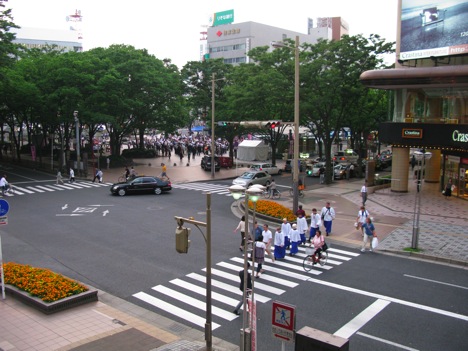
BBC singers heading to the concert hall in downtown Chiba on Saturday evening
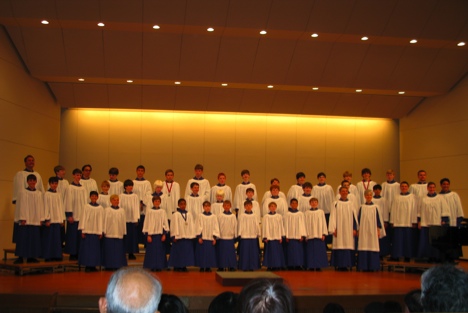
About to take a bow at the Chiba City Cultural Center (6/13/09)
Ullman’s story is a remarkable one. Jewish . . . German immigrant to Mississippi and, later, Alabama . . . Confederate soldier . . . businessman . . . father of six . . . advocate for laborers, women, and children . . . instrumental in the establishment of a high school for black children in Birmingham . . . lay rabbi . . . poet . . . This biographical sketch gives some of the broad brush strokes of that life story.
Ullman’s poem “Youth” has a story all its own. “Youth” was introduced among Japanese postwar leaders because of General Douglas MacArthur’s apparent love for it. The poem hung in his office in Japan along with pictures of George Washington and Abraham Lincoln, and MacArthur evidently introduced it to many Japanese who were instrumental in the rebuilding of Japan. This commemoration to Akio Morita of Sony (related to his contributions to the Samuel Ullman Museum) gives some idea of the poem’s personal significance to business leaders such as Morita, and why it is said to be included in “the top 5 texts loved by corporate management in Japan.”
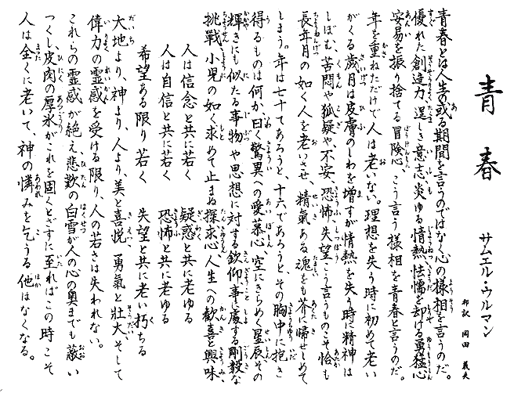
“Seishun” (“Youth”), by Samuel Ullman, translation by Yoshio Okada
Here are links to several Japanese versions of “Youth,” followed by the original English version:
3 well-known translations in print (with commentary on history of its translation)
Translation by Masa Shimamura (private version that is faithful to the original)
“YOUTH”
Samuel Ullman
Youth is not a time of life; it is a state of mind; it is not a matter of rosy cheeks, red lips and supple knees; it is a matter of the will, a quality of the imagination, a vigor of the emotions; it is the freshness of the deep springs of life.
Youth means a temperamental predominance of courage over timidity of the appetite, for adventure over the love of ease. This often exists in a man of sixty more than a boy of twenty. Nobody grows old merely by a number of years. We grow old by deserting our ideals.
Years may wrinkle the skin, but to give up enthusiasm wrinkles the soul. Worry, fear, self-distrust bows the heart and turns the spirit back to dust.
Whether sixty or sixteen, there is in every human being’s heart the lure of wonder, the unfailing child-like appetite of what’s next, and the joy of the game of living. In the center of your heart and my heart there is a wireless station; so long as it receives messages of beauty, hope, cheer, courage and power from men and from the infinite, so long are you young.
When the aerials are down, and your spirit is covered with snows of cynicism and the ice of pessimism, then you are grown old, even at twenty, but as long as your aerials are up, to catch the waves of optimism, there is hope you may die young at eighty.
—
If you would like to read more about Samuel Ullman and this poem, you might try Margaret E. Armbrester’s biography: Samuel Ullman and “Youth”: The Life, the Legacy


 JAYAMOHAN,
  Yasushi,
  (blank), and 9 others are discussing.
Zawa 5:05 pm on June 15, 2009 Permalink |
Sounds very interesting… 🙂
Mike Wilhelm 12:22 am on June 18, 2009 Permalink |
I like that poem. That is the first time I had read it.
nathaiel adap 8:43 pm on July 22, 2009 Permalink |
BEFORE MY FATHER DIED , THIS WAS THE POEM E WAS RECITING
Karyn 10:38 pm on October 12, 2009 Permalink |
Thanks for bringing this poem to my attention. I hope you will find time to give us some more posts!
sad emo and Love poems 10:51 am on March 23, 2010 Permalink |
I love this poem.This was recited on my class in English 3.Love this.
Anonymous 11:30 pm on April 3, 2010 Permalink |
During my college days.. we had a speech choir and we used this poem. Very Nice!
Do Something » 청춘(사무엘 울만) 11:32 pm on April 12, 2010 Permalink |
[…] 참고 : “Youth is not a time of life; it is a state of mind” […]
Rene Bernales 3:56 am on August 21, 2010 Permalink |
I read this poem when I was in high school back in 1997, (Fall Issue of the Reader’s Digest). I loved it and memorized it by heart, but the one I knew and memorized has a longer version of the poem and somewhat different in a way that it has more lines of words in it.
Is the above poem the “original” poem written by Samuel Ullman? and the one printed on the Reader’s Digest 1997 Fall Issue was a revised version? I want to know.
Randall Short 9:52 am on August 21, 2010 Permalink |
There are at least a couple of versions in circulation. A revised version became really popular overseas (especially in Japan) because that was the one that General Douglas MacArthur had. I’m not positive that the version I give is exactly the way Ullman penned it, but I think it is.
Here’s a link to a Japanese site that shows two versions (scroll down to see the English). According to this blogger, the first version on his page is the revised version that MacArthur had:
http://blogs.dion.ne.jp/mrgoodnews/archives/4816474.html
Let me know if you are able to confirm which one is original.
Poetry: Youth by Samuel Ullman (1840–1924) | Chestnut ESL HOME 2:33 pm on January 25, 2012 Permalink |
[…] THE POEM (SOURCE: blogs.law.harvard.edu) […]
Jerre Levy 5:32 am on August 14, 2012 Permalink |
The second version is the way Samuel Ullman wrote it and as it is published in a privately-published book given to Samuel Ullman by his family on his 80th birthday. I am one of his great-granddaughters. He was my mother’s paternal grandfather.
Anonymous 9:39 pm on July 7, 2013 Permalink |
thank
pau 10:15 pm on July 9, 2013 Permalink |
i also love the message of this poem….very well wrote…i want some poem like this one 🙂
Ahmer Zia 7:40 pm on May 17, 2014 Permalink |
I read this poem in for the first time in Reader’s Digest, India. I don’t remember which year it was, could have been between 1989 and 1992, when I was 15-18 years old. I loved this one so much. Although the gist of it remained in my mind since then, this is the first time again that I have revisited it in its full form and it feels so good to read it again..thank you for sharing
Randall Short 8:22 pm on May 17, 2014 Permalink |
Thank you very much for sharing your experience!
‘Youth’ by Samuel Ullman | Translating Japanese Conservatives 3:05 pm on June 5, 2014 Permalink |
[…] Source […]
i love you 9:04 pm on June 30, 2014 Permalink |
that was so great poem!!!!!!!!!
Anonymous 6:58 pm on July 1, 2014 Permalink |
thank you for making this heart touching poem.. 🙂 im so impressed
(blank) 10:51 am on September 2, 2015 Permalink |
AN awesome poem It almost made me cry, Such wonderful life youth is 🙂
Yasushi 4:07 pm on September 4, 2015 Permalink |
I wonder if “predominance of courage over timidity of the appetite, for adventure over the love of ease.” might have been “predominance of courage over timidity, of the appetite for adventure over the love of ease.” though all scripts I encountered were the first of these. “Timidity of the appetite” does not make sense to me. I wonder if it was a typo when the poem was published for the first time.
JAYAMOHAN 3:30 pm on March 24, 2016 Permalink |
Thanks. Read it in the 80’s. Yes Readers Digest, it was! Moulded my thinking around it. But lost it afterwards. Found it today while searching. What a blessing!