US Loosens Internet Restrictions on Iran and Cuba

Arguing that access to the flow of information on the Internet in Iran and Cuba is in line with US interests, the US Treasury has asked Google and Microsoft to give users in those two countries access to their chat services. This is a smart move, but just the beginning of what should be done to increase the flow on online speech in those countries.

Ethan Zuckerman fist noticed a disturbing trend earlier this year when Internet companies such as Bluehost and others began to use sanctions against countries like Zimbabwe, Iran, Syria and Sudan as an excuse to cut off service entirely to users in those countries, even if the users were human rights groups fighting against the governments that are the real target of the sanctions. Not long after he observed the problem in Zimbabwe, Bluehost shut out users in Iran, including leading bloggers like Kamangir. It seems that most firms, large and small, just shut off access to most of their products that require a software download out of fear of running afoul of US sanctions. In their cost-benefit analysis, it is just easier to shut off access and not look at the impact of those decisions on activists in those countries.

However, it seems that Microsoft has continued to allow citizens in Iran, Cuba and other sanctioned countries to use its Hotmail e-mail and Live Spaces blog service, since they are hosted in the cloud. This is possibly another argument in favor of cloud computing, where services are increasingly migrating lately, although it depends on where those services are hosted.

This is a good first step, but there is still much the US can do to ease restrictions on Internet speech and access to software and services provided by US companies in countries where we have the strictest sanction regimes.

Posted in Iran. No Comments »

Russian Ministry Wants ISPs to Filter Internet

Evegeny Morozov over at Foreign Policy recently shared this story from the Russian site InfoX.ru, which reports that Russia is considering technical filtering options. ONI research has not found technical filtering in Russia to date, so if this plan goes through it could be one of the
first known instances of technical filtering in Russia. The article quotes the head of the Russian Ministry of Communications at length, who argues that ISPs should filter the internet for ‘negative content’ at public access points in order to protect children, including one proposal to create white and black lists of sites. A source in the Ministry of Internal Affairs “K squad” (basically, their Internet police) seems to agree with the general idea, saying:

The Internet without filters should be closed, at least in schools.

The justification is found in the somewhat Orwellian sounding bill ‘On the Protection of Children from Information which is Harmful to their Health and Development,’ which is still being debated in the Duma. InfoX reports the following reaction on the bill:

‘In the bill it is said that users should prove how old they are, and based on that the Internet is opened. If a user is silent on this count, users are considered to be six years old,’ said Mark Tverdynin, a representative of the Regional Public Center for Internet Technologies, ‘How a user is going to prove how old they are is unclear.’

According to Mark Tverdynina, providers may terminate your access to many sites under threat of punishment after this law is adopted. ‘There is a danger that this could turn everything into an Intranet instead of an Internet,’ said the expert.

Mobile Phones Easier to Find Than Food for World’s Poor

This news from Foreign Policy’s Joshua Keating is pretty amazing. He writes that:

We’ve reached a very strange point in human history when it is assumed that people who don’t have access to food will have working cell phones.

He points to an announcement by the UN that it will use cell phones to send $22 vouchers to Iraqi refugee families in Syria every two months. They are provided with special SIM cards for the transactions, and the vouchers can then be exchanged for staples such as rice, flour, lentils, chickpeas, and oil at selected stores.

Perhaps expecting that eye brows might be raised at the idea that those needing food aid would have cell phones, the UN’s Emilia Casella reports, “all the 130,000 Iraqi refugees currently receiving food aid from the agency in Syria have mobile phones.”

UN Dispatch’s Matthew Cordell further points out that, according to the ITU, “worldwide at the end of 2008 there were 4.1 billion mobile phone subscriptions, buoyed by developing countries, where two-thirds of those subscriptions were used.” Even if most of us look at ITU data with a fair amount of skepticism, that is a pretty phenomenally high number of cell phone subscriptions, and stories like this seem to indicate that the digital divide may be shrinking faster than many of us expected.

Despite Circulation Numbers, Neither the Sky Nor the Republic is Falling

It has been all of about 15 minutes since we last heard someone bemoan the ‘death of newspapers’ or decide to hold yet another conference blaming the Internet for their downfall, so thanks to the New York Times (Website) for adding more fuel to the fire with a report that circulation has fallen at the top 25 newspapers, with the exception of the Wall Street Journal. Andrew Sullivan captures the essence of the moment nicely:

The Boston Globe’s circulation is down 18 percent in one year; the San Francisco Chronicle’s is down 26 percent. The WSJ is actually stable. But these slides and the readerships they now represent are hard to ignore. They are not signs of an industry as we have known it in trouble. They are signs of it ending.

But these articles ignore that last year, according to Nielson, unique visitors to the top 10 newspaper Web site increased 16%, growing 34.6 million unique visitors in December 2007 to 40.1 million in December 2008. I know, I know, advertisers don’t pay nearly as much for online ads as they do for print ads, but that says more about advertisers than it does about the demand for newspaper content.

And there is another misleading finding about the rankings, which for the first time in a decade put the Wall Street Journal at the top. The Wall Street Journal took that spot, as I understand it, because it is one of the few to charge for online content, and is allowed to include its online subscribers in the circulation totals. When you combine the online NY Times audience (the leader, with 18.2 million unique visitors in December 2008) with its current print circulation of 927,851 on weekdays and 1.4 million on Sundays, they blow away the Journal in total readers (as does USA Today). (Nothing against the Journal, a fine publication, they deserve a pat on the back for getting (rich) people to pay for online content). Further, according to the Newspaper Association of America, peak weekly and Sunday subscriptions for all newspapers appeared to have peaked at around 60-62 million in the 1980s. Yet Nielson found that in August of 2009 there was a unique audience of over 75 million for newspaper Websites, more readers than hard copy newspapers have ever attracted. So why isn’t that the headline? Clearly, there is still great, and apparently growing, demand for quality journalism, if not necessarily newsprint. The advertisers will catch up with the younger demographic reading papers online and the newspaper industry will find new models, but probably not as fast as the old ones will be destroyed.

Posted in Ideas. 3 Comments »

Internet Filtration in Sub-Saharan Africa

Internet penetration in Africa remains undeniably low.  According to the 2008 International Telecommunications Union, only five Sub-Saharan African countries had Internet penetration above 10 percent, and four of those were island nations.  While Internet at five-star hotels in the Seychelles might be widely available, at the other end of the spectrum, Sierra Leone can hardly boast over its 0.2 percent.  In fact, Zimbabwe is the only continental nation with greater than 10 percent penetration.  Perhaps not surprising on a continent where only 17 percent of Sub-Saharan Africans have access to electricity, there is evidence of forthcoming change.

On October 1, the OpenNet Initiative released a report on Internet Filtering in Sub-Saharan Africa, highlighting the potential for broadband in Africa, and still-inchoate governmental policy on monitoring new media. This recent release builds on and expands an ONI report focused on trends over 2006-2007.

While West and Southern Africa have been connected to international cable networks via the South Africa Telcom-3 (SAT-3) sub-marine fiber optic cable to India, much of Eastern Africa was disconnected until July 2009.  Until the arrival of the Seacon cable, East African Internet penetration had been limited by the repeated delays of the East African Submarine Cable System (EASSy).  EASSy will be complete in July 2010, and coupled with the United Nations’ 2007 announcement to leverage WiMAX (wireless Internet available up to 300 feet), the potential for broadband penetration reaches beyond East Africa, and deeper into the rural core of the continent.

Because the Internet is not yet ubiquitous in Africa, cyber-law, censorship, and policy response remains largely undetermined.  Though Zambia instituted cyber-crime law after a hacker turned the President’s photo –on the official website– into a cartoon, in many countries Internet law remains an extension of media precedent.

All of this, outlined comprehensively in the ONI report by Rebekah Heacock, provides the context from which they observed Internet surveillance and filtration in Sub-Saharan Africa.  Past observation in Africa indicated that IP, rather than URL blocking, is most common, and sporadic government raids on Internet cafes in Eritrea and Zimbabwe intimated Big Brother prowess. But while Zimbabwe maintains a strict surveillance regime, and a highly regimented national press, monitoring e-mail and allegedly even firing eight journalists who failed to adequately support Mugabe, ONI research confirmed that Zimbabwe is not filtering domestic Internet.  Across four countries observed, namely Ethiopia, Nigeria, Uganda, and Zimbabwe, only Ethiopia was guilty of Internet filtration. Ethiopia successfully blocked blogs as well as political reform and human rights sites, and arbitrarily allowed far more acrimonious sites.

While broadband is slowly encircling the continent, how Africa will respond to the URL is still largely TBD.

From Broadband to Breadbasket

As addressed in Calestous Juma’s Berkman talk on September 15th, the African continent sits poised on the fulcrum of growth.   Market inefficiencies exist and are held in stasis until government reforms and deregulation opens floodgates of market opportunity, diversification, and stipulated foreign capital injections that create windfalls of improved accounting standards, corporate governance, and transparency. And then there’s technology.

Building upon rapidly advancing technology, Africa is attempting to leapfrog those previously requisite waypoints for growth.  Mobile phones have eclipsed the need for fixed-line communications.  High-bandwidth cables beginning to encircle the continent, coupled with Google’s support of middle-Earth orbit satellites, could lead to a data service revolution, even in rural Africa.  Mobile is trending past voice to data, and mobile is trending past communication to transaction.  The greatest threat to the ATM comes not in the form of bullet-proof glass “mobile banking” units used by Kenya’s Equity Bank, but in the form of hand-held mobile devices. The advent and adoption of transaction services that enable mobile payments such as Safaricom’s M-PESA in East Africa is beckoning obsolescence for brick and mortar banks.  Though Equity Bank has inspired millions of Kenyans to open bank accounts, and is currently home to over 50 percent of all Kenyan accounts, Safaricom’s novelty is groundbreaking and has inspired imitation.

For educated and established African entrepreneurs, these changes herald a time that could not be better.  Though capital markets remain under-developed, investment inflows –comprised of both Development Finance Institute (DFI), institutional, and private capital– are beginning to fuel expansion.  Operating costs in Africa remain higher than in the developed world, but capital structuring focused on post-investment management and execution is becoming more viable as Diaspora repatriation is improving education and presumed operational abilities. But behind the façade of these burgeoning global businesses, it’s still a different story.

Behind the capital injections and international press is a continent comprised of Small and Medium size Enterprise (SME) entrepreneurs, informal labor markets, and tremendous agricultural potential.  Companies such as Karuturi –which raises maize, palm, and flowers–are demonstrating that in East Africa it’s agriculture that can, per dollar of investment, impact the most people via employment. Though technology will continue to improve the lives of Africans through greater access to information, the advent of broadband and mobile will certainly change lifestyle, but may not yet change livelihood.  Tech application for agriculture may not be as sexy as mobile banking, but it is these synergies –moving from broadband to breadbasket– that will empower change in both lifestyle and livelihood across Africa.

Posted in Africa. 5 Comments »

Foreign Media Outlets Targeted in Chinese Malware Attack

Experts at InfoWar Monitor have discovered that journalists working for foreign media outlets in China, including Reuters, the Straits Times, Dow Jones, Agence France Presse, and Ansa, are the targets of a recent malware (malicious software) attack. Nart Villeneuve and Greg Walton suspect that the attack is connected with increased security around the Communist regime’s upcoming 60 year anniversary:

These attacks correlate with reports of increased security measures within China as a result of the 60th anniversary of the founding of the People’s Republic of China. These increased security measures have also been extended to the Internet, with providers of anti-censorship technology reporting increased levels of blocking that prevents people from accessing the web sites of foreign media and news organizations.

One of the key findings in the report is that the attack appears to have originated at a (possibly unsuspecting) university in Taiwan:

The IP addresses currently used by the malware are assigned to Taiwan. One of the servers is located at the National Central University of Taiwan, and is a server to which students and faculty connect to download anti-virus software. The second is an IP address assigned to the Taiwan Academic Network. These compromised servers present a severe security problem as the attackers may have substituted their malware for anti-virus software used by students, employees, and faculty at the National Central University.

It is difficult to prove the extent to which governments use malware and other computer attacks as a tool of foreign policy, but many experts have strong suspicions that, for example, Russia may be exploiting the criminal networks that exist around malware and computer crime in that country for political ends. (More malware comes from Russia, China and the US than anywhere else in the world according to Stopbadware.) For more details on the recent attack in China see the full report or check out this article in the Globe and Mail.

US Threatens Restrictions on Kenyan Officials

The BBC reports that US officials have threatened to prohibit a number of senior government officials from traveling to the United States and that the US may also weigh in more critically against Kenyan requests before international financial institutions. The list of officials includes MPs and government ministers who have refused to create a tribunal to look into post-election ethnic violence in 2007, when over 1300 were killed. The impact of the Internet, SMS and other technology was an important part of both the orchestration of that violence (SMS), but the crisis also saw the creation of Ushahidi, a new tool to crowdsource tracking of violent conflict, and showed the importance of Kenyan bloggers who provided factual, on-the-ground reporting for both a domestic and international news audience. As Josh Goldstein and Juliana Rotich wrote in our Kenyan case study:

Using the lens of the 2007–2008 Kenyan presidential election crisis, this case study illustrates how digitally networked technologies, specifically mobile phones and the Internet, were a catalyst to both predatory behavior such as ethnic-based mob violence and to civic behavior such as citizen journalism and human rights campaigns. The paper concludes with the notion that while digital tools can help promote transparency and keep perpetrators from facing impunity, they can also increase the ease of promoting hate speech and ethnic divisions.

Posted in Africa. 1 Comment »

Russians Look Abroad For Political News

In the Russian newspaper Moskovskii Komsomolets, Mikhail Rostovsky and Mikhail Zubov argue that Russians must now turn to foreign media to learn about politics in their own country:

Russian society learns about important political developments from foreign experts and foreign media outlets, these days. Consider the news that Medvedev and Putin will decide what to do about presidency in 2012 among themselves instead of letting the people make the decision. Who do we owe this knowledge to? Correct. To American political scientist Nikolai Zlobin. Who did ex-President Mikhail Gorbachev choose to inform that this was not how presidents were supposed to behave? He told it to BBC. Finally, who was Yurgens talking to when he made his startling discovery? He was talking to Reuters.

They are talking about Igor Yurgens, an advisor to Russian President Medvedev who, it seems, is not afraid to tell it like it is to the foreign media. He recently compared Putin to the tottering Brezhnev, and here’s what he told Newsweek last February when he was blaming the government for the economic crisis and the need for democratic reforms:

Freedom of speech is vital. It’s one of the reforms Russia needs most. Then the old institutions of power should be broken. Now is the time to develop real democracy. If the crisis grows tougher, the reputation of United Russia [the ruling party] will suffer gravely. At the moment we do not have any real political competition, and few dare to struggle against the ruling United Russia party. The government needs to strengthen democratic institutions now—it’s a matter of the basic principles of survival. Just as the state created its “vertical of power” by fiat, it now needs to dismantle reform by fiat—for the sake of rescuing itself.

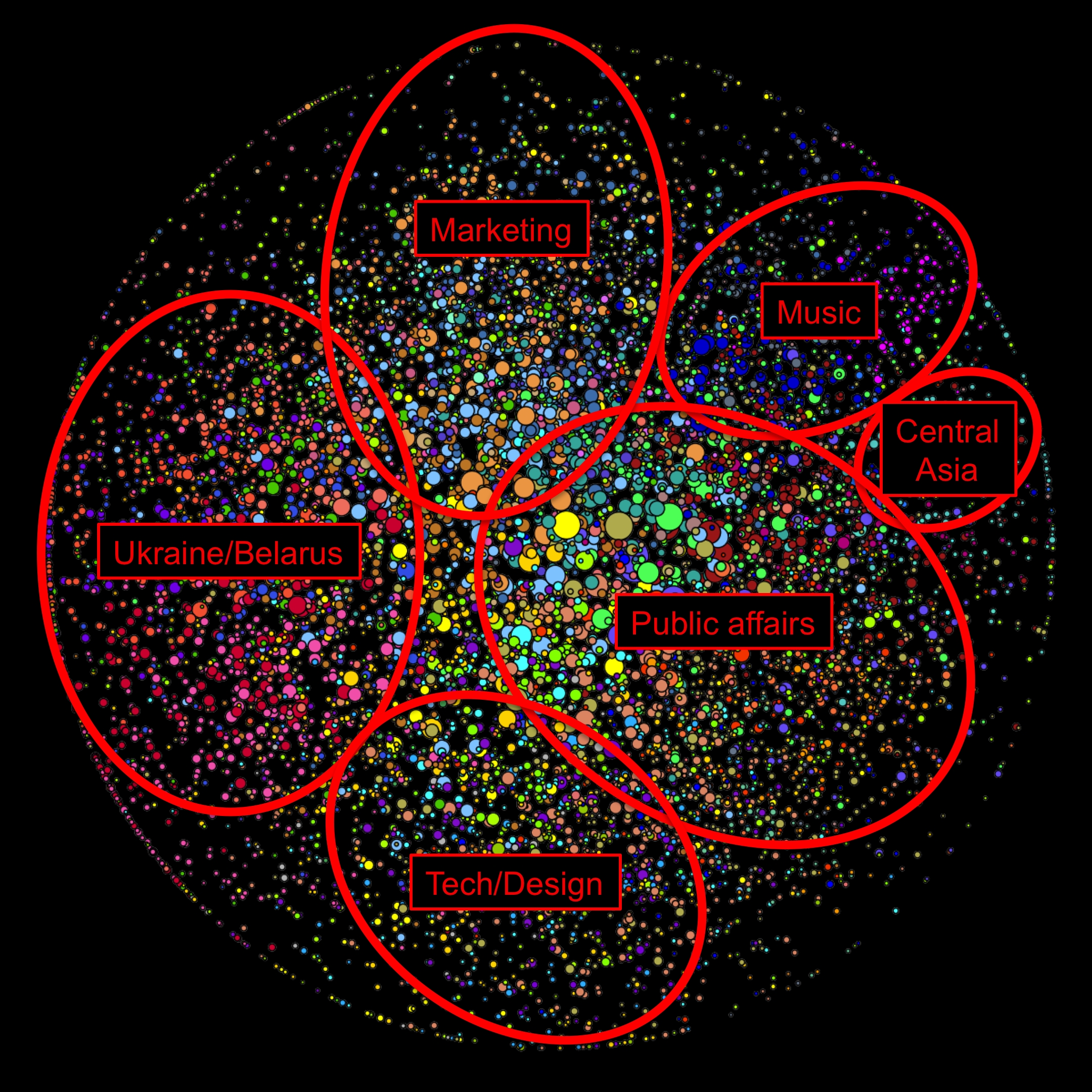
I’d be interested to see if there is any data to back up the assertion that Russians prefer foreign news outlets for their political news. Our exploratory studies of the Russian blogosphere show that Russian Web native sources like gazeta.ru are popular with politically oriented bloggers, but foreign news outlets like BBC also do quite well. Even US supported Radio Free Europe does relatively well, especially with more opposition minded bloggers and when compared to Radio Sawa, Al Hurra and other misadventures in the Middle East. And apparently Medvedev is even looking to bloggers for ideas these days.

H/T: Johnson’s Russia List

Perestroika II Begins Online?

Обращение президента - Дмитрий Медведев_ Россия, вперед! - Газета.Ru
By Karina Alexanyan

On the morning of Sept 10, Dmitri Medvedev published an astonishing article entitled “Forward, Russia!” describing his vision for Russia’s future.

Open Democracy’s Dmitri Travin provides an interesting analysis of the article, comparing it with some of Gorbachev’s first steps under Perestroika.

What is significant about the article – in addition to it’s content of course – is that it did not premier in the morning papers. And there was no mention of it on television before it went “live”. Rather, Medvedev chose to address Russia’s citizens via the online newspaper “Gazeta.ru”.

In addition to being known as a venue for criticism of the Kremlin and commentary by opposition members., Gazeta.ru is a “webnative” publication, meaning that it has no print version and doesn’t exist outside the internet.

As a result, at least initially, the RuNet served as the exclusive forum for the entire discussion of the article. The article’s appearance was eventually announced on the “democratic” radio station “Ekho Moskvy” and word spread from there. By noon, the article was available on the Kremlin’s site as well.

The trajectory of this article provides an excellent opportunity to measure the spread of information (especially information this important) from the Russian internet to the mainstream.

In addition, given that the internet remains an elite medium in Russia, and that an overwhelming majority of Russian’s get their news from television, Medvedev’s choice of Gazeta.ru implies that his intended audience, at least initially, was a select and narrow group – the young & educated urban elite.

Reports on the effect of Medvedev’s announcement are mixed, and, predictably, vary by the source. In his Open Democracy piece, Travin states that the article caused a “sensation” on the internet. In contrast, The Heritage Foundation’s Yevgeny Volk suggests the article received a lukewarm response:

Tellingly though, Medvedev’s target audience, Russia’s young internet readership, had a lukewarm response to their President’s insights. His comments failed to make the spotlight in numerous blogs, being overshadowed by society gossip and sporting events. It looks like Russians are accustomed to hearing Kremlin insiders speak the right words but make no effort to overcome hardships and rectify mistakes.

RussiaProfile also focuses on the reaction online, stating that:

…judging not by the mass media, but by the discussion on LiveJournal, the article was equally poorly received both by our homegrown loyalists, who immediately forgot about loyalty and cruelly criticized the text that came from their favorite supreme authority, and by the regime’s traditional opponents, who mocked the call for the willing and the dissenters to jointly pull Russia out of the present semi-quagmire. 

Nevertheless, the article – and its repercussions – remain a hot topic. A week later, a Yandex search for the Russian terms “Medvedev” and “Forward Russia” still comes up with over 3 million results.

Protected by AkismetBlog with WordPress